
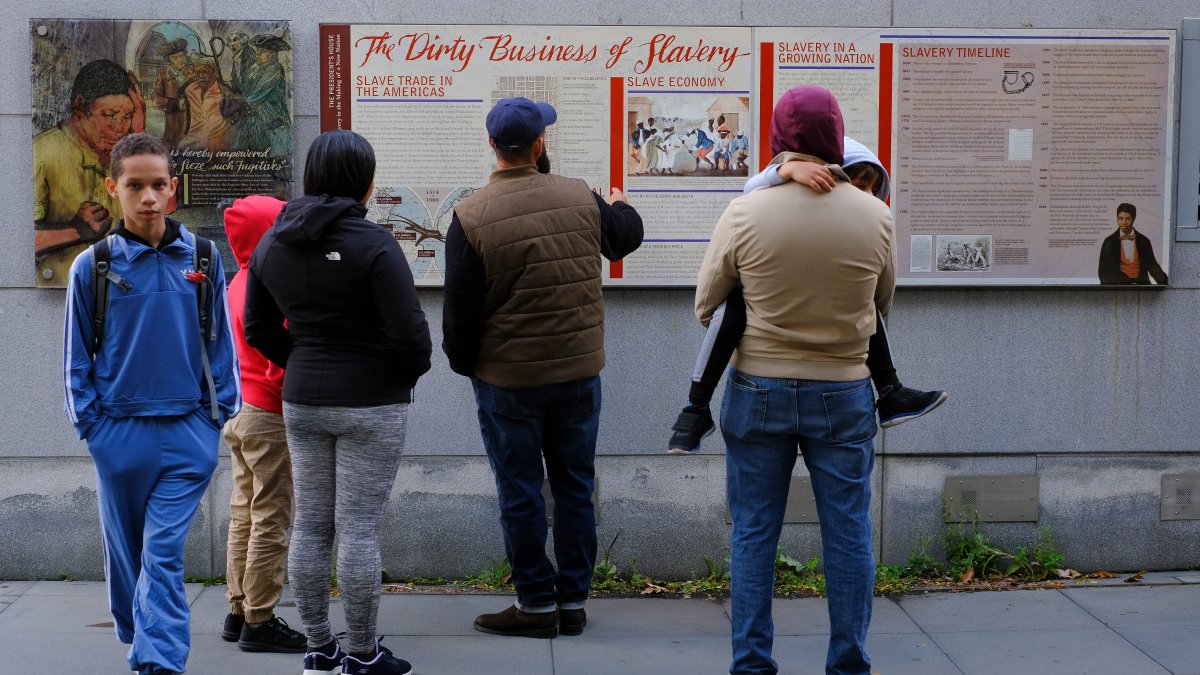
The City of Philadelphia has filed a petition asking the 3rd U.S. Circuit Court of Appeals to rehear its decision that allowed the Trump administration to replace displays at a slavery exhibit at the President’s House in Old City.
The President’s House memorial — located on the corner of 6th and Market streets — honors the nine enslaved people brought by President George Washington when he moved to Philadelphia to serve as America’s first president in the late 1700s.
The exhibit was created in the early 2000s in a collaboration between the City of Philadelphia, the federal government, historians, and private partners. It served as a part of a longstanding cooperation agreement over the Independence National Historical park.
In March of 2025, however, President Donald Trump signed an executive order to restore “truth and sanity to American history” at the nation’s museums, parks and landmarks. Interior Secretary Doug Burgum later directed the removal of “improper partisan ideology” from museums, monuments, landmarks and other public exhibits under federal control, including the President’s House in Philadelphia.
The order sparked a legal battle over the slavery exhibit that has continued for more than a year.
In June, a federal appeals court panel ruled that the Trump administration could replace the exhibit. A three-judge panel of the 3rd Circuit Court of Appeals struck down a lower court’s injunction that required the National Park Service to reinstall the interpretive panels.
The unanimous ruling by the panel said a lower court judge wrongly interpreted Philadelphia’s contract claims involving Independence National Historical Park.
In the latest petition filed in July, the city of Philadelphia argued the court’s issuing of the mandate was both “procedurally flawed” and “substantively objectionable” and called for the court to recall it.
According to the petition, the federal government filed a request for the court to deliver a mandate to install the new panels during the afternoon of July 2, 2026. The appeals court issued its mandate the following morning, July 3, which the city noted was observed as a federal holiday.
The federal government asked the appeals court to issue its mandate because a February injunction issued by U.S. District Judge Cynthia M. Rufe barred changes to the exhibition.
The petition cites Federal Rule of Appellate Procedure 27, which the city says gave it 10 days to respond to the government’s request. Under the rule, the court could act before the 10-day period expired only if it gave the parties notice that it intended to do so.
In its filing, the city argued the federal government, “provided no basis for any urgency, and the Court credited none.”
The city also stated it was not given the opportunity to respond to the federal government’s request to install the panels prior to the Court’s mandate.
The petition notes that, under the Federal Rules of Appellate Procedure, the city has 45 days to seek rehearing. It is still “considering its next steps”.
According to the filings, the federal government argues the city can still seek rehearing, and that, if rehearing is granted, the appeals court could recall its mandate.
Complete timeline of legal battle over slavery exhibit
March 27, 2025
President Donald Trump signed Executive Order 14253, “Restoring Truth and Sanity to American History,” requiring the President’s House memorial be reviewed by the Secretary of Interior, Doug Burgum.
Jan. 22, 2026
The complete slavery exhibit at the President’s House was removed following orders from the National Park Service. The City of Philadelphia filled a lawsuit against Secretary of Interior Burgum and acting National Park Service Director Jessica Bowrun over its removal. The organization Avenging the Ancestors Coalition joined in the lawsuit.
Jan. 27, 2026
Pennsylvania Governor Josh Shapiro filed a legal document in support of the City of Philadelphia’s lawsuit.
Jan. 29, 2026
A public hearing was held on the city’s request to have the President’s House panels returned to Philadelphia by the Department of the Interior and the National Parks Service.
Lawyers representing the Department of the Interior said the city and National Parks Service entered into an agreement in 2006, which ended in 2010. The lawyers argued that full ownership of the President’s House be transferred to the National Parks Service after the completion of the project.
Lawyers representing the City of Philadelphia argued that an original agreement filed in 1950 surrounding collaboration between the city and the National Parks Service superseded the 2006 to 2010 agreement
Feb. 2, 2026
District Court Judge Cynthia M. Rufe ruled that the federal government must continue to store the President’s House displays safely, ensuring they maintain the quality they were at the time of their removal. She also ruled that the City of Philadelphia could file amended documents to their Jan. 22 injunction by Feb. 6.
Feb. 16, 2026
District Court Judge Cynthia M. Rufe ordered that the removal of all “exhibits, panels, artwork, or other items” be restored to the status it was in as of Jan. 21, 2026 – the day before the complete removal of the President’s House exhibition.
A deadline for the Trump Administration was set for Feb. 20, 2026, at 5 p.m.
Judge Rufe prohibited federal agencies from making any changes to the site without mutual agreement from the City of Philadelphia.
The Trump Administration, through the U.S. Department of Interior, filed an appeal to Judge Rufe’s ruling, saying the removal of the exhibit was done to “ensure historical accuracy and completeness.”
Feb. 19, 2026
Some of the President’s House exhibit was reinstalled.
Feb. 20, 2026
A spokesperson for District Court Judge Cynthia M. Rufe announced that she had denied all requests by the National Parks Service to delay the enforcement of her order.
The exhibit was restored.
Feb. 27, 2026
Pennsylvania’s United States House of Representative Brendan Boyle introduced the “Protecting American History Act” to prevent the censorship of U.S. history, following the President’s House restoration.
The bill would require the National Parks Service to restore Independence National Historical Park exactly as it existed on Jan. 21, 2026, including the restoration of all signage, interpretive panels, and exhibits present on this date. It would also prohibit the National Parks Service from making any additions, removals, destruction, or interpretive changes without prior approval from Congress.
April 9, 2026
A federal judge ordered the U.S. government must keep the slavery exhibit at the President’s House as is. The judge decided the Trump administration cannot remove any of the panels of the exhibition.
June 13, 2026
U.S. District Judge Angel Kelley in Massachusetts ordered in an injunction that the Trump administration restore sites across the country that were changed under his Executive Order.
June 18, 2026
A three-judge panel of the 3rd U.S. Circuit Court of Appeals ruled that the Trump administration could replace the slavery exhibit.
The Court of Appeals said a lower court judge wrongly interpreted Philadelphia’s contract claims involving Independence National Historical Park, saying the city merely having stood to sue did not mean its argument had merit.
The panel also praised the plans for the Trump administration’s replacement installation, writing that they were, “full of historical context”.
July 2, 2026
The Trump administration requested a go-ahead to install the new President’s House panels, citing that they “should be fully installed without further delay.”
July 3, 2026
The U.S. 3rd Circuit Court of Appeals ruled in favor of the Trump administration, declaring that the replacement panels can be installed. The panels would replace the 2010 panels telling the story of the nine slaves who lived with George and Martha Washington.
July 7, 2026
Philadelphia filed a petition asking a court to rehear its decision allowing the Trump administration to replace the slavery exhibit.