
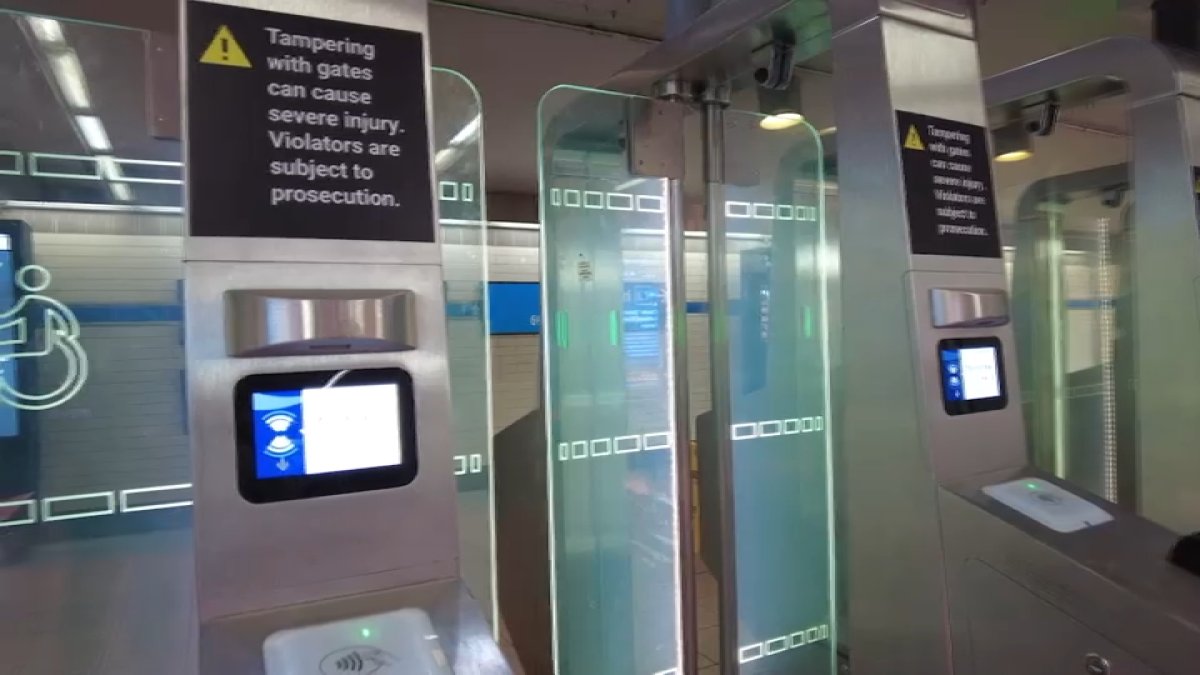
SEPTA is spending money to stop losing money. The transit agency estimates fare evasion costs it $30 million a year. Data reviewed by the NBC10 Investigators shows the investment to prevent fare evasion is paying off, though many riders continue to cheat the system.
With a nearly $200 million budget gap and funding questions looming in Harrisburg, SEPTA is under pressure to bring in every dollar it can. The agency received emergency funding last fall amid stalled budget negotiations.
Over the past year, SEPTA installed full-length gates at 10 stations at a cost of $40,000 each. The gates, which SEPTA calls “3D,” are intended to prevent a person from jumping over a traditional turnstile. SEPTA said the broader station upgrades to increase fare collection total roughly $1 million per station.
Each time a person pushes through a gate, follows a paying rider through, or otherwise attempts to evade a fare, the technology alerts a nearby police officer with an alarm.
Over several days, the NBC10 Investigators watched riders skip their $2.90 fare and avoid new technology aimed at preventing fare evasion.
“It’s a little frustrating because I struggle to afford it sometimes, but I still do it,” Genny Evans, a SEPTA rider, said.
The NBC10 Investigators rode with Evans as she traveled into West Philadelphia on the trolley.
“Very often I tap to pay and someone, I mean, they ram up against my backside, and it’s incredibly uncomfortable,” Evans said of riders following her through the new gates.
Evans believes SEPTA should spend more money on upgrading the system so riders will respect it and want to pay.
“Is it really worth going after fare evaders for a couple of bucks?” NBC10 Investigative Reporter David Charns asked Jim Zuggi, SEPTA’s deputy chief of police.
“Yeah, a couple bucks, it grows,” Zuggi said.
Data provided to the NBC10 Investigators shows the new technology is forcing more people to pay. At the 10 stations where the full-length gates are installed, fare evasion has been cut roughly in half — from about one in two riders not paying to about one in four, according to SEPTA.
Somerset Station recorded the highest fare-evasion rate at 78%, the agency said. Other stations with high fare-evasion rates include Church, Hunting Park, Susquehanna-Dauphin, North Philadelphia and Wyoming, according to the agency.
A 2024 law change also allows the agency to issue citations of up to $300 for failing to pay a fare. SEPTA police issued more than 9,000 citations in 2025, according to the agency. The money collected goes to the courts, not SEPTA.
“If we continually use an old system that people are fare evading, we’re never going to be able to get that money back,” Zuggi said.
Zuggi showed the NBC10 Investigators the new gates at 13th Street Station. While officers were present during the demonstration, cameras at SEPTA headquarters can track fare evaders in real time whenever an officer is not at the station, Zuggi said.
Fare evasion is not just a SEPTA problem.
In New York City, where similar full-length gates are operating at 20 stations, about 11% of subway riders do not pay, according to the MTA.
In Washington, D.C., where similar gates are rolling out, Metro reports a fare-evasion rate of about 4%.
SEPTA expects the new machines will pay for themselves over the next two years, Zuggi said. At 40 stations without full-length gates, SEPTA is installing modified turnstiles that cost about $4,000 each.
“Pay your fare. Be better,” Zuggi said. “Realize that the service that we provide for you needs to get funded.”
SEPTA said it will add full-length gates at 13 more stations by 2028. Once the current phase is complete in 2027, all 50 stations on the B and L lines will have full-length gates or modified turnstiles.
All stations will eventually have the new full-length gates, the agency said.
While not part of stalled budget negotiations, SEPTA’s future funding remains uncertain, with some lawmakers continuing to question the agency’s accountability.
The NBC10 Investigators asked several lawmakers, both Democrats and Republicans, whether the new tools to curb fare evasion make them more confident in the agency’s finances.
Several declined to comment or did not respond amid current budget negotiations.
The NBC10 Investigators can be reached at david.charns@nbcuni.com and ali.ingersoll@nbcuni.com.