
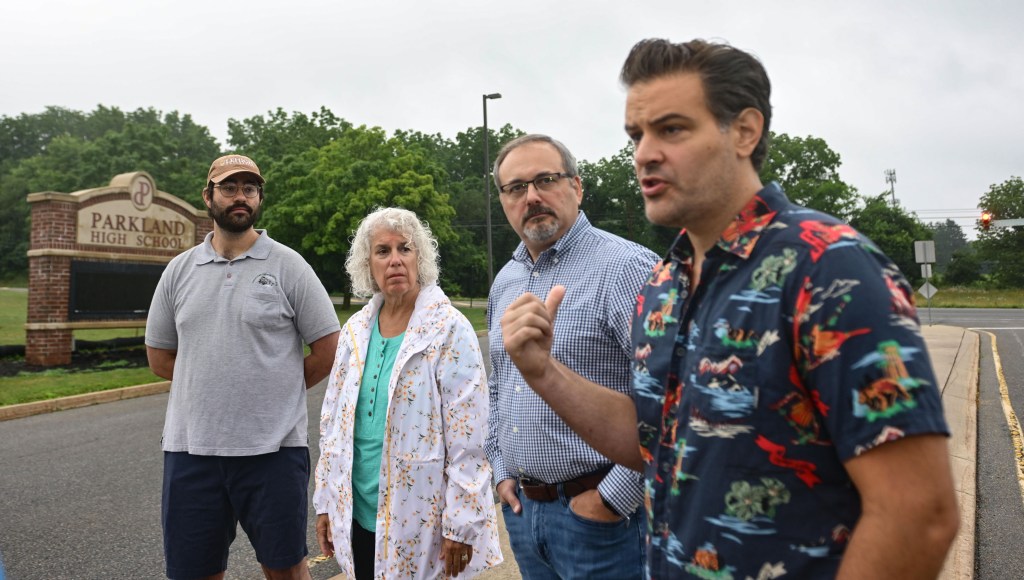
From the freshly mowed athletic practice fields at the North Cedar Crest Boulevard entrance to Parkland High School, it’s easy to visualize the proposed 1.5 million-square-foot Project Atlas data center looming over students playing football.
For Alice Lenthe, a retired environmental health and safety professional who has two grandchildren who will attend the high school, that image includes droning generators and hot machinery.
“No child should have to practice on that field with the heat that’s going to come off that data center,” Lenthe said. “There are a lot of environmental issues. There are a lot of health and safety issues for the community, and for the students here at Parkland.”
Mobilized by concern over the data center’s impact, Lenthe and other South Whitehall Township residents have formed a nonprofit to fight the project. Members of the South Whitehall Civic Alliance retained an attorney and are raising funds for what they expect to be a long and expensive legal battle.
The first shot will likely be fired Thursday, when the data center’s developers go before the township planning commission to move the project forward. Alliance lawyers are expected to file an objection to the plan. Next, they’ll need to hire experts, Alliance member Spurgeon J. Dunbar said. As of this week, members have raised nearly $35,000 of their $120,000 goal.
“We’re asking the community to help us. These are attorneys for the entire community. Our group really represents the people of South Whitehall, and in order to fight this we can’t just show up as an angry mob saying we don’t want it,” Dunbar said.
Project Atlas is proposed for a 410-acre site at 2493 N. Cedar Crest Blvd. The complex would include three data center buildings, a 40,680-square-foot administrative building, a 39,167-square-foot warehouse and an electric substation.
A new road is proposed to connect Cedar Crest with Mauch Chunk Road, and include a 10-foot-wide path that would be open to the public.
Edged US, the firm building the data center, has promised that it will be a quiet operation with minimal environmental impact that would bring in $11.5 million annually in taxes for Parkland School District.
“Edged US is committed to being transparent throughout this process and to being a good neighbor in every community where we build,” said Marcie Kaplan, Vice President and Head of Marketing.
The land where the data center is proposed sits in South Whitehall’s Planned Innovation, Research and Technology overlay, an area specifically zoned to attract tech development. This will make any legal fight against it even tougher, Dunbar said. But he noted that South Whitehall residents last year voted overwhelming to approve a 0.1% increase in their earned income taxes to support an open space referendum.
While the land across from the high school was not part of the land addressed in the referendum, the vote showed that residents prize natural spaces, he said.
“We don’t have zoning laws that can keep up with how fast technology is moving. And with that vote, a vast majority of the community said, ‘Hey, we want to preserve the land we have,’ ” Dunbar said.
The nonprofit’s work against the data center has attracted residents from outside South Whitehall. Evan Sandercock, a North Whitehall woodworker with a degree in civil engineering, joined the alliance to protect the school where he hopes to send his future children.
“As soon as I saw what they wanted to build so close to Parkland High School, I was against it. This really is not the location for it,” Sandercock said.
The group hopes members of the community pack Thursday’s meeting, which has been moved to Springhouse Middle School in anticipation of a large crowd. Though the members admit they’re waging a David vs. Goliath fight against a deep-pocketed developer, Alliance members believe they stand a good chance.
“This is our home,” member Greg Sussman said. “History has proven that people fighting for their home tend to do better than the invaders.”