
July 9, 2026, 12:24 p.m. ET
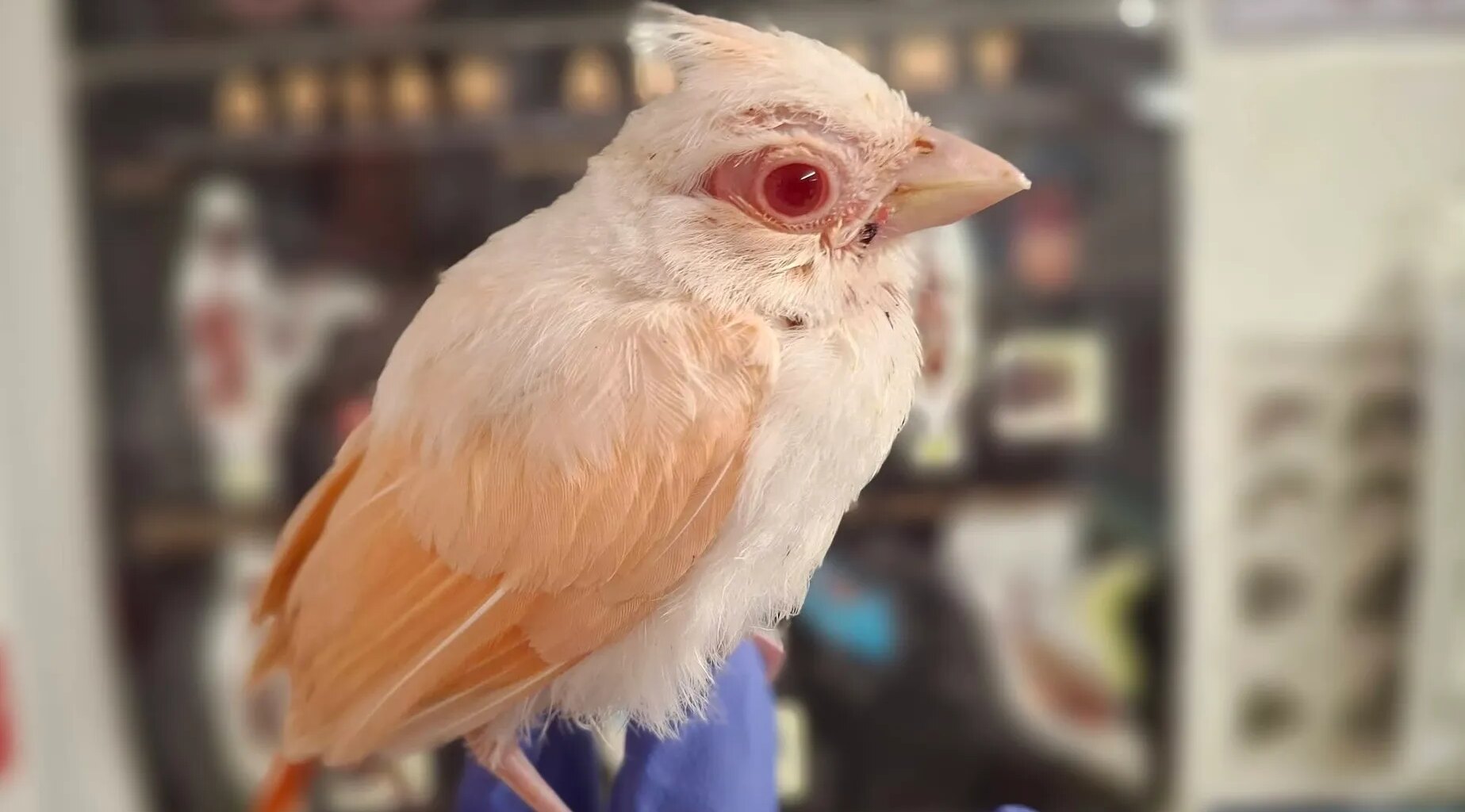
The bird, named Frosty, cannot be released due to its lack of camouflage and poor eyesight.The center hopes Frosty can become an educational ambassador for wildlife outreach programs.
A rescued rare albino cardinal in Pennsylvania may soon become a new ambassador for wildlife education.
The fledgling bird was found under a car July 1 by a man who thought the small bird was in distress or injured. His mother-in-law called Raven Ridge Wildlife Center in Washington Boro, Lancaster County, for advice and help.
With the recent high temperatures and heavy rainstorms, the center advised them to bring the unknown type of bird in for an evaluation.
“I said if you can get the bird, we will be more than happy to take it in,” Tracie A. Young, founder, director and rehabilitator at the center, said in a July 8 telephone interview.
They brought the bird in a closed box to the center and started doing paperwork.
Need a news break? Check out the all new PLAY hub with puzzles, games and more!
“I could hear the chirping in the box and I could tell it was a cardinal,” Young said. “I opened the box, and I was like, ‘Is this what I think it is? It’s an albino cardinal.’ And it just took us by shock because we opened the box to triage the animal and here is this albino cardinal chirping at us.”
Go Outdoors PA: If you find a young or injured animal, here’s how and when to respond

“I was just in awe, because it was so beautiful. I’ve never seen one before.”
Fortunately, the baby bird didn’t have any physical injuries.
“It was just hopping around, but it was a fledgling, which means they have jumped out of the nest. They can’t fly effectively for seven to 10 days, but the parents still continue to take care of their fledglings on the ground,” she explained.
With this male bird being unique to other bright red cardinals, she said, “I’m really surprised that this bird made it as long as it did because it has no natural camouflage colors and pink eyes.”
According to Cornell University’s Orinithology Lab, albinism is a rare genetic mutation that prevents the production of melanin. They have pink eyes because the only color comes from the blood vessels behind their eyes.
According to Avianreport.com’s survey data, “Leucism and albinism occur at a rough estimate of 1 in 30,000 birds. Leucism is more common than albinism.” Their survey data suggests that of 100 birds that show abnormal plumages, 82 are leucistic, and only three are albinistic.
Leucism is an abnormality in the pigment in the feathers which usually leads to pale or light-colored plumage.
More: Pennsylvania game warden finds rare colored raptor covered in oil

Young said albino birds also have poor eyesight. “Its feathers are not strong, like they would be on a normal bird or fledgling. They’re very delicate,” she said.
With these traits, the center said the bird cannot be safely released back into the wild.
“He cannot see that well and he has no camouflage colors. Sometimes they have a long lifespan and sometimes they don’t. But he surely is so bright white that a predator is going to find him immediately,” she said.
The bird came into the center when the temperature flirted around triple digits.
“We thought how ironic, as hot as it is, here we have this albino white bird that came to us, so we are calling him ‘Frosty,’” Young said. “This little Frosty came to us on these hot days. He’s eating well, he’s doing well.”
The center posted a few photos of Frosty on its Facebook page and bird watchers have been sharing their excitement for this unique creature.
“They are saying it’s just a rarity and what a privilege to see this bird,” she said. “There are some birders that this is on their checklist of birds to see and some of them will never see one.”
For now, they are letting Frosty grow, and the staff will be watching his temperament.
“He will probably be part of our ambassador team,” she said.
The center provides educational outreach programs and she’s hopeful the bird will be OK to participate as people would enjoy seeing a white cardinal.
Some animals are OK with being around the public and others are not.
“We will have to see how the bird’s temperament is,” Young said. “We need to make sure the animal is able to visit public places and we don’t want to make this stressful for the bird.”
The rehabilitation center itself is closed to the public, so these outreach programs would provide the only opportunities for the public to see Frosty.

Some of the birds that live at the center help other feathered friends and Frosty may become a foster parent. For example, Young said they have a great horned owl named Pharoah who was involved in outreach programs but then he didn’t like them. They soon found the owl another activity.
“He’s a foster dad. He raises all of our baby great horned owls. That’s his job and he enjoys it,” she said.
As for Frosty, his future role at the center is to be determined as his personality develops.
“We’re still teaching it to eat on its own, so it’s still getting fed by hand. So we don’t know yet,” she said.
However, she’s optimistic it will have a bright role at the center despite its lack of colors.
“It’s pretty unique. I’ve never seen one in my entire life,” Young said. “It’s a beautiful bird.”
Brian Whipkey is the outdoors columnist for USA TODAY Network sites in Pennsylvania. Contact him at bwhipkey@usatodayco.com and sign up for our weekly Go Outdoors PA newsletter email on this website’s homepage under your login name.Follow him on Facebook @whipkeyoutdoors.