
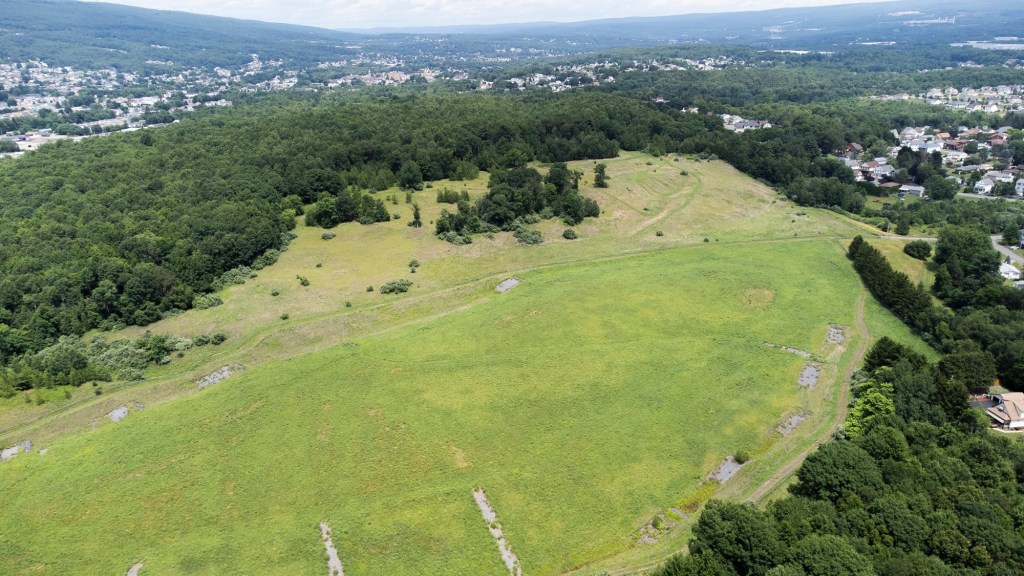
Two Midvalley businessmen want to transform over 100 acres of undeveloped land into housing and greenspace above the former, now-remediated Marjol Battery site in Throop.
Pine Tree Properties 1 LLC purchased the land last month from Arizona-based Gould Electronics Inc. for $505,000, according to a property transaction recorded June 29. The 101-acre property begins off Delaware and Franko Streets, northeast of the former battery processing plant. Marjol Battery shut down more than 40 years ago, becoming a federal Superfund site due to lead contamination.
Marjol Battery encompassed about 44 acres southwest of Pine Tree’s property from 1963 until 1982. Pine Tree’s property is not part of the Marjol site.
The U.S. Environmental Protection Agency’s Superfund program concluded an extensive remediation project in 2010, which remained in compliance during the most recent assessment a decade later.
Pine Tree Properties organized with the Pennsylvania Department of State on May 14 using the address 859 Enterprise St., Dickson City, which corresponds with the location of Kriger Pipeline Inc. Alfred Kriger Jr. and Jason Iyoob are listed as the organizers of the company. Kriger’s nephew, Jim Marzolino, who is the president of Kriger Construction Inc., has emerged as a central figure in the rush to develop data centers and power plants locally. Companies tied to Marzolino and his construction firm propose four data centers and three power plants in Dickson City, as well as a data center and power plant in Archbald.
Kriger also recently partnered with another Midvalley businessman, Ron Augelli, the owner of Talk Shirty to Me on Enterprise Street, to develop a youth sports complex along the Lackawanna River in the northeast corner of Dickson City. The two spent $900,000 for the 17-acre property.
In Throop, Pine Tree Properties has discussed developing the land for townhouses, Zoning Officer Andy Hegedus said in a text.
“Definitely no data center,” he said.
The land is largely zoned for low-density residential housing, with a band of environmental conservation land along the Lackawanna River.
Iyoob, a Jessup native and Archbald resident who operates Throop-based J’s Painting and Rock Hard Coatings, said their plans aren’t set in stone yet, but they want to develop a combination of housing, green space and walking trails. He mentioned both townhouses and single-family homes.
“Our goal is to transform the long-vacant property there into a safe, high-quality residential community that the people of Throop could be proud of, rather than have a black eye on them,” he said.
They chose the name Pine Tree because of the large number of pine trees on the land, and they want to preserve 20 to 30 acres of green space, Iyoob said.
With a surge in data center proposals locally, Iyoob stressed that they have not even given data centers a thought. Throop’s zoning also prohibits them on the site.
“I’m just not in that world, and I don’t hope to be,” he said. “I just think housing benefits the local area so much more and so much longer.”
Developing next to the Marjol site is their biggest hurdle, he said. He and Kriger paid for independent soil testing throughout the property, including near the Marjol site.
“Everything’s good — there was no concern,” he said. “Our biggest thing is we just want it to be safe.”
Gould Electronics, which purchased the Marjol plant in 1980 and shut it down two years later, bought the 101-acre parcel in 1999. Throop previously intended to buy the property from Gould a decade ago for upscale homes and walking trails, but council subsequently abandoned those plans.
Marjol used its plant to crush batteries, drain the battery acid, remove the lead, and dump the battery casings into strip mining pits, a drainage way and in the central portion of the facility, according to the EPA. After removing the lead, Marjol melted it down into ingots, processing approximately 12,000 to 14,000 pounds of lead per day.
The operation resulted in about 372,000 cubic yards of crushed battery casings and contaminated soil. As a Superfund site, it underwent an extensive remediation effort involving consolidating all of the waste into a roughly 10-acre on-site landfill, which it then encased with a cement mixture, according to the EPA.
The EPA conducted a long-term stewardship assessment in 2020 that determined the site was in compliance, with no major disturbance of the landfill cap or regulated fill area.
Iyoob does not have a timeline yet, but he hopes to move quickly, potentially starting in late winter or early spring.
“I just think it’s going to be such a benefit for the area,” he said.