

AccuWeather.com
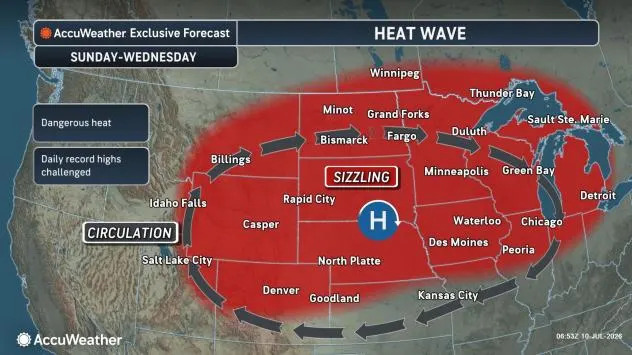
A major heat dome will build over the interior West before expanding into the Upper Midwest and eventually the East. The heat in the East is expected to be shorter and less intense than the early July heat wave, but parts of the West could come within a few degrees of all-time record highs.
Dangerous heat will grip even the desert Southwest, where communities are used to extreme temperatures. The pattern will raise the risk of heat exhaustion, heatstroke and heat-related deaths.
Motorists are urged to carry plenty of water with them in the event of a breakdown.
Temperatures will climb well above 100 degrees Fahrenheit across much of the Great Basin and Intermountain West this weekend. The building heat dome has already pushed season-high temperatures into the 110s in Phoenix, Las Vegas and Palm Springs, California.
The heat will expand north this weekend, bringing highs of 106 in Salt Lake City, 108 in Bismarck, North Dakota, and 109 in Billings, Montana. Those temperatures will be 10-25 degrees above historical averages during what is typically the hottest part of the year.

As the heat shifts east into the north-central United States early next week, some daily record highs will be challenged. As the hot air spreads east of the Rockies into more humid air, AccuWeather RealFeel® Temperatures will run 10-20 degrees higher than the actual air temperature.
While the North American monsoon will begin to temper the heat across parts of the West with increasing clouds and thunderstorms, multiple days of 90-degree heat are forecast across the Midwest, including Minneapolis, Chicago, Detroit and Cleveland. Minneapolis and Chicago can expect at least four consecutive days with highs at or above 90.

“Temperatures will peak in the mid- to upper 90s in the Interstate 95 cities of the mid-Atlantic and New England during the heat surge next week,” AccuWeather Vice President of Forecast Operations Dan DePodwin said. “While high temperatures and humidity will still create dangerous conditions, the heat will be somewhat less intense and shorter-lived than the early July heat wave.”
The hottest days in the Northeast are expected to be Tuesday through Thursday.

The heat dome is forecast to break down from north to south later next week in the Central and Eastern states.
Despite the breakdown of the heat dome farther east, much of the north-central United States is expected to enter a stretch of little or no rainfall along with continued very warm to hot weather. The combination of limited rainfall and high evaporation rates could place crops under increasing stress.

Summer highways: Tire inflation and driving tips for extreme heat
As millions take to the roads and drive long distances during the summertime, motorists are reminded to reduce their speed, especially on winding roads in extreme heat.
Tire temperatures can climb far higher than the surrounding air. Combined with extremely hot pavement and the friction generated while driving, excessive heat can increase the risk of a dangerous blowout. Driving at lower speeds helps reduce the tire temperature to safer levels.

A team member for Chris Buescher checks tire pressure before a NASCAR Cup Series auto race at Chicagoland Speedway in Joliet, Illinois, on Sunday, July 5, 2026. (AP Photo/Nam Y. Huh)
Underinflation, excessive braking and heavy loads can substantially increase tire temperatures.
Experts recommend inflating tires to the pressure specified by the vehicle manufacturer, which is typically listed on the driver’s door jamb or in the owner’s manual. Tire pressures should only be checked and adjusted when the tires are cold, such as before beginning a trip in the morning.
Want next-level safety, ad-free? Unlock advanced, hyperlocal severe weather alerts when you subscribe to Premium+ on the AccuWeather app. AccuWeather Alerts™ are prompted by our expert meteorologists who monitor and analyze dangerous weather risks 24/7 to keep you and your family safer.