
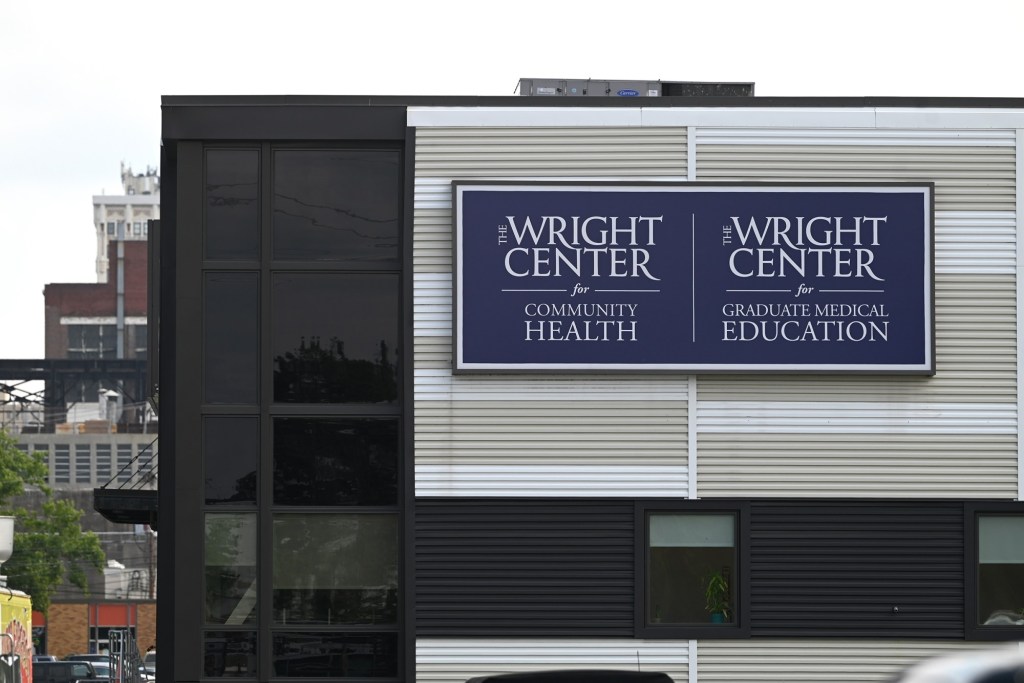
SCRANTON — It didn’t take very long for Dr. Robert E. Wright to notice the growing physician shortage in Northeast Pennsylvania.
Wright, an Archbald native, had just returned to Lackawanna County in 1971 after he completed his fellowship in hematology and oncology at the University of Washington in Seattle. He wanted to find a way to address the physician shortage as well as expand his and other physicians’ expertise.
The business model he used led to the creation 50 years ago of The Wright Center, a physician-led nonprofit to operate clinics and partner with Temple University to train resident physicians. It was one of the first such centers in the country accredited for the model and the first in the region, according to Paul Krzywicki, the center’s executive director of marketing and communications.
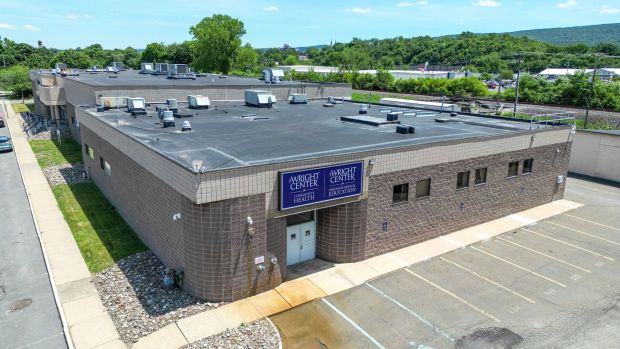 The Wright Center for Community Health Wilkes-Barre, 169 N. Pennsylvania Ave., seen here in August 2024, will open an on-site pharmacy in mid-March. The new pharmacy’s services will be available for patients and the general public. (FILE)
Wright established a physician residency program and the center partnered with area hospitals to train the residents. In 2011, The Wright Center launched the Graduate Medical Education Safety-Net Consortium to integrate patient care with workforce development to combat primary care shortages and improve access to care. The Wright Center’s community health centers formed partnerships with Allied Services, Commonwealth Health, Geisinger Health System and the Veterans Affairs Medical Center, to embed resident physicians where they were needed.
Over time, The Wright Center expanded to 14 community health center locations in four counties and a mobile medical and dental clinic that serve more than 38,000 patients annually while creating tomorrow’s healthcare professionals.
Training first
Wright began by establishing the Scranton-Temple Residency Program on Feb. 17, 1976 with community support and a $1 million Primary Care Workforce Development Grant from the U.S. Health Resources and Services Administration (HRSA) Bureau of Health Manpower.
The program, designed to attract medical school graduates to the region for internal medicine
residencies, welcomed its inaugural class of six resident physicians one year later, in 1977.
“Since then, The Wright Center has expanded its accredited physician training programs to
include residencies in physical medicine, rehabilitation and family medicine, as well as
fellowships in cardiovascular disease, gastroenterology and geriatrics. To date, its residency
and fellowship programs have graduated more than 1,100 physicians, many of whom provide
care in underserved communities similar to those where they trained,” according to the center’s history.
The residency program’s board renamed the program in Wright’s honor in 2010.
The Wright Center’s consortium has become one of the largest funded by HRSA, Krzywicki said.
“The idea was percolating for a couple of years, two to three years,” said Brian Ebersole, senior vice president of strategic enterprise and ecosystem development at The Wright Centers for Community Health and Graduate Medical Education. “There was some information, research coming out about physician shortages in the ‘70s. He (Wright) was feeling it when he came back to practice in the area. He was already starting to see a shortage of primary care doctors.”
Wright wondered what it would look like to train physicians locally, Ebersole said.
“At the time, such a program needed a medical school partnership,” he said. “There was no local medical school.”
That’s how the partnership with the Temple University program started. The program focused on developing primary care physicians and specialists.
Ebersole said that at the time, there were some delays or concerns in developing infrastructure.
The Wright Center incorporated in 1976.
“From incorporation it took a year and half to bring in the first class of residents,” Ebersole said. The center needed accreditation and had to recruit faculty to make sure there were enough physicians in area to be part of the education.
“It wasn’t a closed network that was created, it was an open invitation,” Ebersole said.
He said the need and opportunity were there. There had to be a funding source. The $1 million federal grant helped. But Ebersole said grants should not be looked at as sustaining operations forever. There had to be other funding.
Beyond NEPA
We do have partnerships that expand beyond Northeast Pennsylvania,” Ebersole said, citing a partnership of about 15 years with an Ohio hospital that didn’t have the infrastructure in internal and family medicine, cardiology and gastroenterology The center has helped develop residency programs in Arizona, Washington state and Washington, D.C.
“We still are a community-based consortium,” Ebersole said. “We train close to 200 physicians each year. We’re not insular in our model. The program places residents into a variety of settings. Some of the graduates stay with us.”
This year, 67 resident and fellow physicians graduated from the Wright Center for Graduate Medical Education during its 47th annual commencement on June 20, at Hilton Scranton and Conference Center. Meanwhile, 60 new physicians were on board to start their residency training on July 1.
Ebersole said one graduate this year stayed on as a primary care physician and educator with the center. A couple each year stay with the centers or in communities. He said the physicians train in a multiple of settings, including the Wilkes-Barre VA Medical Center.
“We don’t think they will all stay in the area,” he said. “We wish they would.”
He estimated about 40% stay within the area.
But there still is a need for physicians here.
Ebersole said The Wright Center is still growing locally, with the addition of a Clarks Summit clinic and it recently opened a 14th location in Carbondale. The clinics are located in Lackawanna, Luzerne, Wyoming and Wayne counties, plus the mobile unit to provide medical and dental services in other areas.
An affiliation with NYU Langone Dental Medicine formed in 2021 to become a residency training site for NYU’s Advanced Education in General Dentistry Program. A psychiatry program, which no longer is running, was introduced in 2017, with the last graduates graduating in 2023, Krzywicki said.
First clinics
The first clinic of what would be The Wright Center, the Scranton-Temple Health Center, opened across from Regional Hospital in Scranton in 1997. The second location, in Jermyn, was a clinic Dr. Linda Thomas-Hemak, current president and CEO of The Wright Centers for Community Health and Graduate Medical Education, operated before she partnered with the center and officially signed on with the residency program in 2002. Krzywicki said the Jermyn site was rebuilt in 2012.
“We’re looking where are the needs, where are the opportunities to train not just physicians, but other health professionals.” Ebersole said.
“We’re looking at an opportunity in Monroe County and in Tunkhannock,” he said.
He added, “What’s really important is not growth for the purpose of growing, but responding to needs in the communities or where services are starting to close up or shut down.”
Geisinger sponsors several residency programs in their system.
“We do partner with Geisinger CMC for some of the training, although they no longer fund the consortium,” Ebersole said. “They provide us with learning environments.”
The Wright Center provides care regardless of people’s ability to pay.
“We provide a sliding scale based on income and assessment. If they don’t have coverage or are ineligible for coverage, we connect them to coverage,” Ebersole said.
The sliding scale is based on the federal poverty level.
The Wright Center leaders are celebrating, not just this year for the 50th anniversary of incorporation, but also next spring to mark the anniversary of the first training of resident physicians.
“We’re working on a documentary that really tells the story of how The Wright Center has seen the community needs and responded to those needs,” Ebersole said. “It’s exciting to see what the future holds.”