
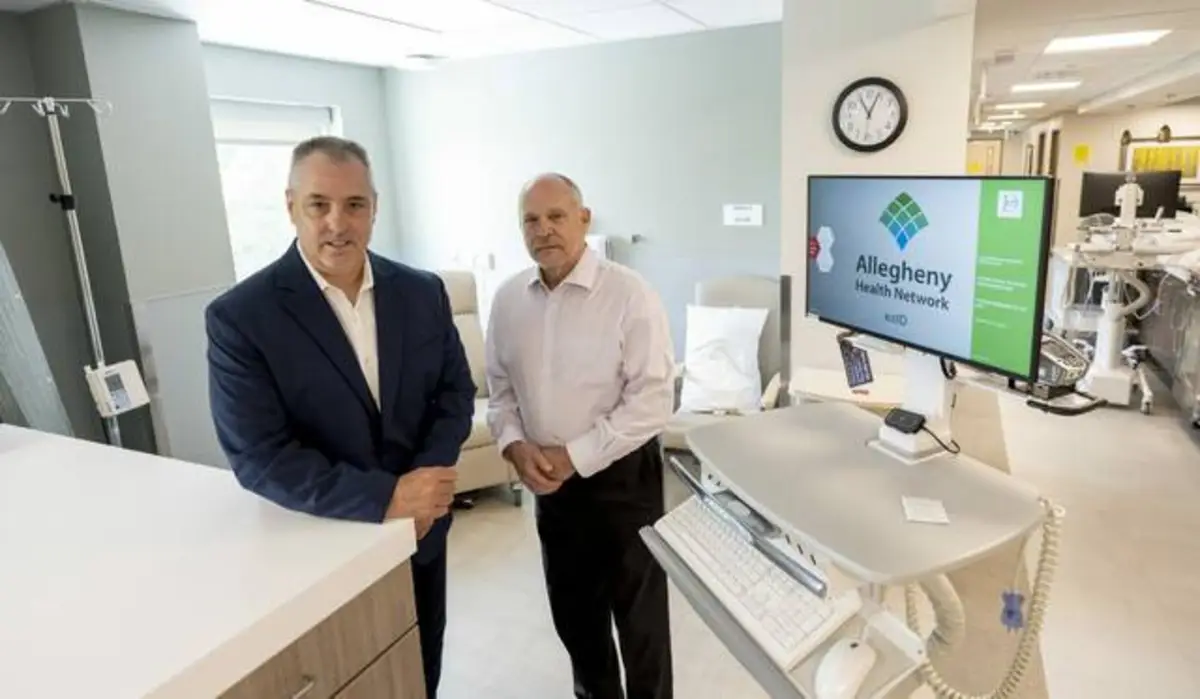
Neither Rick Letterman nor Jeff Main had symptoms when routine bloodwork revealed they had multiple myeloma, a rare blood cancer. Diagnosed less than four months apart, the co-workers supported each other through treatment while becoming advocates for regular medical checkups.
Letterman was feeling good before a routine physical in 2021. His diagnosis of the blood cancer that forms in the bone marrow sent him reeling.
“I wasn’t having any symptoms. It was a shock,” said Letterman, 62, of Moon. “The doctors were saying it was kind of rare, and when you hear cancer, it hits you.”
Multiple myeloma begins in plasma cells. Healthy cells make antibodies to fight off infections, but multiple myeloma cells multiply out of control. They produce proteins that impact the body with frequent infections, severe fatigue and neurological conditions such as tingling or pain in arms and legs.
The disease is uncommon but highly treatable. It accounts for nearly 2% of all new cancer cases in the U.S. (roughly 36,000 people diagnosed), according to the American Cancer Society.
In the U.S., the average lifetime risk of getting multiple myeloma is less than 1%, or about 1 in 108 for men and 1 in 133 for women.
During the initial months after Letterman’s diagnosis, he leaned on Main, his friend and supervisor. The pair have worked together for 19 years at Main’s Pittsburgh-based tech management firm, Questeq.
“He debriefed me through the whole process,” said Main, 57, of Robinson.
Less than four months later, the men were blindsided when Main was diagnosed with the same illness.
“I was driving when I got the call,” Main said. “I almost wrecked my truck. It was surreal. The first thing I did was call Rick and tell him, ‘I think I’m in the club with you.’”
According to the International Myeloma Foundation, men are diagnosed 1½ times more often than women. The disease hits Black people twice as often as other racial groups.
Most diagnoses happen in people 65 and older. Fewer than 1% of cases are in people younger than 35.
Main credits routine medical exams for catching cancer in the early stages.
“I’ve been getting a gamut of tests for years,” he said. “The fact that my protein moved 1 point wasn’t significant at all, but it caught my doctor’s attention because it was a change.”
Dr. Santhosh Sadashiv, an Allegheny Health Network oncologist and hematologist, said there is no identifiable cause for multiple myeloma. Researchers have suggested exposure to chemicals such as pesticides and Agent Orange, but theories have not been concretely proven.
“There are a few familial conditions that could make you high risk for developing myeloma, but the cause really remains elusive,” Sadashiv said.
While some patients may be asymptomatic when diagnosed, most have bone pain or fractures, recurrent infections or worsening fatigue.
Physicians have grouped the most common clinical signs into an acronym, CRAB:
• Calcium elevation: Bone damage can release excess calcium into the bloodstream and can make people thirsty, nauseous or confused, and spur muscle or bone aches.
• Renal insufficiency: Excess abnormal proteins produced by the myeloma cancer cells can thwart a kidney’s ability to filter blood. It can lead to renal failure, leg swelling, reduced urination and fatigue.
• Anemia: Abnormal plasma cells prevent healthy marrow cells from functioning and can cause anemia. This can cause symptoms such as weakness, fatigue, shortness of breath and dizziness.
• Bone disease: Myeloma can damage the bone and lead to pain, along with fractures from minor traumas.
“Prevention is challenging since there’s no identifiable cause, but if there’s a strong family history, it’s worth bringing it up with your physician,” Sadashiv said.
He recommended people follow a healthy lifestyle of diet and exercise to “potentially prevent disease and also improve tolerance to treatment should one be diagnosed.”
A national research project is underway to help identify precursor conditions and to try and prevent them from developing into cancer, Sadashiv said. The PROMISE Study screens healthy people who could be at high risk for multiple myeloma with the goal of making it a preventable cancer.
The free study is available to eligible people online at enroll.promisestudy.org.
Health experts also are looking to artificial intelligence as a tool to help determine which patients are most likely to benefit from specific therapies.
Featured Local Businesses
Data presented at the 2026 American Society of Clinical Oncology annual meeting found that immune-related signals hidden in biopsy slides could predict differences in patient outcomes. The research was conducted by Sylvester Comprehensive Cancer Center, part of the University of Miami Miller School of Medicine.
The insights could help tailor treatment strategies moving forward.
Multiple myeloma is not curable, but significant advancements in therapies have doubled five-year survival rates since the 1990s, according to the Cancer Research Institute. If detected early, about 81% of patients live five years or longer.
Treatments to kill the cancer cells and prolong remission include a personalized mix of targeted drugs, immunotherapies and stem cell transplants. According to the Mayo Clinic, the standard approach typically moves from aggressive initial rounds of treatment to long-term maintenance.
“Treatment has taken leaps and bounds,” Sadashiv said. “If you were diagnosed in the early 2000s, the median survival was five years. Today, it is more than tripled.”
Letterman and Main were treated at the AHN Cancer Institute.
“I was like the fullback, going through everything first,” Letterman said. “I would tell him everything, starting with the biopsies to the IV shots to the different types of chemo. There was a lot of sitting in chairs for hours.”
Main said he didn’t experience much sickness, but the process took a mental toll. There was an enormous amount of shots and pills, along with the challenge of navigating health insurance and other logistics.
“It took a lot of time and knowledge, and I’m glad we had each other to talk to,” he said.
Their professional lives continued largely as usual. Their biweekly work meetings became just as much about treatment plans and side effects as deadlines and deliverables. The pair joked it was the toughest project they’ve ever worked on together.
Under the care of Sadashiv, both men received stem cell transplants during the course of treatment.
“I entirely advocate for standard blood tests,” Main said. “The difference in catching this early is a prognosis that is great or one where you have X amount of time.
“What saved both of our lives is proactive blood tests.”
Letterman completed treatment and is in remission. Main is nearing the end of treatment.
“Patients can lead a pretty great life,” Sadashiv said. “Chemotherapies are tolerable, and they don’t have the complications they used to.
“The future is pretty bright for treatments. New ones keep coming and there could be a time when people could be cured.”