
When Carl Andrew Spaatz first saw the light of day on June 28, 1891, in Boyertown, the concept of an airplane or an air force might have been something invented in the fiction of Jules Verne or H.G. Wells. As they had for most of the 19th century, individuals who usually called themselves “professor” were still appearing with large hot air balloons in small town squares to amaze the locals. But that was about to change.

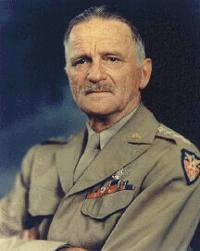
General Carl A. Spaatz
U.S. Air Force
Spaatz grew up in a close-knit Pennsylvania German community. This brief description of the community Spaatz would have known in his youth appeared in the New York Times of January 14, 1908, following a disastrous fire that destroyed a theater in the town, killing 170 people:
“Boyertown, a post borough of Berks County-on the Colebrookdale Railroad is forty-eight miles from Philadelphia and is about sixteen miles east from Reading. It contains the Kallynean Academy, the Mount Pleasant Hill Seminary, seven churches, two banks, cigar factories, iron mines and carriage and machinery making factories. A weekly newspaper is published. The population is about 2,500.”
The carriage factories may be gone but the Colebrookdale offers a great scenic tourist railroad ride today.
The weekly newspaper was the Berks County Democrat, done in a print shop run by Spaatz’s father Charles B. Spatz (1865-1929), a former member of the Pennsylvania House of Representatives (1896-1898). Carl later added the second ‘a’ to his last name to aid in its pronunciation, which was Spots.
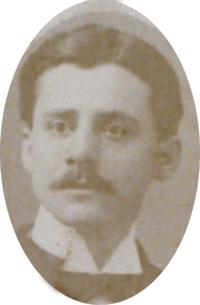
Charles B. Spatz
PA House of Representatives Archives
It was young Carl’s task as a youth to become familiar with all the details of the operation of the newspaper including as a linotype operator.
In its article on the fire, the Times notes that “Ex Representative Charles B. Spatz of Berks County was one of those injured. He was assisting in getting out some of the helpless victims when he fell from a ladder and several of his ribs were broken.” Perhaps this is when young Carl’s assistance with running the newspaper was most needed.
Many sources suggest his father used his political influence in getting Carl admitted to West Point in 1910. But for whatever reason Spaatz was unhappy (homesickness perhaps) and shortly thereafter asked to resign from West Point. When his father heard of this, he got together with a local congressman who that evening went to the White House and aroused a sleeping President William Howard Taft. After some effort they got Carl readmitted.
While at “the Point” Spaatz acquired the nickname “Tooey” because of his resemblance to another red-haired student named F.J. Toohey. It was a nickname that would stick with Spaatz for the rest of his life.
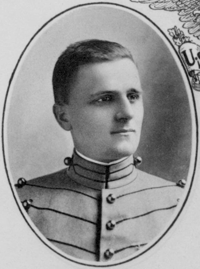
Portrait of Carl Andrew Spaatz (1891–1974) at West Point in 1914 from The Howitzer: The Yearbook of the United States Corps of Cadets
Spaatz, who graduated from West Point on June 12, 1914, ranked 57th out of a class of 107. According to his Wikipedia page, many of his classmates would later rise to the rank of brigadier general or higher. Spaatz first served as an infantry lieutenant with the 25th Infantry in Hawaii and was later assigned to the Signal Corps Aviation School at San Diego for pilot training.
How much Spaatz knew about flying then is unknown. The U.S. had been dealing with the Wright Brothers for several years and had an infant air force. In 1916 Spaatz got his first experience flying with the First Aero Squadron, chasing Poncho Villa in Mexico. His superior was General John J. Pershing, who he would get to know a lot better later. In 1917 Spaatz married Ruth Harrison of Fort Riley, Kansas. They would have three children, Katherine, Ruth and Carla.
When the U.S. entered World War I in 1917 Spaatz followed the American Expedition Force to France. The various European powers had been fighting an air war with the German ace Baron von Richthofen, aka the Red Baron, already on the verge of becoming a legend. Spaatz was assigned to an air base and saw three weeks of action before the end of the war and was awarded the Distinguished Service Cross with three German planes to his credit.
In the interwar years Spaatz largely served in California and Texas. “Spaatz experienced the chaotic ups and downs in rank common to regular officers in 1920,” notes his Wikipedia biography. That year the National Defense Act reorganized the military. Among the outposts Spaatz served at were Kelly Field, Fort Sam Houston and Ellington Field, all in Texas.
Perhaps the most dramatic peacetime moment in Spaatz’s career came in 1925 when he served in Washington in the Office of the Chief of the Air Corps and was called to testify for the defense at the court-martial of Colonel Billy Mitchell, who challenged his superiors’ actions following the crash of the airship Shenandoah.
According to one source Spaatz, “forthrightly exposed the critical weakness of American airpower, testifying that the Air Service possessed only 59 modern planes and could muster at most 15-pursuit aircraft.” The prosecution basically dismissed that evidence as irrelevant. Mitchell died in the 1930s and was vindicated by World War II.
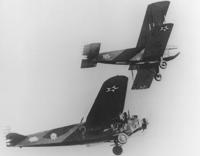
The Question Mark refueled by a Douglas C-1
U.S. Air Force
Perhaps Spaatz’s best-known action between the wars was establishing an aviation record by keeping the airplane named Question Mark over the vicinity of Los Angles for over 150 hours. This feat created a lot of publicity. He was awarded the Distinguished Flying Cross.
The 1930s were good years for Spaatz promotion-wise. He rose in rank in the peace-time Army Air Corps. In 1935 he enrolled in the Command and General Staff School at Fort Leavenworth, Kansas. By January 1939 he was at the Office of the Chief of the Air Corps in Washington.
Spaatz was there that fall when the war broke out in Europe. With a real threat of war in the offing Spaatz was sent to England to observe the RAF and the Luftwaffe in combat. He was allowed to travel to air bases. Apparently, the sight of Spaatz’s German name caused quivering of stiff upper lips in certain British Army circles. Finally, an amused Spaatz signed in as “Col. Carl A Spaatz, German spy.” That apparently broke the ice.
On the other side of the Channel an incident was taking place at the same time. An American foreign correspondent Steven Laird who happened to be from Emmaus found himself by chance during a Berlin air raid shelter alone with Hermann Goering, head of the Luftwaffe. Hearing Laird was from Pennsylvania Goering asked, “Do you know my old friend Tooey Spaatz from Boyertown and have any idea where he is?” Laird was stunned and replied for all he knew he was in Boyertown. Goering implied they had written to each other before the war.
As far as is known there never were any letters between the two or at least none that survived. Perhaps Goering had heard rumors that that Spaatz was in Britain and thought Laird could confirm that. Whatever the source apparently it was never confirmed. Later at Nuremberg Spaatz interrogated Goering.
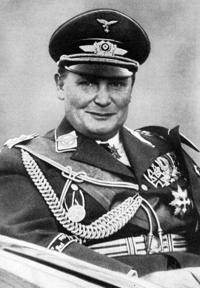
Hermann Göring (or Goering), Commander-in-Chief of the Luftwaffe, 1935 – 1945
Royal Air Force Museum
With American entry into the war Spaatz was at the center of the action. Army Chief of Staff George Marshall as early as January 1942 named Spaatz commander of Air Force Combat Command and eventually, he directed the United States’ portion of the strategic bombing campaign against Germany under the direct command of General Eisenhower.
One of Spaatz’s major contributions to the strategic bombing effort was the so-called Oil Plan. He believed that the best way to paralyze Axis war efforts was to cut off the oil supply. A modern army, from planes to tanks to troop convoys, Spaatz saw, was based around oil. Being able to disrupt the enemy’s oil supply was to control their transportation and movement. And war industries also were dependent on oil.
Eisenhower and some others felt that railroads were what should be destroyed first to upset the enemy’s movement. But this disagreement did not prevent them from working together. “After the war Eisenhower said that Spaatz, along with General Omar Bradley, was one of two American general officers that contributed the most to victory in Europe,” states Wikipedia.
With the close of war in Europe Spaatz was transferred to the Pacific and oversaw the atomic bombings of the Japanese cities of Hiroshima and Nagasaki. He was on the deck of the battleship Missouri to witness Japan’s surrender on September 2, 1945.
After the creation of an independent Air Force under the National Security Act of 1947 President Truman appointed Spaatz first Chief of Staff of the new United States Air Force. Later he would serve on the committee that selected the Colorado site for the Air Force Academy. Retiring in 1948 he wrote a regular column for Newsweek magazine from 1952 to 1962.
Spaatz died at Walter Reed Army Hospital of congestive heart failure on July 14, 1974. He is buried at the Air Force Academy in Colorado Springs.
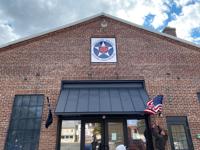
Tom Rader | 69 News
With the General Carl Spaatz National Air Force Museum, his hometown has honored its favorite son in a unique way. Located at 10 General Spaatz Ave. in Boyertown, it offers self-guided tours and interactive exhibits that offer visitors unique experiences.
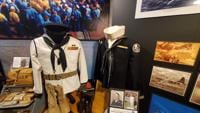
A self-guided tour is $10. Interactive tours are $25. Call to make reservation at (484)-945-3402. For more information, see the museum’s website.