
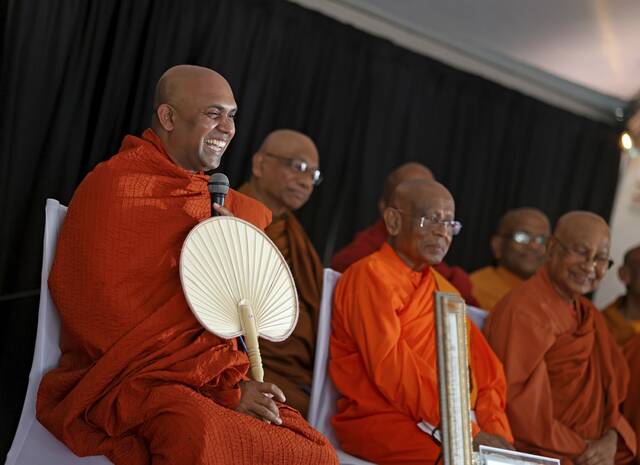
Members of the local, national and international Sri Lankan and Buddhist communities gathered in West Deer Sunday to celebrate the appointment of the chief abbot of the Pittsburgh Buddhist Center as the chief monk of his order for the United States.
Bhante Soorakkulame Pemaratana was named chief monk of the Ramanna Monastic Order in the United States.
In this new position that did not previously exist, Pemaratana oversees the well-being of monastics and the operation of the order’s temples across the country, making him the spiritual leader of an entire monastic tradition on American soil.
“It’s a huge responsibility, but we trust him completely,” said Ananda Gunawardena, president of the Pittsburgh Buddhist Center.
The appointment, in recognition of his nearly two decades of service, was made in January. But it was at the urging of Mahinda Samarasinghe, the Sri Lankan ambassador to the United States, that Sunday’s public ceremony and formal announcement came about.
Pemaratana was not responsive to the idea of having such an event, said the ambassador, who after five years is leaving the office at the end of July.
“I had to then use my diplomatic skills to start lobbying other Buddhist priests and proposing to them that we should have a ceremony of this nature. All of them wholeheartedly agreed that we have to do it,” Samarasinghe said. “When Dr. Pemaratana came back to Pittsburgh, he was told by his senior monks we are going to organize this ceremony and whether you like it or not you have to participate.
“That’s the kind of exemplary Buddhist monk he is.”
Also extending congratulations to Pemaratana were Gov. Josh Shapiro and Pittsburgh Mayor Corey O’Connor, who declared July 12 to be “Dr. Soorakkulame Pemaratana Day” in the City of Pittsburgh.
Razin Karu, executive director of the Governor’s Advisory Commission on Asian American and Pacific Islander Affairs, read from Shapiro’s letter to Pemaratana, in which he wrote that his honor recognizes decades of dedicated service.
“Though this new role will bring greater challenges and responsibilities, it is with confidence in your faith and skills that you will oversee the operation of the order’s temples across the United States and act as the order’s primary representative in public and private affairs,” Shapiro wrote. “I am certain that you will continue to represent Pennsylvania, and your Sangha, with great distinction for many years to come.”
The Pittsburgh Buddhist Center was founded in Harrison in 2006 by Sri Lankan Americans from Altoona, State College and Pittsburgh and formally dedicated in 2007. It moved to West Deer in 2021.
A native of Sri Lanka, Pemaratana, 49, entered monastic training in 1986 at the age of 10. While immersed in monastic discipline, mastering Pali and Sanskrit while studying Buddhist philosophy and classical texts, he was also encouraged to pursue an education in the English language.
He was 18 when he completed his monastic degree, and received his higher ordination at 20.
Pursuing higher education, Pemaratana earned a bachelor’s degree in social sciences in 2001, a master’s in Buddhist studies in 2002, and a second master’s in philosophy in 2005.
He came to the U.S. and arrived at the Pittsburgh Buddhist Center in 2008, where he was appointed chief abbot. He was invited to come to Pittsburgh because the new temple needed a monk who could speak English.
Coming to Pittsburgh was a big decision and, he said, a risk.
“I didn’t know anything about Pittsburgh. I hadn’t even heard about Pittsburgh,” he said. “When I told my master that I was invited to go to Pittsburgh, and when I told my friends I was invited to go to Pittsburgh, they thought that I was going to Petersburg. They thought I was going to Russia.”
An enticement for Pemaratana to come to Pittsburgh was that he could pursue his doctorate degree. He completed a Ph.D. in religious studies at the University of Pittsburgh in 2017. Since 2018, he has taught as a faculty member at the University of Pittsburgh, John Carroll University and Carnegie Mellon University.
After moving the Pittsburgh Buddhist Center in 2021, Pemaratana led the establishment of the Cleveland Buddhist Vihara and Meditation Center in Akron, Ohio, in 2022.
After first arriving at the Pittsburgh Buddhist Center, he expanded its programming, starting Dhamma lessons in English for children and adults, weekly meditation sessions, Buddhism classes, Dhamma camps, spiritual counseling and chaplaincy services to Pittsburgh’s correctional facilities.
Sue Goodwin, formerly of Oakmont and now residing in North Carolina, has been with the center almost since its inception. She recalled the early Wednesday night meditation sessions where only three people showed up.
But Pemaratana did not care and continued to work to make connections and grow the community, so that over time meditation workshops and groups began being held at libraries in Oakmont, Fox Chapel, and Penn Hills and at East Liberty Presbyterian Church, reaching 200 people a week, not counting those held online, she said.
One way he grew the center was through trips to Walmart.
“He loved going to Walmart,” Goodwin said. “One day he said to me, ‘What makes me really happy is the people employed at Walmart wear their names on their clothing. That way when we check out we can address them by their names when we chat.’ ”
Pemaratana even visited a cashier when she was in the hospital.
Pemaratana and others “created relationships there out of very simple behaviors of connecting with people. They connected through generosity, respect, loving kindness, all of the things the Buddha teaches,” she said. “One by one by one these little examples continue to build the population that came to the Pittsburgh Buddhist Center.”
Near the end of his remarks of appreciation for the accolades bestowed upon him, Pemaratana explained why he addresses people as he does.
“We are deeply connected to each other. In Buddhist belief, we believe that we have been living in our previous lives also. The reason that we are attracted to each other may be due to the reason that we have been family members, and friends and colleagues in our previous lives, too. That’s how I think about people,” he said. “Whenever I meet a person, I don’t consider any person as a stranger. I meet that person as if I know that person before. I have that past, and I talk with the person as if I know that person.
“Let’s treat everyone as if we know everyone before.”