
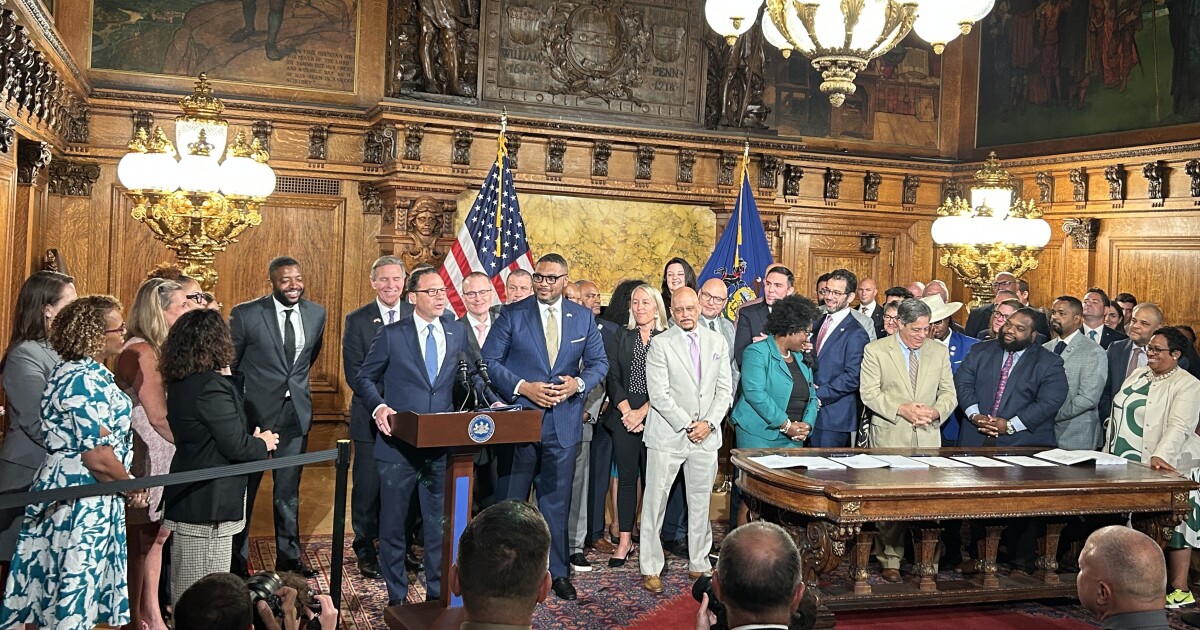
With key bills signed by Gov. Josh Shapiro Sunday evening, the $50.8 billion Pennsylvania state budget increases funding for public education, doubles support for rape crisis centers and includes no cuts to Medicaid and little action on data center regulation.
Local lawmakers say residents of Pittsburgh — and Allegheny County — have plenty to pay attention to in the final deal, which allocates dollars through the next fiscal year.
Shapiro, who had pushed for a spending plan of more than $53 billion, also sought new revenue generators, such as legalized marijuana and a tax on skill games. The deal does not include new public transit funds or a minimum wage hike — key proposals from Democrats — but it does direct another year of “adequacy gap” dollars to the state’s poorest school districts.
The governor himself gave a shoutout in his post-budget speech to advocates from Pittsburgh Action Against Rape, who helped secure their first operating increase in five years.
“When I called the leaders in Pittsburgh this morning, I thanked them for the education they gave me and so many others, and the work they did not just to help the Pittsburgh center, but these important centers all across our Commonwealth,” Shapiro said to a packed room in the Capitol.
The 47 crisis centers throughout Pennsylvania had been trying to build back since last year’s budget impasse resulted in furloughs, and in some cases layoffs. Now, instead of splitting a pot of $12 million, the centers will share nearly $25 million.
Sadie Restivo, executive director of PAAR, said flat funding since the pandemic may have resulted in some centers restricting this year. Some 25,000 survivors each year rely on the services across the state, and, without this increase, they may have had to travel farther for support or forgo it altogether.
“Compounding no increase and higher demand for services, this really was a year that was going to, I think, make or break a lot of our centers in the Commonwealth,” Restivo told WESA Monday.
“What everyone has to remember is, you don’t have to have just been assaulted in order to receive help. Sometimes it takes a long time to recognize that you’re ready to receive help,” she added.
The plan also preserves the state’s nearly $8 billion rainy day fund by using off-budget “special” funds and accounting maneuvers.
While lawmakers had seemingly rushed to address public outcry about data center construction, such as allowing municipalities to press pause on development, few regulations made it into the budget. Only one of Shapiro’s GRID plan proposals materialized — requiring hyperscale cloud-computing campuses to report and estimate their annual natural resource use.
Pittsburgh Democratic Rep. Jessica Benham said she has hope that those concerns are addressed later this year, when lawmakers return to session in late September.
“At the very least, we got reporting requirements for water and energy usage in the budget for data centers in one of the code bills,” she said “That at least was something, [but] from my perspective, it’s simply not enough.”
With data centers representing a newer concern for Harrisburg, some longstanding issues were finally addressed for the next fiscal year, said Senate Democratic leader Jay Costa.
Costa said some of his older constituents in Allegheny County have cause to celebrate this deal: up to $300-per-month more in state pension payments, a first for pensioners on the state system since 2002.
“Certainly the retirees of Pittsburgh, the [State Employees’ Retirement System employees], the retired teachers and retired state workers, retired police officers, retired firemen, all after 24 years are now going to get a cost-of-living adjustment in their retirement checks,” he said in a telephone interview while driving back to his district. “It goes to address the affordability that they’ve been struggling with.”
Costa also pointed to industries in Pittsburgh that could benefit from millions more derived from the updated Innovate PA tax credit, calling it “a program that’s going to create $125 million and the opportunity for folks who operate in the life sciences and the biotech space, and which is really important to Pittsburgh.”
Allegheny County itself may chalk up a procedural win, too, according to House Democrat Aerion Abney, who chairs the county delegation. Items purchased in the county but shipped from elsewhere did not include a 1% sales tax usually collected for county coffers.
“We made that technical fix so that we estimate this will bring in roughly an additional million dollars a year for the county,” Abney said.
Notably, the state budget notably doesn’t tap into the state’s “Rainy Day Fund,” as Shapiro’s proposal would have done along with drawing on new revenue streams. Abney said drawing on balances in special reserve funds and delaying some payments, including those to “managed-care organizations,” made that possible.
“It is something that we have done in the past,” he said. “It’s very complicated… but everyone will get paid.”
Both this year’s budget, signed 12 days late, and last year’s protracted deal relied on the tactic, according to Senate GOP leader Joe Pittman.
“Four-and-a-half billion dollars over the last two years, we have pulled out of the couch cushions of the bureaucracy. I’d like to say we flattened them like a pancake, but I actually think there’s more there,” Pittman told reporters in a post-budget press conference.
While some of Bellevue Rep. Emily Kinkead’s priorities for anti-hunger programs remain flat-funded this year, she said she’s thrilled that the line item benefiting the Pennsylvania Prison Society has returned: $600,000 allocated for bus services, so that families can visit incarcerated relatives. The pandemic effectively shut down the state’s support for the program, but the budget deal this year reinstates it, she said.
And with federal uncertainty surrounding Medicaid — and work requirements expected to start next year — Benham said she’s thankful that the spending deal does not touch healthcare social services, which some fiscal conservatives had previously sought to downsize.
“As somebody who came out of the disability-services world, ensuring that not just folks with disabilities, but everybody in our communities who have healthcare needs have access to affordable healthcare is a high priority for me,” she said. “We obviously can’t do anything about federal cuts, but I’m really proud that at the state level we’ve avoided cuts.”
Among other county-specific state budget wins, according to Abney are a $6 million increase for county search-and-rescue efforts, a $2.6 million boost for Pitt based on “performance-based funding,” and nearly half a million dollars combined for cystic fibrosis and autism research.