
From Philly and the Pa. suburbs to South Jersey and Delaware, what would you like WHYY News to cover? Let us know!
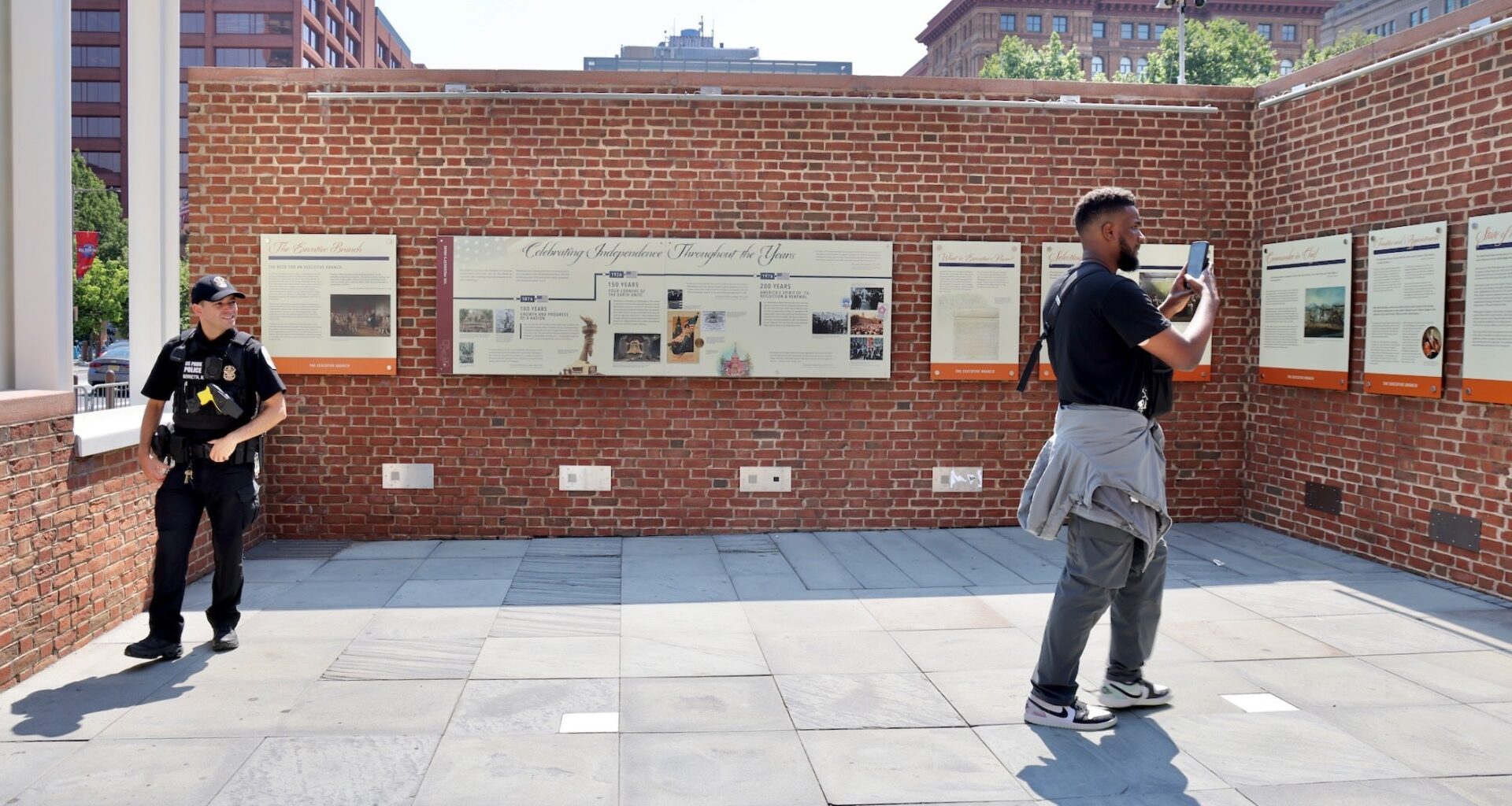
The Trump administration has completed its overhaul of the President’s House Site on Independence Mall, installing a new exhibit that critics say softens George Washington’s role as an enslaver and shifts attention away from the nine people he held in bondage while living in Philadelphia.
Workers replaced the remaining exhibits overnight, possibly ending the fight that pitted the city of Philadelphia against the federal government over who controls the story told at the important historic site.
A panel that had been titled ”The Dirty Business of Slavery” has now been replaced by signage that reads ”Celebrating Independence Throughout the Years.”
Less than two weeks ago, a federal appeals court cleared the way for the National Park Service to replace the exhibit. The court concluded that Philadelphia had no legal authority to dictate interpretive content at the federally owned memorial after donating the site to the park service nearly two decades ago.
The new exhibit retains references to slavery and the nine people Washington enslaved while serving as president in Philadelphia, but it devotes significantly more space to the history of the executive mansion and the early presidency
It also softens George Washington’s views on slavery compared to the previous display.
“In 1774, Washington helped draft the Fairfax Resolves at Mount Vernon,” one panel reads. “These condemned the slave trade as ‘wicked,’ ‘cruel,’ and ‘unnatural’ and called for putting ‘an entire Stop’ to it. Over time, he became increasingly committed to the gradual abolition of slavery.”
The exhibit also notes that as president, Washington signed legislation that “both upheld and limited slavery,” including the Fugitive Slave Act, “passed by a veto-proof majority of Congress, which allowed slaveholders to recapture those who had escaped and penalized anyone who assisted them.”
“He also signed measures restricting slavery’s expansion, including the 1789 Northwest Ordinance, which banned slavery in the Northwest Territory, and the 1794 Slave Trade Act, which barred the participation of American ships in the transatlantic slave trade,” that panel reads.