
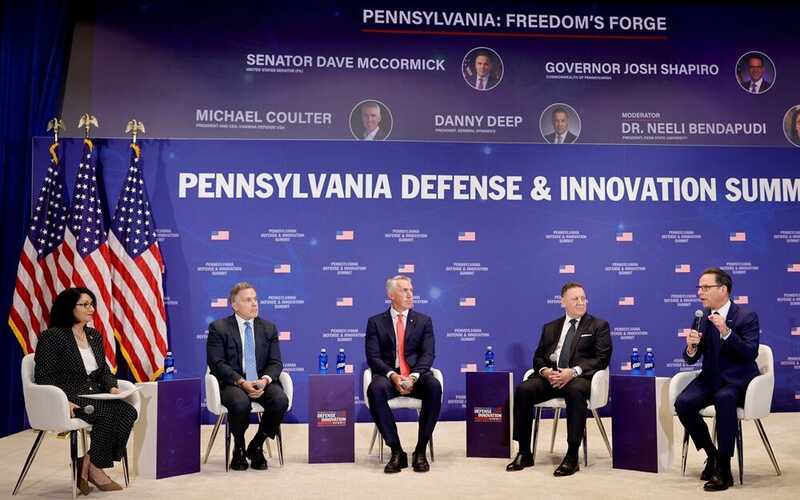
CARLISLE- Business executives, government leaders and academic officials gathered at the Pennsylvania Defense and Innovation Summit this week with a shared message: maintaining America’s military advantage will require faster innovation, stronger public-private partnerships and a skilled workforce prepared for the future.
Hosted by U.S. Sen. Dave McCormick at the U.S. Army War College, the summit brought together leaders from industry, government and higher education to discuss strengthening the nation’s defense industrial base while positioning Pennsylvania as a national leader in defense manufacturing and technology.
Penn State University President Neeli Bendapudi, who moderated one of the summit’s panels, highlighted the university’s long-standing contributions to national defense research.
“At Penn State University, $1.45 billion in research is conducted annually, and 30% of that is from the Department of Defense,” Bendapudi said. “Not a single submarine has been built in the last seven decades that hasn’t had Penn State University expertise.”
McCormick said Pennsylvania’s combination of manufacturing, research institutions and skilled workforce makes it uniquely positioned to lead the next generation of defense innovation.
“We’re on the cusp, but we have to really drive a dramatic transformation in how we think about national security and who’s leading the charge,” McCormick said. “Everybody should leave here anxious that we’re not doing enough, anxious to do more, anxious to work together and anxious to follow up on creating the kind of change that everybody on this panel has talked about.”
Pennsylvania Gov. Josh Shapiro said the defense sector represents one of the Commonwealth’s greatest opportunities for economic growth while strengthening national security.
“I think the defense space, with all the promise that it has, ends up being a key part of our growth in this Commonwealth,” Shapiro said. “My hope, based on this summit, is not so much the conversations that take place up here, but the private conversations that you all have in the hallways that lead to commercial activity, that leads to more job creation in Pennsylvania, leads to more prosperity for Pennsylvanians, and most importantly, more national security for the United States.”
Shapiro noted Pennsylvania’s economy grew 5.4% last year, ranking among the nation’s fastest-growing economies, while the state has increased funding for workforce development and apprenticeship programs by more than 60%.
Hanwha Defense USA CEO Michael Coulter outlined the company’s major investments in the Philadelphia Navy Yard, where the company plans to expand domestic shipbuilding.
“We have more than doubled the workforce since we acquired the shipyard,” Coulter said. “We’ve put over $200 million into the shipyard in the past year. We are ‘foot on the throttle’ to make shipbuilding great again, and Pennsylvania is the heart of that.”
Coulter emphasized that automation will create new opportunities rather than eliminate jobs.
“We’re envisioning the workforce of the future,” he said. “Today I’m a welder. Tomorrow I’m operating five robot welders. Five years from now I’m doing something even more advanced.”
General Dynamics Executive Vice President Danny Deep said Pennsylvania has become one of the company’s most important manufacturing hubs, employing more than 2,200 workers and relying on over 1,100 suppliers across the Commonwealth.
“When the war started in Ukraine, we were producing 14,000 rounds of artillery a month,” Deep said. “Through government investment and General Dynamics investment, we went from 14,000 rounds a month to 50,000 rounds a month. That’s because of this public-private partnership.”
Deep warned that the nation’s biggest threat may be complacency.
“We can’t get complacent, and we can’t assume that once this acute threat goes away, we can fall back on our laurels,” he said. “If this intensity and this focus wanes in any way, it will be catastrophic.”
McCormick agreed, pointing to China as America’s greatest strategic competitor.
“China is our primary adversary in terms of a risk to our geopolitical leadership,” he said. “Winning for America and winning for Pennsylvania is a team sport. We need labor leaders at the table. We need the traditional defense companies. We need emerging technologies. We need Republicans and Democrats working together.”
Shapiro echoed those concerns, saying innovation and faster procurement will be critical to maintaining America’s competitive edge.
“I think the biggest risks are a lack of innovation, a procurement process that’s too damn slow at a time where China’s moving too fast, and isolation,” Shapiro said. “We’ve got to figure out a way to better and more quickly connect the research that’s happening in our universities with our tech companies, with our traditional defense companies, and streamline that process.”
The governor also stressed the importance of working alongside allied nations.
“One of the unique advantages we have is we’re the United States of America,” Shapiro said. “We have an opportunity to bring allies in, rely on some of their research institutions and innovation, and work together to continue to build the modern-day arsenal of democracy.”
The panel concluded with speakers expressing optimism that the summit will generate new partnerships and investment opportunities throughout Pennsylvania.
“I really appreciate the senator pulling this forum together,” Deep said. “Aerospace and defense is unique. To be successful, it has to be a partnership between industry, academia and government. That’s the ecosystem.”
Bendapudi noted, “”We don’t want you to just leave here with a good memory. We want you to come back and invest here. We have a governor that’s determined to make us agile and responsive, a senator who’s bringing everyone together, business partners who are ready to work with you, and university systems saying, ‘Come here. We want to grow with you.””