
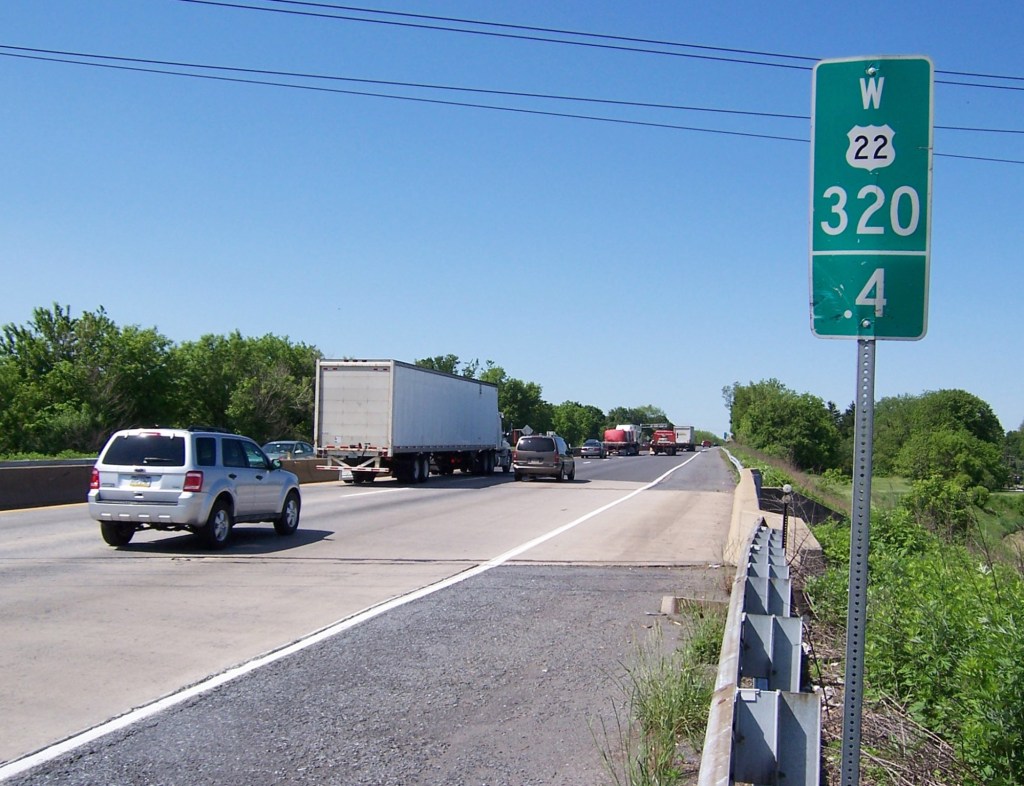
What can be done to keep traffic moving efficiently along Route 22 in the Lehigh Valley? There will soon be a plan for that.
A Lehigh Valley Transportation Study committee received an update Wednesday morning on the Route 22 Safety, Mobility, and Congestion Management Plan that is scheduled to be released in November.
Chris Stanford, an engineer and planner at Michael Baker International, said the goal is to understand the issues around the Route 22 corridor and establish a long-term vision for improvements.
“We’ll be looking to develop a targeted list of short term, middle term, and long term projects, and developing a phased and phase capital improvement plan for addition to the Future LV and the metropolitan transportation plan,” Stanford said.
Stanford said next steps for the rest of the summer will include the project team focusing on developing, costing and analyzing alternatives. They are evaluating right-of-way, utility and environmental impacts for proposed improvements.
In the fall, they will use a formal scoring system to select preferred projects and establish the final phased capital action plan.
The study is being funded by a $1 million grant from PennDOT that was secured by state Sen. Nick Miller, D-Lehigh. It will look at congestion relief, safety, mobility, environmental quality and economic growth. It will be a vastly updated version of the 22 Tomorrow plan that was published in 1999.
Here are four things to know about early findings from the Route 22 study:
It’s truly the Lehigh Valley’s Main Street
Daily traffic volumes on Route 22 were measured between the Tilghman Street interchange in Upper Macungie Township and the Delaware River bridge in Easton.
The study found that the 23-mile stretch of highway averaged about 40,000 vehicles daily near Tilghman and increased between 60,000 and 75,000 at Cedar Crest Boulevard in South Whitehall Township to more than 90,000 at MacArthur Road/Seventh Street in Whitehall Township.
That volume remains high through Fullerton Avenue to Airport Road in Hanover Township, Lehigh County. The number gradually decreases beginning at Route 378 before dropping back down to below 40,000 at Route 33 in Bethlehem Township.
Stanford said the numbers found that only 7% of daily traffic travel the entire corridor from the split with I-78 in Upper Macungie all the way to Easton. The vast majority use it for local trips, which creates the slowdowns at merge points.
“That is part of the challenge with this corridor,” he said.
It’s a dangerous highway
Between 2020 and 2024, the corridor had 2,050 crashes and an additional 117 on ramps.
About 60% of westbound lane miles and 78% of eastbound lane miles experience crash rates that exceed the statewide average of similar roadways.
The crashes are widely distributed rather than concentrated in isolated “hot spots.”
“This doesn’t mean that there’s tragic safety issues out there today, but it shows that since 22 is an older facility, things have been built to different design standards over the years and over the decades,” Stanford said.
Older construction
The highway was built in 1954 and it shows its age.
Current left shoulders are only 4 feet wide, and right shoulders are 8 to 10 feet. Modern standards for high-volume corridors recommend 12-foot shoulders to safely accommodate emergency pull-overs and vehicle breakdowns.
Many of the interchanges have kept their original design and are spaced closely to each other. The study found that 16 interchange ramps are spaced too closely together, 24 acceleration ramps and 13 deceleration ramps fail to meet modern length standards, and all but one of the interchanges is designed for speeds below the recommended 30 mph minimum.
Twenty-nine of 33 bridges along the corridor are rated in “fair” condition and four are considered to be in “good” condition. Six of the bridges have what’s considered a substandard vertical clearance of less than 16 feet, 6 inches.
Projects in the pipeline
The study is coordinating with PennDOT improvement projects that have already in various stages of design.
They include:
• Improvements to the Fullerton Avenue interchange that include a connection to the future Riverside Drive coming up from Allentown.
• Widening Route 22 to six lanes between Fullerton Avenue and Airport Road. Construction on the $28 million project is expected to begin in late 2028 or early 2029 with completion in two-to-three years. It will be timed to align with the reconstruction of the Fullerton Avenue interchange.
• Redesign of the Route 191 interchange in Bethlehem Township. The project, estimated at $115 million, is in the preliminary engineering phase. Final design is scheduled for completion in 2031 with construction to be finished in fall 2034.
• Rehabilitation or replacement and widening of the Route 145 bridge over Jordan Creek, near the Route 22 interchange in Whitehall Township. That project, estimated to cost $7.3 million, is in design with construction anticipated in 2029.
Morning Call reporter Evan Jones can be reached at ejones@mcall.com.