
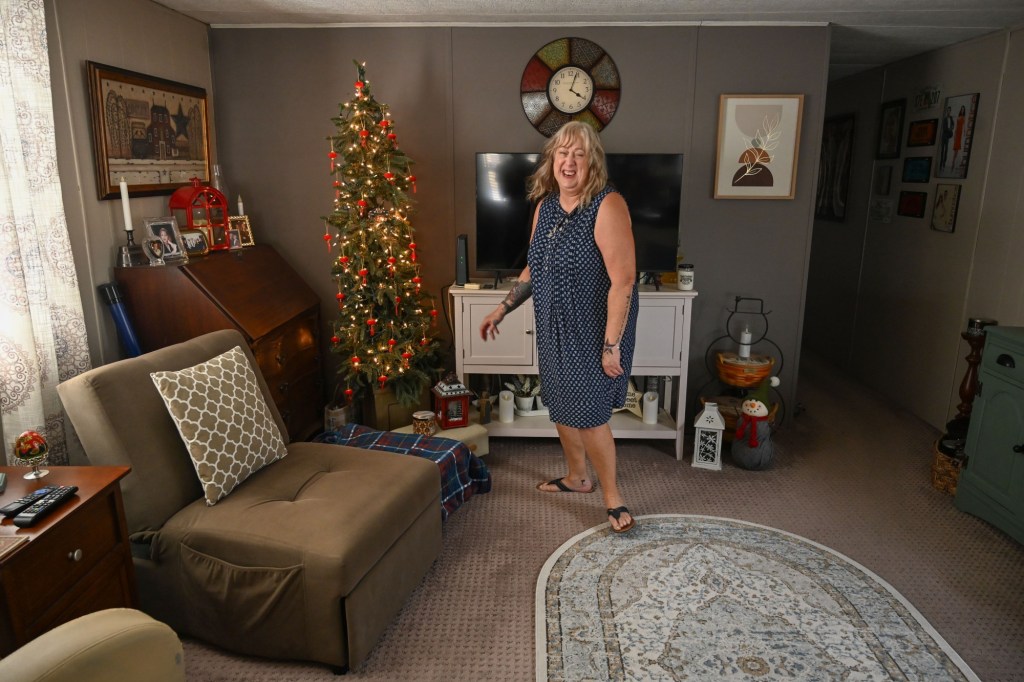
Melissa Schroeder sits in her living room with her neighbors wondering how much longer she can afford to remain in her manufactured home, and if help will ever come.
Like many in the Red Maple Acres community — which has more than 200 lots on the border of Lower Macungie and Upper Macungie townships near Wescosville — Schroeder has had to deal with steep prices on the land she rents from the owner, GSP Management Co.
While she owns her house, she rents the lot from GSP, which recently bought the 18-acre property from ARX Communities for $30.5 million. There are also utilities and property taxes. Simply picking up and moving somewhere less expensive isn’t an option, as transporting a mobile home can cost thousands of dollars.
For several months, it looked like help may be coming from Harrisburg via a trio of bills designed to give manufactured home owners ways to deal with the increasing rates and the rise of corporate ownership of the mobile home parks. However, the bills are still waiting for final approval, and legislators are sounding the alarm that time may be running out for the current session.
Meanwhile, mobile homeowners like Schroeder are frustrated.
“I’m almost 70. I want to retire,” Schroeder said. “And I can’t. I don’t even see it. Because [the rent] is going to go up. Every time I turn around, it’s going up.”
Red Maple Acres residents say they have seen rents almost double in the last three years. Those paying around $440 about three years ago are now seeing rates approaching $900. Many of them live on fixed incomes and still pay thousands in maintenance.
“I honestly did not think at my age right now, I would be struggling so hard just to live,” said Peggy Hoffman, who has also invested thousands of dollars to maintain her home. “I did better when I started out at 19 when I left home. Where are you going to go?”
Hoffman and Schroeder, along with Emma Simeone and Nancy Jensen, are part of a group of Red Maple community members who have reached out to their local lawmakers, including state Rep. Gary Day and Sen. Jarrett Coleman, both R-Lehigh, and the state attorney general’s office for help.
Debate in Harrisburg
There are two bills in Harrisburg with a long list of bipartisan co-sponsors that aim to address the price hikes. Senate Bill 745 sits in the Urban Affairs and Housing Committee, as does a companion bill, HB 1250, that passed the House June 10.
Provisions in the legislation include requiring 180 days’ notice of all rent and fee increases, and capping annual increases based on the Consumer Price Index — though they would allow justified exceptions and temporary capital surcharges.
A third bill, SB 746, which would give manufactured home residents the right of first refusal when a park is sold, passed the Senate Urban Affairs and House Committee unanimously in June and is awaiting action by the whole body.
It’s uncertain whether they will get to Gov. Josh Shapiro’s desk before the end of the session. Shapiro has said he’d sign such bills and mentioned manufactured homes in the housing action plan his administration released this year.
“Can you imagine our elected officials sitting by, while every month that passes means financial ruin and the loss of homes for more residents of manufactured housing?” Bob Besecker, of the Coalition of Manufactured Home Communities of Pennsylvania — which has members in more than 100 communities across the state and advocates for tenants — said at a recent news conference in Harrisburg.
State Sen. Judy Schwank, D-Berks, who introduced SB 745 and SB 746, said further delay isn’t an option.
“These are commonsense reforms and will protect hardworking Pennsylvanians and help keep them in their homes,” Schwank said. “It’s critical that we stand with these homeowners and enact this legislation before the session ends, so we don’t have to start this entire process again in 2027.”
Opinions on what to do varies, even among manufactured home owners. Joe Welsh, who lives at Miller’s Edgewood Mobile Home Park in East Allen Township, said living at a family-owned property has its advantages.
“When you have on-site or nearby owners who can respond to situations, it’s a much better living situation than some absentee landlord and you’re talking to a computer screen that may be AI,” he said.
He said there should be some distinction between smaller and larger property owners.
“What you’re seeing in the legislation is a response to abuses by hedge funds,” Welsh said. “It would be nice from a public policy standpoint if we could draw a distinction … between the on-site management or some consideration in the equations.”
‘A broad brush’
Jared Surnamer, vice president of the Pennsylvania Manufactured Housing Association and president of Valley Community Management in Allen Township, said many parks are family-owned small businesses and not hedge funds.
“To paint with a broad brush, I don’t know if that’s a good policy,” Surnamer said. “I do feel like a lot of community owners, family communities, are caught in the middle where we’ve had decades of good practices. Now we’re facing being the only price-controlled housing. It’s just scary.”
The proposed legislation could bring price controls, which could handcuff park owners when dealing with rising costs caused by property taxes or state-mandated infrastructure upgrades to such things as sewer systems.
That, Surnamer said, could make the business unsustainable.
“The last two or three times that we upgraded water or sewer systems, it was just shy of half a million dollars. If that’s not able to be factored in, I just think that’s just misguided,” he said. “It’s like a misguided solution to a legitimate concern that the residents have.”
Surnamer said he’s heard about the massive rent hikes at some communities when a corporate entity buys a family-owned park where rents hadn’t been raised in years. The new owners are simply catching up to market rates, but the sticker shock is understandable, he said.
He said the PMHA recommends modest, periodic and well-communicated rent increases aligned with inflation, rather than sudden, massive jumps.
“Communication is everything,” Surnamer said, “because our residents, by and large, are easy and a pleasure to work with, and usually very understanding. If my tenants are concerned, I need to be concerned, because this is how we put food on our table.”
What can be done?
With the Lehigh Valley already facing a housing shortage of more than 9,000 units according to Lehigh Valley Planning Commission statistics, Surnamer has a similar opinion as other developers and landlords: expand the supply to help keep costs down.
“Investment companies recognize that when the supply is fixed, they use this almost as their investment prospectus,” he said. “They say, ‘This is a good investment because the demand is rising and there’s a fixed supply … ‘ That’s basic economics.”
Financing programs from the federal government that offer nonrecourse commercial loans to large investment firms are also a problem, Surnamer said, because they allow corporate buyers to outbid smaller operators.
State Rep. Liz Hanbridge, D-Montgomery, said large investors have found they can make a quick profit from these communities.
“National reporting has shown that Wall Street investors openly view manufactured communities as cash cows,” said Hanbridge, who introduced SB 1250. “That is how some of these firms described communities filled with seniors, veterans, retirees and working families. Not neighborhoods, not homes, not people. Cash cows.”
Other reforms could include overhauling zoning laws that hinder development, something Republicans in Harrisburg have proposed in response to the governor’s housing plan, which advocates guardrails on lot rent increases and protecting owners who finance from higher interest rates.
For instance, Coleman has advocated giving automatic approval for developments that have secured water and sewer service in a nonresidential zone. It includes “flexibility” for multifamily, mixed-use and adaptive reuse projects by eliminating requirements such as excessive setbacks or lot size, height restrictions that prevent adding affordable units, mandatory fences and one-size-fits-all parking mandates.
Morning Call reporter Evan Jones can be reached at ejones@mcall.com.