
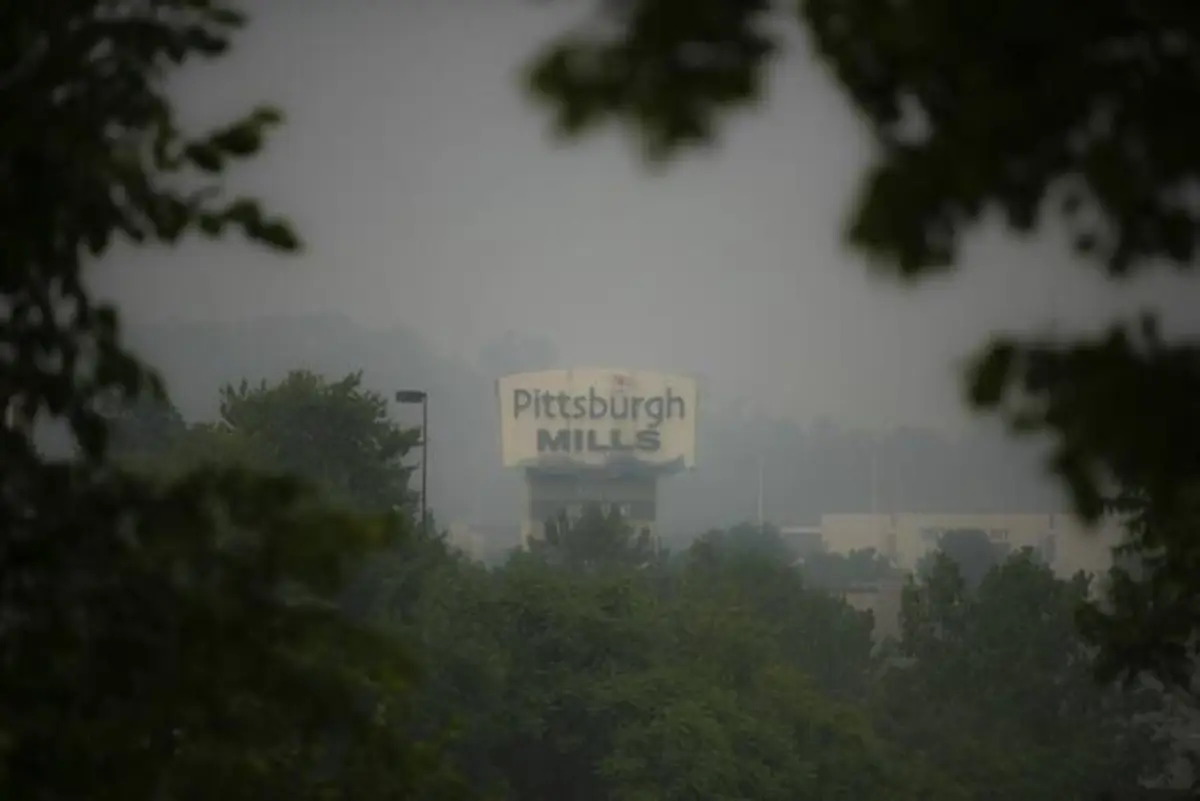
The air smelled as bad as it looked on Thursday in Western Pennsylvania as health officials cautioned residents to stay indoors.
And the haze is far from over.
Andrew Kienzle, a meteorologist with the National Weather Service in Moon, said air quality was expected to worsen into Thursday night.
The smoke is drifting from wildfires burning across northern Minnesota and western Ontario, Canada.
The Allegheny County Health Department warned residents that air quality has reached the Code Maroon (Hazardous) level in parts of the county because of wildfire smoke.
Just after 4 p.m., the city of Pittsburgh announced closure of its pools for the rest of Thursday because of air quality concerns.
County health officials advised residents to avoid outdoor activities Thursday evening and possibly Friday as smoke remains in the region.
The EPA’s Air Quality Index classifies Code Maroon as a hazardous level, meaning everyone is more likely to experience health effects.
Officials recommended:
•Everyone: Avoid all physical activity outdoors.
•Sensitive groups, including people with respiratory or heart conditions, older adults and children: Stay indoors and limit activity.
Thursday afternoon, the Pittsburgh region was around 100 on the Environmental Protection Agency scale, but it was expected to climb into the 200 to 300 range, Kienzle said, with those conditions continuing overnight and into Friday.
The Air Quality Index’s “unhealthy” category ranges from 151 to 200, meaning “members of the general public may experience health effects,” and the “very unhealthy” category is 201 to 300.
“(It’s) been kind of flowing southeast toward us over the last couple of days, but it’s really dropping down on the Pittsburgh grid,” Kienzle said. “We are expecting it to improve, but it will be at least 36 hours before we see that meaningful improvement.”
Here is an image showing the projected concentration of smoke across the region through Friday. pic.twitter.com/CaSuFO9ow6
— NWS Pittsburgh (@NWSPittsburgh) July 16, 2026
For comparison, the Air Quality Index topped 300 across parts of Western Pennsylvania during the June 2023 smoke event caused by wildfires in Quebec, according to the National Weather Service data.
“Anything above 300 becomes hazardous on that scale,” Kienzle said.
In Cleveland on Thursday afternoon, he said there’s “pretty shockingly bad air quality” over 500 on the scale. Downtown Cleveland is at 596 as of 2:30 p.m., and other areas are up to as high as 609.
Dr. Sally Wenzel, director of the University of Pittsburgh Asthma and Environmental Lung Health program, said wildfire smoke is similar to wood smoke and contains tiny particles that can irritate the body.
“The smoke consists of particulate matter that’s smaller than one-thirtieth the diameter of a human hair,” Wenzel said. “When it gets into the eyes, the back of the throat or the lungs, it can cause irritation.”
Wenzel urged people to stay indoors when possible and wear a well-fitting N95 mask if they must be outside. She said masks are especially important for people with respiratory conditions and anyone planning to exercise outdoors.
Dr. Tariq Cheema, division chief of pulmonary and critical care at Allegheny Health Network and a teaching professor at Drexel University, said wildfire smoke can be especially irritating because the tiny particles can travel deep into the lungs.
“I can’t really quantify it, but it’s like walking into a room full of cigarette smoke,” Cheema said.
People with asthma, emphysema or other chronic lung conditions are more likely to experience problems, he said.
“There’s been a significant increase in phone calls from people who are not doing well — who have lung disease,” Cheema said. “Sometimes we have to put these folks on steroids.”
Cheema advised residents, especially those with lung conditions, to stay indoors as much as possible while air quality remains poor.
“I noticed the smoke around 11 this morning,” Michael Spanos, 40, who runs Gus & YiaYia’s ice ball stand on Pittsburgh’s North Side, said Thursday afternoon. ” We opened the shaved ice stand around noon, and you can just look and see the haze in the air. I haven’t had any trouble breathing, but customers have mentioned they’ve been having issues. They say they can feel it in their throats, like a burning sensation when they breathe.”
Customer Chuck Pollard, 66, remarked: “Ain’t nothing we can do about it.”
Featured Local Businesses
Bob Kassanitsh 65, was concerned as he finished an ice ball at Gus & YiaYia’s.
“It sucks,” he said. “Just the smell, my eyes feel funny like they’re getting swollen.”
He headed to his car for shelter.
“I’m not feeling too good,” Kassantish said.
Kienzle said it looks like the smoke will linger through Friday morning at least, with some into the afternoon and then “gradual improvement as we get into Friday evening.” He expects smoke to largely move northeast by sunrise on Saturday.
Western Pennsylvania residents should monitor air quality alerts issued by the Allegheny County Health Department and the state Department of Environmental Protection, meteorologists said, as smoky conditions are expected to persist.
In Tarentum, the haze prompted concern among residents.
“You don’t want to take a deep breath,” said Willene Aikens, a volunteer firefighter for the Eureka Fire-Rescue EMS in Tarentum.
Aikens urged people with pre-existing health conditions to consult their doctors or local hospitals if they experience symptoms and to limit time outdoors when possible.
At Diamond Antiques and Gifts, employees Rhonda Netzel and Laurie Van Tine watched the smoky conditions worsen throughout the day.
“When I came in this morning, I didn’t notice anything,” Netzel said. “I saw on the news about the big fire and thought, ‘Surely it’s not really going to come here.’ But it got worse and worse, and now it’s kind of suffocating.”
Van Tine said customers repeatedly commented on the smoky conditions.
“It’s been progressively worse as the day goes on,” she said. “People have been saying it’s foggy, smoggy, stinky. Their eyes are itchy and burning. The heat is plenty enough to deal with without the smoke.”
Staff writers Nadia Commodore and Naomi Girson contributed to this report.