

This story is part of the WHYY News Climate Desk, bringing you news and solutions for our changing region.
From the Poconos to the Jersey Shore to the mouth of the Delaware Bay, what do you want to know about climate change? What would you like us to cover? Get in touch.
Health officials are urging people to limit their time outdoors as smoke from hundreds of wildfires burning in Canada and northern Minnesota continues to blanket the region with dangerous levels of air pollution.
The Philadelphia area was under a Code Purple Air Quality Alert on Friday morning, meaning levels of particulate matter are dangerous to everyone.
People with health conditions, including respiratory and cardiovascular problems, as well as children and the elderly are urged to take extra precautions.
Those who must go outside should wear a mask, health experts say. N95 masks, when fitted properly, are designed to filter the fine, tiny particles that are less than 2.5 microns in diameter known as PM 2.5, that are polluting the air across the region.
“The level of air pollution is bad enough that it’s going to affect people both with and without significant lung issues,” said Dr. David Manoff, chief of pulmonary and critical care medicine at Temple University Hospital.
PM 2.5 are 30 times smaller than the width of human hair, and are easily inhalable. The particles can settle deep in the lungs and enter the bloodstream.
People with cardiovascular and respiratory conditions are more likely to experience worsened symptoms, and are more prone to develop infections like pneumonia. People who are otherwise healthy could be impacted by the smoke, health experts say.
“If you have to go out, the city’s recommendation to wear an N95 if you can, is probably a pretty reasonable one,” Manoff said.
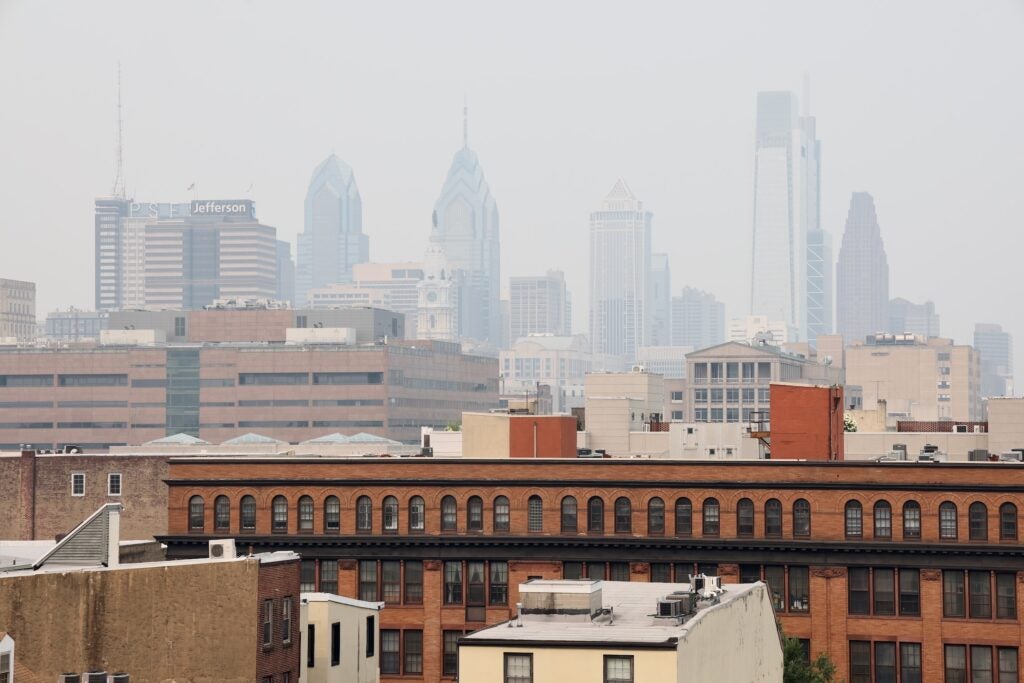 Philadelphia’s skyline is faintly visible from the Ben Franklin Bridge as smoke from wildfires in Canada reaches Philadelphia on Friday, July 17, 2026. (Emma Lee/WHYY)