
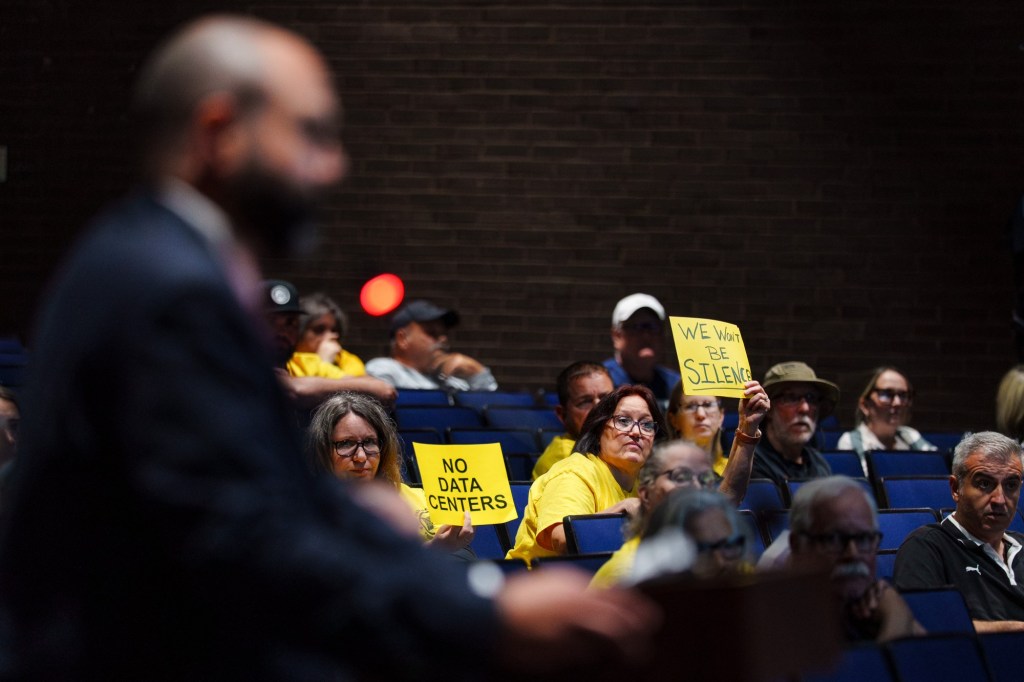
Archbald residents have legal standing to challenge the validity of the town’s data center zoning ordinance, despite living more than 600 feet from any proposed sites, a Lackawanna County judge ruled Friday.
In a legal battle pitting eight Archbald residents against the borough and three data center developers, Judge Mark Powell denied a motion from the developer of the Project Scott data center campus on Eynon Jermyn Road. The April 6 filing contended residents did not live close enough to data center sites to legally challenge Archbald’s zoning.
The second recent court win for Lackawanna County residents shows the impacts of data centers extend beyond their immediate neighbors. Last month, county Judge Margaret Bisignani Moyle ruled that a Scranton woman had legal standing to oppose plans for a data center campus in Ransom Twp. that was two-thirds of a mile from her Keyser Valley home.
Archbald residents Phillip Sardo, Jack and Amy Swingle, Marilyn Jones, Robert and Phyliss Paone, Joseph Sabia and Justin Healey filed a land use appeal Dec. 23 asking the court to invalidate Archbald’s data center zoning amendment over alleged procedural issues.
Since that filing, attorneys representing Archbald I LLC (Project Scott and Project North); Green Mountain 6 LLC (Project Green Mountain); and Cornell Realty Management LLC, Wildcat Realty Holdings LLC and Pine Hill Dream LLC (Wildcat Ridge Data Center Campus) intervened to join Archbald in defense of its zoning ordinance, which allows all of their data center campuses — except Project North — as conditional uses.
The Valley View School District and Lackawanna County Housing Authority also filed motions to intervene on the side of residents to challenge the zoning. Attorneys representing data centers and Archbald challenged Valley View’s intervention. Their motions have yet to address the housing authority, which filed its request for legal standing June 30, about a month after Valley View.
Lackawanna County Court of Common Pleas President Judge James A. Gibbons will hold a hearing Sept. 3 at 9:30 a.m. to consider standing for both the district and housing authority.
Four former borough council members voted Nov. 24 to adopt the contested data center zoning amendment. The legislation applied restrictions on data center campuses while subjecting them to approval from council. Residents pushed back, claiming the ordinance permitted data centers in too many places while lacking enough protections.
The ordinance created four data center overlays that conditionally allowed data centers:
• Hundreds of acres along Business Route 6 and Route 247, which are zoned for conservation and medium/high-density residential uses. This is Wildcat Ridge.
• The wooded area immediately north of the Archbald Pothole State Park and Staback Park along Business Route 6 and Eynon Jermyn Road. This is Project Scott.
• Industrial land along Power Boulevard and in the Valley View Business Park.
• A narrow L-shaped band on the outskirts of Stavola Silverbrook Land LLC’s mining land along the Casey Highway. This is Project Green Mountain.
Attorneys for Archbald I LLC argued in the motion to dismiss that the residents lacked standing to appeal because they do not live within or adjacent to the data center overlay districts.
Powell disagreed with that argument, noting that although Archbald I contends case law establishes a 400-to-600-foot range where residents can appeal, Pennsylvania law does not impose any rigid geographical limitations. The residents established that they are affected because they live within close proximity to data center overlays, ranging from 1,600 feet to just over 5,200 feet, Powell wrote.
State law doesn’t establish a fixed distance where a landowner would lack standing, according to Powell.
The judge cited Friends of Lackawanna v. Dunmore Borough Zoning Hearing Board, where members of the Keystone Sanitary Landfill opposition group challenged its decadeslong Phase III expansion. The landfill similarly argued members of Friends of Lackawanna lacked standing because they lived about a quarter-mile to a half-mile away from the landfill. A judge determined they could proceed based on evidence of rotting garbage, dust, bird droppings and truck traffic.
In Archbald, Powell references that Archbald’s zoning ordinance authorizes uses operating “in an unmitigated state” that will produce noise exceeding the borough’s limits.
Archbald’s zoning exempts data centers’ backup generators from noise limitations during power outages and similar emergencies, as well as routine maintenance and testing during daytime hours.
During a hearing Monday, Archbald’s own noise expert said there was no scientific reason for that exemption.
Powell also describes the infrastructure authorized in the ordinance, including transformers and substations, water storage facilities, electrical fields, and other industrial or utility uses “whose scale and operational characteristics differ materially from ordinary residential or commercial development.”
In a statement Friday, attorney Justin Richards of Elliott Greenleaf P.C., who represents the residents and members of Stop Archbald Data Centers, said the appellants are grateful for the court’s careful review and ruling.
“Now that our standing has withstood this challenge, we welcome the opportunity to carry our procedural validity challenge forward toward adjudication,” Richards said.