
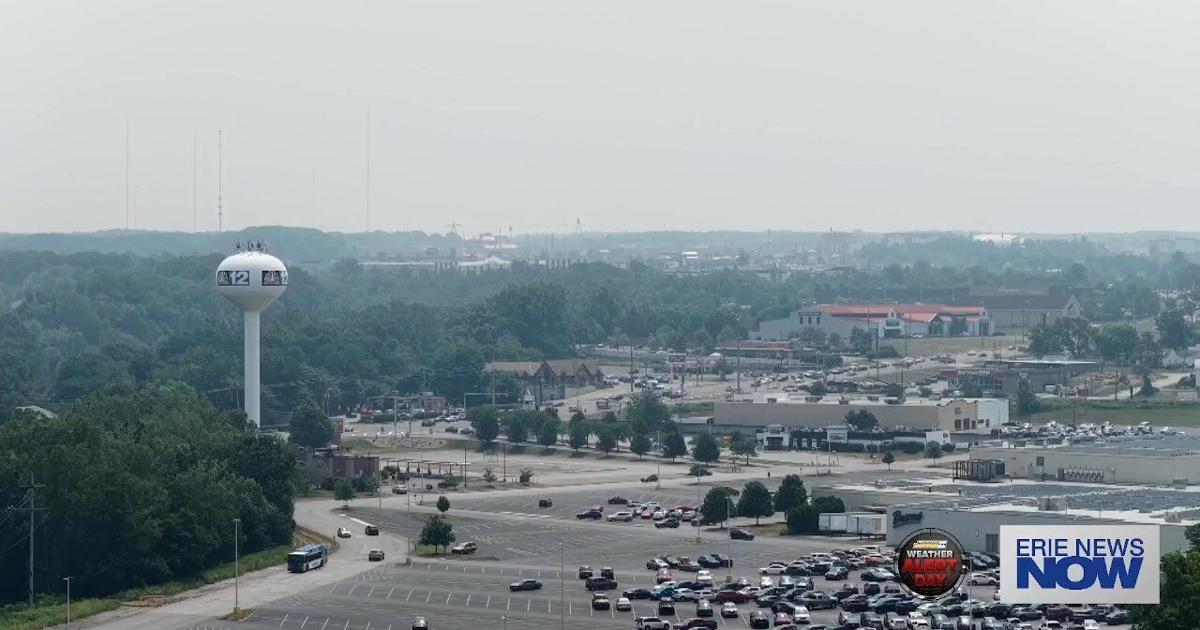
As air quality alerts remain in effect across the Erie region, health experts are urging residents to limit their exposure to smoky conditions, warning that the health risks extend beyond people with pre-existing medical conditions.
Doctors say the fine particulate matter carried in wildfire smoke can affect nearly everyone, causing irritation and increasing the risk of more serious heart and lung complications. Local hospitals have already seen an increase in patients seeking treatment for smoke-related illnesses, and environmental experts believe the poor air quality could continue as wildfires burn.
Dr. Matthew Becker, System Director of Cardiovascular Medicine at LECOM and a volunteer expert of the American Heart Association, said the greatest concern is the microscopic particles found in the smoke.
“Smoke is what we’re calling it, but whether you’re in LA or New York where there’s traditionally smog, or whether you have fire debris like we have now, particulate matter is what we talk about,” Becker said. “You’re inhaling things like nitrogen dioxide, there’s a lot more ozone on the ground level that can inflame the cardiovascular system, cause your blood to become more sticky, more prone to clots, and decrease the oxygen in your blood.”
He said those effects place additional strain on people already living with heart or lung disease, but healthy individuals are not immune.
Symptoms can include coughing, headaches, itchy eyes or throat, shortness of breath, and fatigue. Many Erie residents say they’ve already noticed the effects.
“It’s been, especially yesterday, I feel you could definitely smell a difference in the air,” said Erie resident Beth Detter. “Today, I feel like it’s cleared up a little, but it’s still hazy.”
Chris Edmiston, an Erie resident, said the smoky conditions have aggravated her migraines and raised concerns for her family.
“I suffer from migraines, and I felt a lot more triggered by the smell,” Edmiston said. “It just feels kind of toxic. Even with the air conditioning, it’s in your house, too, so your kids are breathing it.”
Becker said he has already seen multiple hospital admissions in recent days tied to the smoky conditions.
“I have already personally seen multiple admissions this last couple of days for COPD or emphysema or cardiovascular disease like heart failure,” he said. “These are people who are already struggling to stay well.”
He added that widespread smoke events can also place additional pressure on healthcare systems, much like other large-scale public health events.
Environmental experts say residents should prepare for the possibility that air quality alerts could continue for some time.
Former EPA pollution expert Michael Petroni said the wildfires responsible for the smoke are unlikely to be extinguished quickly.
“It’s not reasonable to think that they’re gonna go out anytime soon,” Petroni said. “It would take massive amounts of rain to put a fire out of that size, and some people have been predicting that the fires might not go out until the snow falls over the winter.”
With another summer weekend ahead, Becker encourages residents to reconsider spending extended periods outdoors if air quality remains poor.
“I think today and probably tomorrow, it’s sunny, it’s Erie, we want to get out and celebrate, it’s the weekend,” Becker said. “I think probably minimize that. I think try and stay inside.”
If spending time outdoors is unavoidable, experts recommend checking the latest air quality conditions before leaving home, wearing a properly fitted N95 mask, setting vehicle air conditioning systems to recirculate indoor air, and avoiding ventilation systems that pull smoky outdoor air inside.
Health officials say taking those precautions can help reduce exposure while wildfire smoke continues to impact the region.