
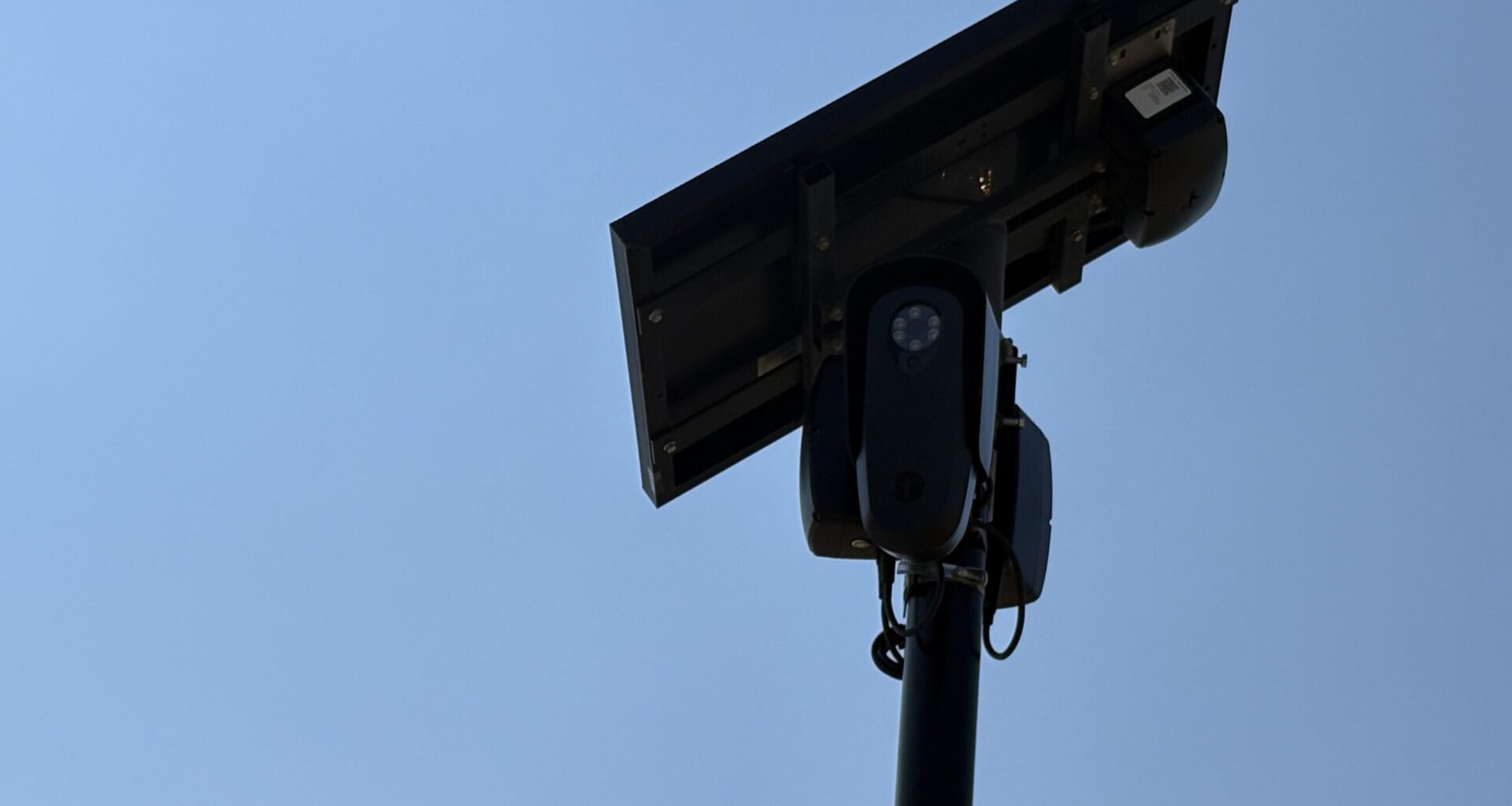
Erie County has more cameras than any county in upstate. There are nearly 400 installed throughout WNY and they generate data searched extensively by police agencies.
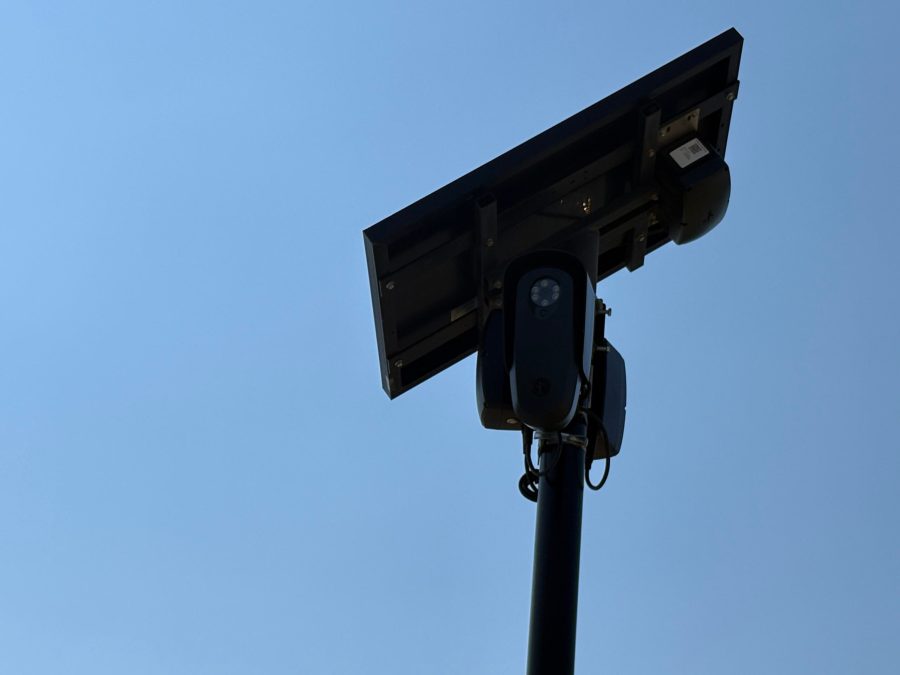
A Flock camera installed at The Boulevard shopping plaza in Amherst. Photo by J. Dale Shoemaker.
Editor’s note: This is the second story on the use of license plate readers in Western New York. Our first story focused on the prevalence of the cameras and their use by law enforcement.
Law-enforcement agencies have installed as many as 395 license plate reading cameras to track drivers’ movement across Western New York.
The cameras watch students driving to class at Buffalo State University.
They capture the cars of shoppers at local Lowe’s and Home Depot stores, at the Walden Galleria Mall and at The Boulevard plaza in Amherst.
They record the vehicles of residents and visitors of low-income housing in the city — along with those pulling up to buy weed at a dispensary on Virginia Street.
Twenty law enforcement agencies in Erie and Niagara counties have installed license plate readers or search for vehicles using the Flock surveillance network, an Investigative Post analysis found. The cameras record a vehicle’s make, model, color, markings and license plate. Flock cameras then store that information in a database connected to as many as 6,500 other camera networks, accessible by thousands of police agencies across the nation. (Buffalo says data gathered by its license plate readers is available to city cops only.)
Five local towns with Flock cameras, for example, each reported 300,000 to 500,000 plates captured by their devices over the past month. Those agencies then made a collective 1,500 searches of the Flock system over the same period.
Open-source data shows 291 license plate readers in Erie County, among the highest number in the state and more than any county in upstate. Only Nassau County on Long Island (331) and Queens County (307) and New York County (299), both in New York City, are reported to have more, according to data from DeFlock, an open-source project created by a group opposed to the use of license plate readers. By contrast, Monroe and Onondaga counties, home to Rochester and Syracuse, have a combined total of 193.
The data has limitations — it counts routine surveillance cameras at an Amherst elementary school as license plate readers, for example — but Investigative Post was able to verify with police departments or public records that many of the reported camera locations in Western New York were accurate, including 226 of 291 reported in Erie County.
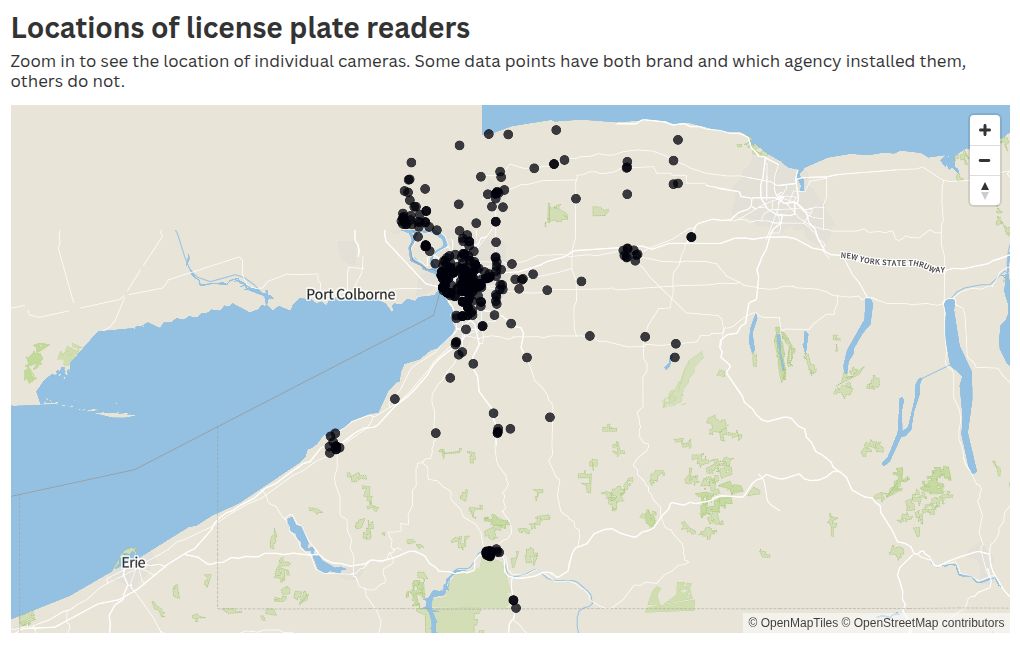
More than 100 of the license plate readers deployed in Erie County were made by Canadian firm Genetec and installed by Buffalo police. Others were made by Flock Safety, a fast-growing technology company backed by Silicon Valley funding, or Axon, the company that’s made its name selling Tasers and bodycams to police.
Garret Langley, founder and CEO of Flock, has called DeFlock’s tracking of his company’s cameras “terroristic” and similar to “antifa.” Langley, whose company has received more than $650 million in Silicon Valley funding, said the group’s “primary motivation” in identifying the locations of his company’s cameras “is chaos.”
But in response to open records requests from Investigative Post and local residents, police themselves have shared the locations of their cameras.
Buffalo police, for example, provided via a recent records request a list of where 114 Genetec cameras are located. (As Investigative Post previously reported, most are in poor zip codes on the East Side and Lower West Side.) Police in the Town of Tonawanda, West Seneca and Buffalo State University also shared the locations of their Flock cameras. The locations of the license plate readers lined up with the DeFlock map.
Paris Lewbel, a Flock Safety spokesperson, said Langley was “referring to a group of people that was purposefully putting police officers and their active cases at risk” and that his “phrasing could have been better.” He said the company aims to balance public safety with drivers’ privacy.
“We believe at Flock that privacy and safety should coexist,” Lewbel said. “We think the conversation about privacy is important. We take it seriously.”
The data shows that Erie County has the most license plate readers in Western New York. Next is Niagara County with 49, Cattaraugus County (16), Genesee County (13), Chautauqua County (12) Orleans County (10), Wyoming County (4). No data was available for Allegany County.
Police here say the license plate readers have proven to be a powerful investigative tool that enables officers to find missing vehicles and people, find shoplifters and solve other crimes.
Niagara Frontier Transportation Authority Police Chief Brian Patterson, for example, said his agency uses Flock to both find stolen cars and to assist federal investigations stemming from incidents at the airport.
“It’s another investigative tool that law enforcement agencies use to solve crime and protect citizens,” he said. “Being a law enforcement agency, we take advantage of all the technologies that we can in order to carry out what we do.”
Critics, however, say the cameras are unwarranted surveillance of the general public.
“Where you come and go is private information,” said Jonathan Manes, senior counsel at the MacArthur Justice Center, a legal advocacy organization focused on civil rights. “Even though we do these things in public, we are not all being tailed 24/7 by the police. And yet, now, it can be searched up.”
Who can view your license plate data
Data analyzed by Investigative Post found that 20 police departments in Erie and Niagara counties conducted more than 218,000 searches of the Flock network between January 2025 and June 2026.
Which police can access local Flock depends on who they share access to their network with. The entire Flock system encompasses around 6,500 individual networks of cameras operated by thousands of law enforcement agencies.
Cheektowaga, for example, shares data from its network of 31 Flock cameras with 170 other police agencies — from New York and bordering states. Cheektowaga, in turn, has access to more than 600 other Flock networks.
Amherst, which is now switching its license plate readers from Flock to Axon, shared information with 114 other police departments across New York.
The Town of Tonawanda, according to records, shares information from its 13 Flock cameras with 65 other departments and has access to three dozen.
It wasn’t immediately clear how many networks Lancaster, Kenmore and Buffalo State University share with. But records showed that Kenmore has access to Flock in 603 other jurisdictions while Buffalo State police can access Flock information from 982. Those include other colleges like the University of North Carolina Chapel Hill, Purdue University in Indiana and Temple University in Philadelphia.
Manes, the civil rights attorney, said the sharing aspect of Flock “means that a police officer in Texas, say, could … search up a license plate, and pull data about somebody’s movements in Tonawanda.”
In response to an inquiry from Investigative Post, Buffalo Police spokesperson Timothy Richards said the city’s cameras are not connected to the broader Flock network, meaning only the city’s 700 officers can see drivers’ information. Richards noted, however, that two officers “in specialized positions” have access to the Flock network and use it when “creating intelligence reports and tracking dangerous suspects of violent crimes.” Data showed those two officers made more than 3,800 searches over the past 17 months. Richards said the city does not pay to search the Flock network.
Flock drones in Lancaster
Meanwhile, the town and village of Lancaster, which share a police force, is on the verge of deploying a new Flock technology: Drones.
The two unmanned flying machines would be installed on the roofs of municipal buildings and used by officers to respond to 911 calls to assess a scene before they can arrive by squad car. The drones would record live video of the scene and then store the footage on a police server.
Village of Lancaster Trustee Gavin O’Brien has raised numerous concerns about use of the technology.
“I kind of threw a fit about it, because I figured this is something that people in the village should be able to weigh in on,” he said.
He noted that the village didn’t have a say when the town police installed Flock license plate readers in its jurisdiction.
After conversations with Flock representatives and the police, he said the company and police brass agreed to only store video recordings for 21 days instead of 30; agreed to not record video while flying to a scene, only once the device arrived at a scene; and to enable two-factor authentication so that officers couldn’t share access to the system with unauthorized users.
He said he “exercised what oversight I had” but said it was “minimal.” Use of the drones is set to begin soon. O’Brien said he still has concerns about use of the drones at all, including whether the footage will be shared with outside departments. For now, he said, the footage will not be shared.
But, he said: “I have no doubt that there is intent to make this stuff accessible, just like how their [license plate reader] stuff is accessible, to any subscribing department in the country.”
He, too, is concerned about infringements on personal privacy.
“I think you could solve a lot of crimes if police could just walk in people’s houses randomly and look around,” he said, tongue in cheek. “No warrant, just come in, search around, and if you’re clean, you’re clean.”
“In this country,” he added, “we don’t allow that.”
Lancaster police Chief William Gummo did not return a request for comment.
How much plate readers cost taxpayers
The cost of license plate readers varies. Flock leases its readers, while other companies sell their cameras.
Local police have used a variety of funding sources to pay for these cameras including local taxpayer funds, grants and federal aid given to municipalities during the pandemic.
Using pandemic aid, Buffalo bought one batch of Genetec license plate readers for $366,000. Those cameras covered 14 intersections, but the network has since expanded.
Richards declined to provide purchase orders for the cameras — he requested Investigative Post file a Freedom of Information request for those documents — but said the “majority” of the cameras were purchased with grant funding, “not city resources.”
Subscribe to our free weekly newsletters
Town of Hamburg Police Chief Peter Dienes told Investigative Post his department leases four Flock cameras at a cost of $12,000 annually.
Beginning in 2022, Cheektowaga leased 10 Flock cameras for $25,000 per year. The town now has 31, though its total current bill wasn’t immediately available. Captain Jeffrey Schmidt, a police spokesperson, declined to comment on the town’s use of Flock cameras.
The Town of Tonawanda is ending its Flock contract but has paid the company $45,000 for use of the cameras since early 2025, according to Captain David Price.
Amherst is switching its cameras from Flock to Axon, Captain Gregg Huller said. It had paid Flock $60,000 annually for 17 cameras, funded via a Gun Involved Violence Elimination (GIVE) grant from the state. Axon’s cameras are more expensive: $300,000 for 24 cameras. But the town will own those instead of lease them.
posted 1 day ago – July 17, 2026