
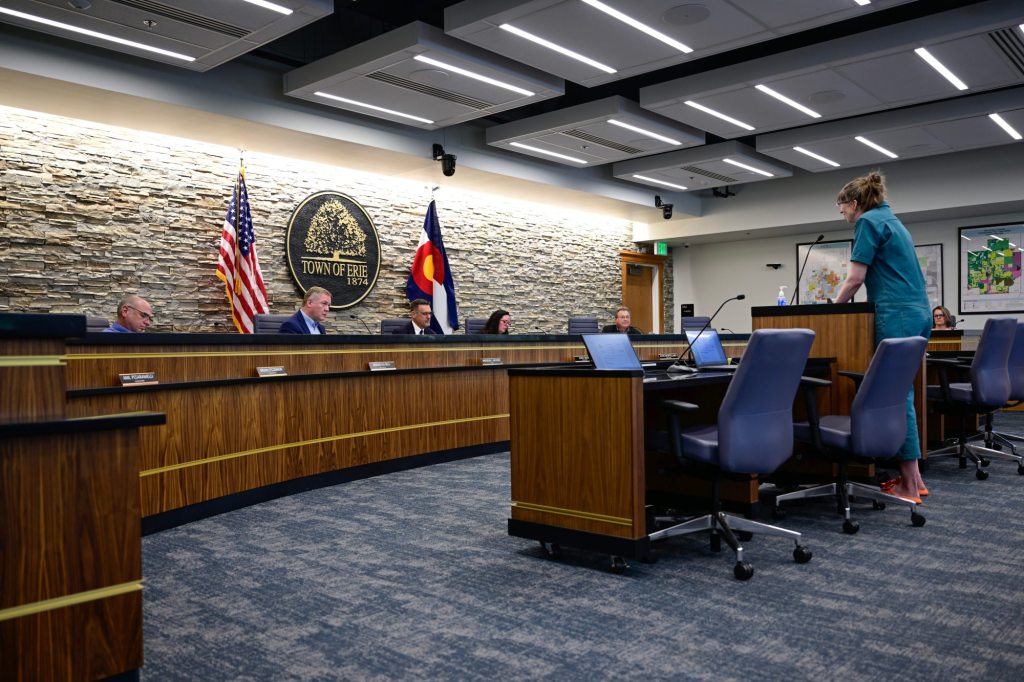
A consultant hired to negotiate Erie’s multimillion-dollar deal with oil and gas operator SM Energy Company has submitted his invoice — and is asking the town to consider paying him about $30 million. Residents have begun circulating a petition that has the potential to overturn the deal entirely.
Matt Owens of Alameda Mineral Advisors sent the invoice June 26, shortly after the Erie Town Council approved a sale of town-owned mineral rights within the drilling area for SM Energy’s planned Draco well pad.
Under the agreement with SM Energy, Erie would receive a $4.5 million cash payment; a 3% share of production revenue for the Draco project, which town officials estimated could generate more than $19 million for Erie over the next two decades; about 160 acres of land on County Line Road valued at roughly $14 million; and the plugging and abandonment of 17 wells.
According to Erie’s contract with Alameda approved in December, the consultant would only be paid if a mineral rights deal went through — receiving 7.5% of any agreement’s value, and capped at $4.5 million unless the Town Council approves a higher payment.
In a letter accompanying his invoice for $4.5 million, Owens says the approved deal’s maximum value could exceed $401 million and suggests the town increase payment above the contract’s cap due to what he called the “extraordinary and unexpected results” of his negotiation with SM Energy. Owens’ letter says that 7.5% of $401 million would settle his consulting fee at just above $30 million.
That valuation, according to the invoice, includes envisioned development on the County Line Road land and purported future tax revenue that the town has not confirmed to the Daily Camera. His estimate for the deal has been disputed as “exaggerated” and “grossly inflated” by some town leaders.
Town spokesperson Gabi Rae in June said Owens’ earlier estimate that the deal could have a value of $465 million relied on assumptions about future development that remain uncertain.
“At this point, the number is not something we would use as an accurate estimation for budgeting,” Rae previously told the Camera.
Town officials continue to evaluate the land included in the agreement with SM Energy and “will share the results of that due diligence when it is completed,” Rae said in an email last week.
Owens’ letter adds that he would “honor and accept” a decision by the town to pay him the minimum amount of $4.5 million within the contract’s “mandated 30-day period” after his invoice for that amount was submitted. That deadline would hit at the end of this week, on Sunday.
But Rae said Erie’s contract with the consultant stipulates that “no payment is made until the Town receives value from the agreement” with SM Energy. Town legal counsel has been meeting individually with council members to “discuss what the contract outlines with regard to payment to Alameda Minerals,” Rae said.
“If the Council wanted to hold a vote to go outside the bounds of those contractual stipulations, that would be a discussion and decision for Council to make as the policy makers for the Town’s budget,” Rae added.
Resident-led petition circulates
Erie residents opposed to the SM Energy deal have begun circulating a petition to give voters a chance to overturn it.
“This petition will bring the Town Council’s recent sale of the town-owned mineral rights to a public vote. By putting this issue on the ballot, every voter in Erie will have a voice in the decision of whether to sell Erie’s minerals,” resident Emily Brecht said during a Town Council meeting last week.
“People have asked me why this issue was not put to a public vote to begin with, and that’s a really good question,” added Brecht, who identified herself as a “representative for the referendum petition currently circulating in Erie.”
As of Monday afternoon, it was unclear how many residents have signed the petition thus far, or at what stage in the process the referendum currently sits.
If organizers gather signatures from 5% of the town’s registered electors — for example, about 1,480 signatures based on January data, according to a town document — the referendum could go to voters for a decision, likely through a special election in December.
“If all the requirements are met for the referendum, we expect that the Town would need to hold a Special Election in December for this topic,” Rae said. “There is a very, very slim possibility all of the pieces and parts could be completed in time to sit on the regular election, but that is not likely.”
Under the town charter, the Town Council’s ordinance approving the mineral rights deal remains in effect during the referendum process, unless the council suspends it or a court overturns it. If voters reject the ordinance through an election, the agreement with SM Energy would be “nullified,” Rae said.
For many residents, opposition to the deal has been aimed at how the mineral rights deal was negotiated, including discussion Owens and town leaders had in executive session, a type of meeting closed to the public that can be used by town officials to discuss legal matters.
Dozens showed up to public meetings with the Town Council this year to protest the deal, and more than 200 signed a June letter addressed to council members arguing that the hiring of Owens — a former executive at Civitas Resources, the oil and gas company that merged this year with SM Energy — “has undermined public trust.”
Rae said attorneys are “providing legal advice to the Council about the timing of the items in the agreement vs. what a referendum might mean,” including how it could affect payment to Owens and any transactions with SM Energy included in the agreement.