
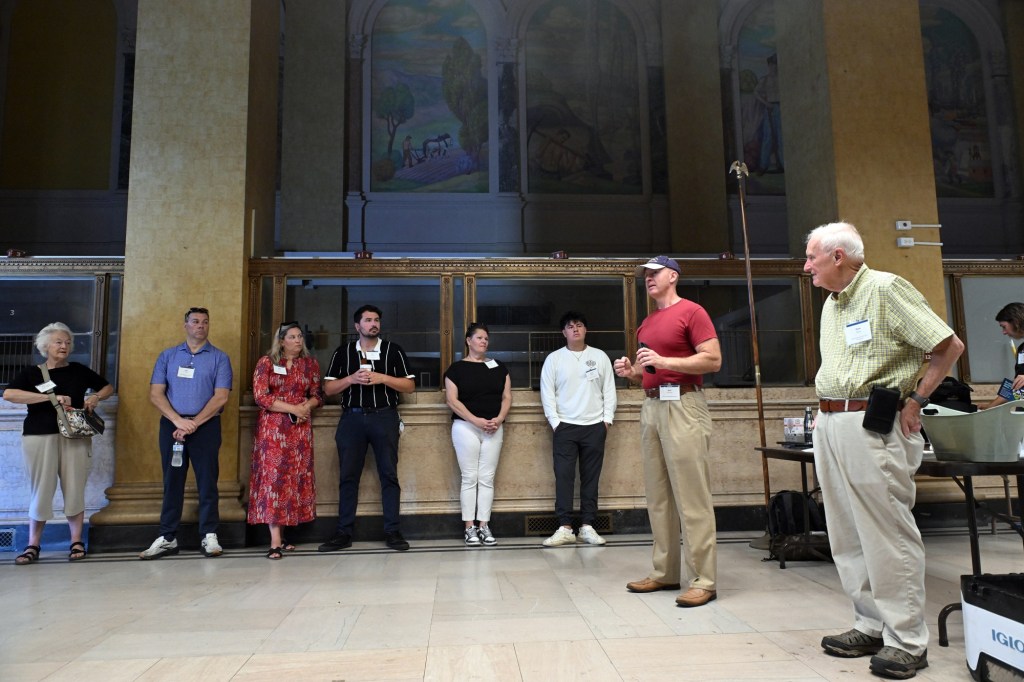
Sustainability advocates, preservationists, developers and local business leaders got a behind-the-scenes look at plans to transform two long-vacant Penn Street landmarks into housing, retail and restaurant space.
The recent tour, hosted by Green Building Alliance as part of its Resilient Reading initiative, highlighted the $52 million redevelopment planned by Shuman Development Group for two former bank buildings, 435-443 Penn St.
The buildings have stood largely vacant for more than three decades.
Alan Shuman, CEO of the development group, said his plan combines historic preservation, adaptive reuse and new construction to create about 150 residential units and 53,000 square feet of commercial space, while restoring activity to one of the city’s most recognizable intersections.
During the tour, the developer explained the challenges of adapting century-old buildings while meeting modern building codes and preserving architectural features required to qualify for federal historic preservation tax credits.
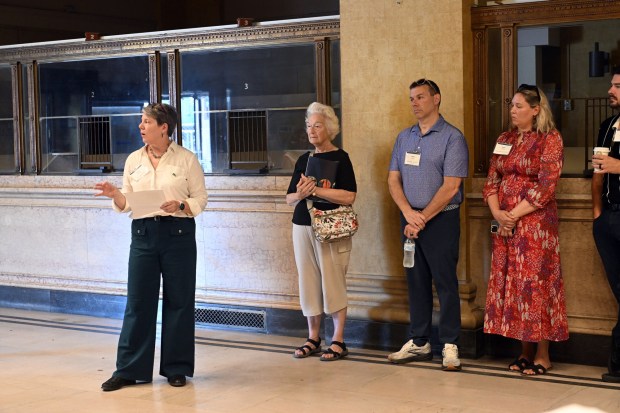 During a tour of the former Farmers Bank at Fifth and Penn streets on Tuesday, July 14, 2026, Chris Cieslak, Green Building Alliance’s chief operating officer and vice president of programs, said the organization’s Resilient Reading initiative connects local building owners with technical assistance, funding opportunities and educational resources that can make older buildings more energy efficient. (BILL UHRICH/READING EAGLE)
Chris Cieslak, Green Building Alliance’s chief operating officer and vice president of programs, said the organization’s Resilient Reading initiative connects local building owners with technical assistance, funding opportunities and educational resources that can make older buildings more energy efficient while respecting their historic character.
Rather than directing the redevelopment itself, Cieslak said the alliance’s role is to help experienced developers share their knowledge while identifying ways to integrate energy efficiency and healthy building practices into projects like Shuman’s.
The tour was intended to showcase Shuman’s redevelopment effort so other property owners and developers could learn from his experience, she said.
“Alan is definitely committed to Reading,” Cieslak said. “He has a lot of experience in Reading.”
Shuman said the project still needs zoning approvals, reviews for historic preservation tax credits, environmental surveys and other requirements before work can begin later this summer.
“We are moving forward right now with all of the behind-the-scenes paperwork,” he said, noting the redevelopment will proceed in phases.
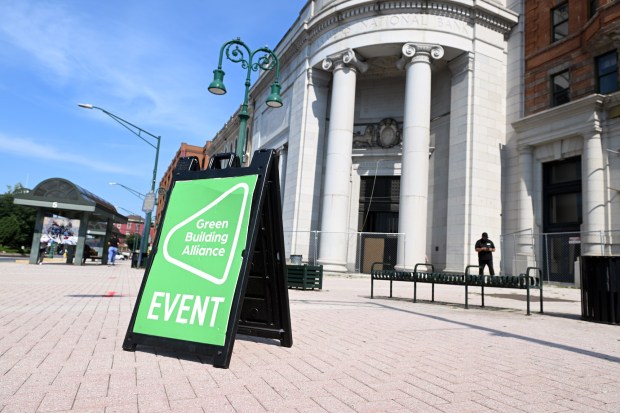 The Green Building Alliance offered a tour of the former Farmers Bank at Fifth and Penn streets that Shuman Development Group is redeveloping. (BILL UHRICH/READING EAGLE)
The first phase will focus on restoring the former Farmers National Bank building, Shuman said. The building, completed in 1925, will retain its commercial character, he said, with retail uses such as restaurants, coffee shops and other businesses. The roughly $10 million project is expected to be completed this winter.
In a separate $20 million phase, the adjacent nine-story Colonial Trust building, completed in 1903, will be converted into 54 condominium units above approximately 15,000 square feet of retail space, Shuman said.
The developer said he hopes financing for that phase will be in place by the end of the year, allowing construction to begin in 2027.
A third phase, he said, calls for a new five- to six-story building on adjacent land that would add 90 residential units and commercial space.
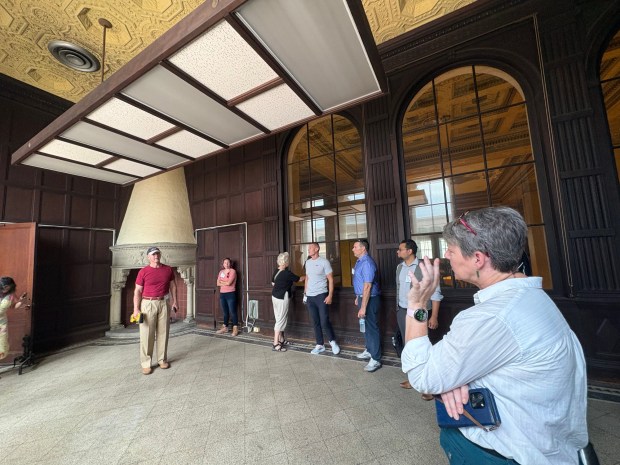 Developer Alan Shuman fields a question from Green Building Alliance Chief Operating Officer Chris Cieslak, right, during a tour of the former Farmers Bank at Fifth and Penn streets that Shuman is redeveloping. (BILL UHRICH/READING EAGLE)
Shuman said the redevelopment is intended not only to restore landmark buildings but also to spur broader reinvestment in the city’s downtown core, a vision echoed by local historian Alexa Freyman, founder of the website and Facebook page Berksiana, formerly Berks Nostalgia.
Freyman said the redevelopment demonstrates why historic preservation remains central to downtown Reading’s future.
“The buildings here on Penn Square are not just monolithic remnants of an older era,” she said. “They are the structural anchors that hold the blueprint for the modern residential and economic comeback.”
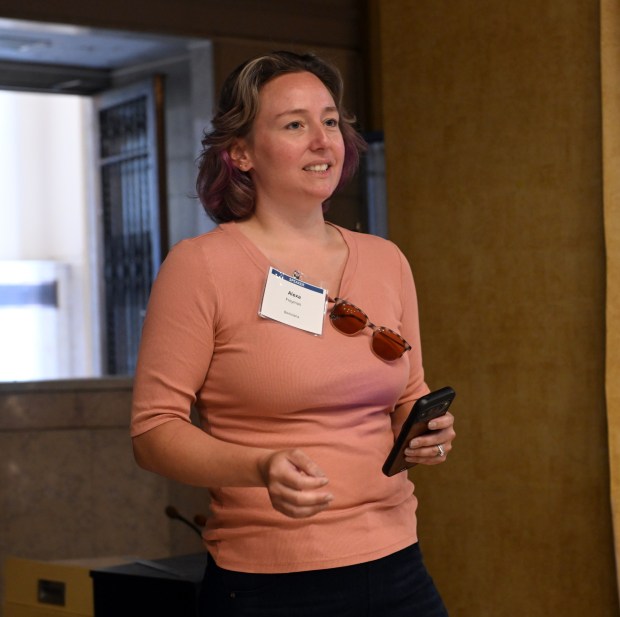 Berks historian Alexa Freyman offers some historical perspective during a tour of the former Farmers Bank at Fifth and Penn streets by the Green Building Alliance. (BILL UHRICH/READING EAGLE)
She also placed the buildings in historical context, describing Penn Square as a center of city and county commerce since the mid-1700s.
“We are standing in the most historically significant economic crossroads in not only the city of Reading but all of Berks County,” she said.
The former Farmers National Bank, she noted, traces its roots to 1814 and originally operated from a Colonial stone building on the site that hosted George Washington during an overnight visit in 1794.
As Reading grew into an industrial powerhouse in the late 19th and early 20th centuries, Freyman said, the monumental bank buildings became symbols of the city’s prosperity.
Preserving the historic buildings offers both economic and environmental benefits, she said, noting that reusing the massive masonry structures avoids demolition waste while preserving architecture that would be prohibitively expensive to replicate today.
“The greenest building is truly the one that is already built,” she said.