
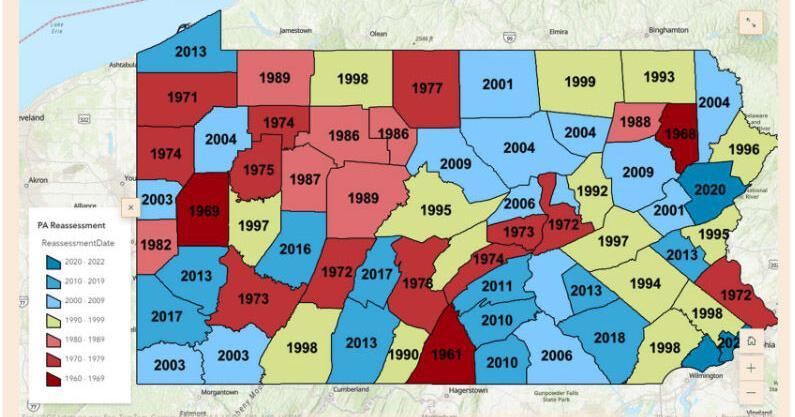
Pennsylvanians have a common response to the word “reassessment”: don’t like or want them, it’s a money grab for more taxes, it’s too costly and it’ll mess up the real estate market.
Those beliefs are not reality, according to Josh Zeyn, Tioga County’s chief assessor and past president of the Assessors’ Association of Pennsylvania.
Zeyn spoke at a June 22 press conference in Perry County calling for a predictable reassessment schedule, funding to offset the costs of reassessments and improved statewide coordination and technical assistance.
Pennsylvania is the only state in the nation without an established reassessment cycle.
“We are one of the last states with an indefinite base year system,” Zeyn said.
Delaware was the most recent state to implement a required reassessment cycle. It was forced to take action, implementing a five-year cycle following a 2020 court ruling that determined the existing system was unconstitutional.
Fairness
In Pennsylvania, property reassessments take place to update real estate values used to calculate local property taxes. Property taxes are levied by the county, township, borough and school districts. A reassessment is performed to ensure that property values reflect current market conditions and property owners are paying their fair share of taxes.
“The biggest misunderstanding about reassessments is that people believe their taxes will go up,” said Dawn Avery, a broker at Penn Oak Realty based in Wellsboro. “Part of the reason for a reassessment is to make the tax burden fair. If a property is not reassessed regularly, conditions change, Markets change. That person is not paying what they should be. It could be higher or lower; it could go either way.”
Zeyn reported on tax payments for 23 Tioga County properties that sold for $125,000 from 2017-2020 at an Oct. 3, 2024 hearing before the Senate Democratic Policy Committee. He found that those 23 properties — all selling for the same amount — had assessed values ranging from $42,000-$120,000. As a result, the county tax bill ranged from a low of $289 up to $815, a difference of $525. School district taxes, with millage rates of 16.16-19.02, had even more variance with tax bills of $735-$2,100, a difference of $1,365.
Cyclical and forced reassessments
Tioga County’s most recent reassessment went into effect in 2024. Before that, reassessments were performed in 1970, 1981, 1990 and 2001. Potter County’s last reassessment was in 1977, and has started a reassessment this year. Potter is not the oldest base year in the state. Franklin County has that distinction, conducting its last reassessment 65 years ago in 1961.
Some counties in Pennsylvania are more proactive in having reassessments conducted. Perry County has conducted three since 2000, Zeyn said. Lancaster County has adopted a resolution to conduct one every eight years, performing much of the work in-house. Tioga County commissioners have adopted a similar resolution for regular reassessment cycles.
But not conducting a reassessment has its own issues, including lawsuits that force counties to reassess.
“When counties do not do regular reassessments, sometimes they face lawsuits. Taxpayers will challenge assessments on uniformity issues. Sometimes reassessments are court ordered. That happened in Beaver and Schuylkill counties,” Zeyn said.
The date of the most recent reassessment serves as a base year that determines the baseline market value of all real estate. Taxes are calculated based on what a property was worth in that specific year, not its current market value.
Record keeping
The thing is that markets change over time, Avery said. Values fluctuate as development takes place, areas grow or lessen in popularity, demand changes for different styles of housing and changes (additions and demolitions) take place. While assessors and municipalities keep track of some of that information (new builds and demolitions), some things also slip through the cracks.
To be continued next week