
The House of Representatives passed Wednesday legislation to restrict stock trading by members of Congress, with Republican U.S. Rep. Rob Bresnahan supporting the GOP-backed bill that would also impose voter ID requirements.
The “Stop Insider Trading Act” legislation, H.R. 7008, does not amount to a complete ban on congressional stock trading, but would generally prohibit members of Congress, their spouses and their dependent children from purchasing individual stocks while in office. It would not bar members from holding or selling their existing stocks, but would require them to publicly disclose in advance their intent to sell stocks or other “covered investments.”
The bill cleared the lower chamber by a vote of 232-198, with 13 Democrats joining Bresnahan and all of his fellow House Republicans in voting for it.
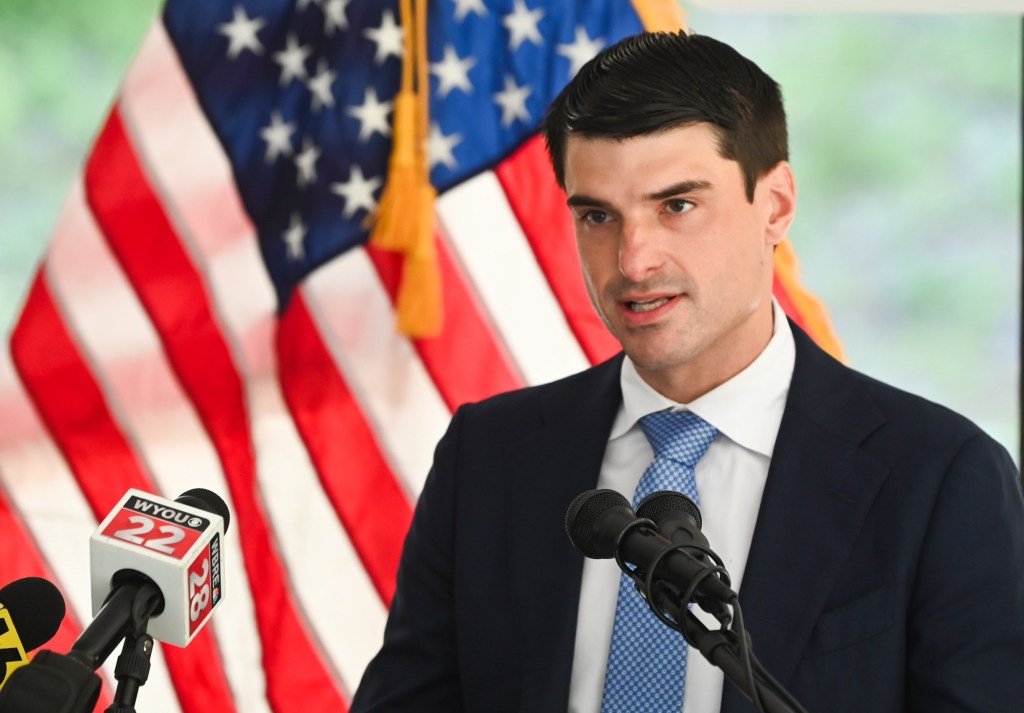
 U.S. Rep. Rob Bresnahan speaks during a press conference at Applewood Farm in Scott Twp. Tuesday, May 26, 2026. (SEAN MCKEAG / STAFF PHOTOGRAPHER)
The voter ID provisions House Republicans added to the legislation would require voters casting a ballot in an election for federal office to show a “valid physical photo identification” if voting in person, and to submit a copy of their ID or take other steps if voting by mail. It made the prospect of broad bipartisan support for the legislation, which faces an uncertain future in the Senate, all the less likely.
Elected in 2024, Bresnahan, R-8, Dallas Twp., ran on a promise to ban congressional stock trading but came under scrutiny last year when an April 2025 New York Times report identified him as “one of the most active stock traders in the freshman class.” He and his spokespeople have repeatedly said he doesn’t trade his own stocks and had no involvement in the hundreds of trades he disclosed last year.
“Members of Congress should never be allowed to trade their own stocks and profit off the information they are entrusted with; this is a belief I have held since before taking office, and this belief has not changed,” Bresnahan said in a press release. “By putting reasonable restrictions on the buying and selling of stocks and increasing penalties for violations means greater levels of transparency and a renewed commitment to serving the American people and them alone.”
Should the bill become law, members of Congress who violate it would be “assessed a fine equal to $2,000 or 10% of the value of the transaction, whichever is greater, and any net gain realized from a transaction,” per Bresnahan’s press release. He was a co-sponsor of the legislation.
Democratic Scranton Mayor Paige Gebhardt Cognetti, who is challenging Bresnahan for the 8th Congressional District seat in what’s expected to be one of the nation’s most competitive House races, has repeatedly accused him of corruption involving stock trading. An ambitious “anti-corruption” policy agenda Cognetti recently unveiled includes a congressional stock trading ban.
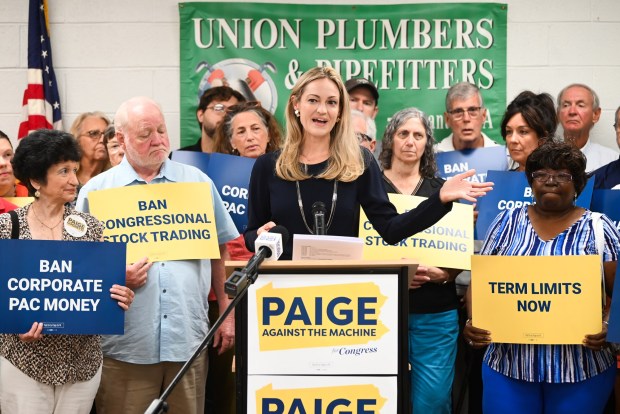 Democratic candidate for Pennsylvania’s 8th congressional district Paige Cognetti holds a press conference at the United Association Local Union 524 in Scranton Thursday, July 9, 2026. (SEAN MCKEAG. / STAFF PHOTOGRAPHER)
In a statement referencing Bresnahan’s stock-trading controversy, Cognetti said his vote Wednesday is “yet another acknowledgment from Bresnahan that he knew what he was doing was wrong and did it anyway.”
“Bresnahan won’t be able to paper over his record of public corruption,” she said. “This bill would allow him to maintain a stock portfolio worth millions, including the defense stock he purchased shortly before the first strikes in Iran and his stock in a data center provider as big corporations threaten to take advantage of our community once again. Rob, and other members of Congress, will continue to take votes where they potentially stand to financially benefit.”
Bresnahan’s press release lists several examples of his having “consistently supported banning congressional stock trading,” including other legislation he introduced or co-sponsored. Cognetti’s statement said she entered the congressional race because she “won’t sit by while politicians like Bresnahan break the public trust and use their office to enrich themselves.”
Neither Bresnahan nor Cognetti referenced the unrelated voter ID elements of the House-passed bill.
Republican U.S. Rep. Thomas Massie of Kentucky, who lost a GOP primary race in May to a Trump-backed challenger, accused Republicans of adding voter ID to the legislation to get Democrats to vote against it so Republicans can use the issue to their advantage in the midterm elections.
“If we really wanted to ban stock trading for members of Congress, we would offer stand alone legislation and could get a large bipartisan majority, and the bill would have a chance of passing on the Senate,” Massie said on social media Wednesday. “But today we have political theater cooked up by 25-year-old staffers.”
The potential fate of the “Stop Insider Trading Act” notwithstanding, the 8th District race here could have a significant impact on the balance of power in the next Congress. Bresnahan’s reelection would bolster the GOP’s chances of maintaining its House majority, while a Cognetti victory would make more likely the prospect of Democrats regaining majority control of the lower chamber for the last two years of the second Trump administration.
The nonpartisan Cook Political Report’s House Race Ratings list the local race as a “toss up,” which is how it identifies the most competitive races where either party has a good chance of winning. The 8th Congressional District includes all of Lackawanna, Wayne and Pike and parts of Luzerne and Monroe counties.