
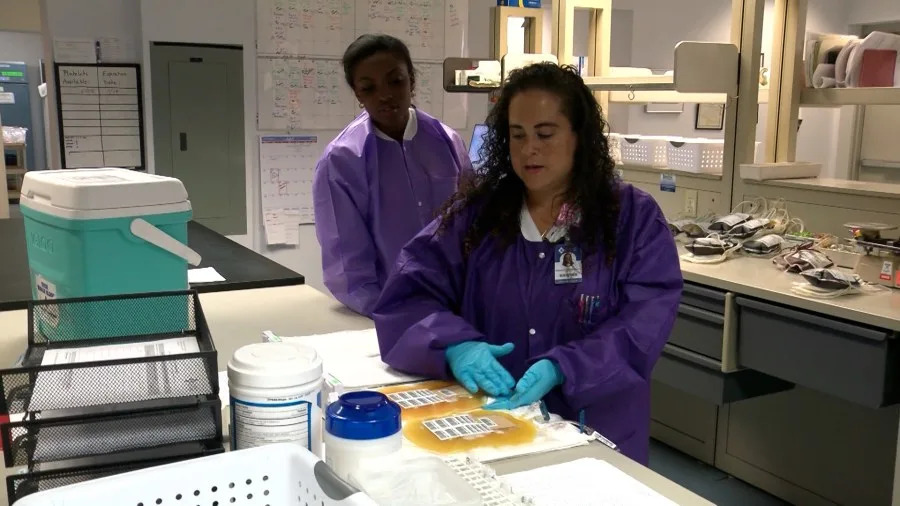
Before donated blood reaches a patient, it passes through the hands of skilled medical technicians.
Our Jade Leah Burns found out what steps are taken to make transfusions safe in this week’s Clocking In.
During a visit to the Erie Community Blood Bank (CBB), donors show up to give blood, But, where does it go after that?
Donations immediately go to the lab where a medical technologist analyzes samples that will help physicians save lives.
Before Burns worked in the lab, she had to put on the right protective apparel — lab coat, gloves and closed-toed shoes.
The majority of people give whole blood when they visit, which is mostly used in emergency situations when a person is bleeding out. But when Burns clocked in, a fresh supply of platelets needed to be processed.
“The platelets, those are for people who can clot at all, who are going through cancer treatments, burn victims, people who are having a tough time just having those proteins even,” said Demarla Eschenbach, a medical technologist for the CBB.
The first step is inspecting the color, making sure it’s in an acceptable range, and swirling.
This motion gets rid of any agitation that would cause the platelets to clump.
The samples are examined by holding them up to light, checking if there’s a clear view of the platelet swirl and no clumps.
Then it was time to be processed.
The plates are put into an analyzer machine that illuminates the sample using UV radiation, killing anything that potentially might be growing.
Once it’s done there, the product is hung up, drained and put in an extractor.
“That’s just expelling any air that we have in there. And this also is used on the other side when it comes to the red cells and plasma because it will separate,” said Eschenbach. “And then you’re going to squeeze all of those extra platelets out and air out the bag.”
The last step is modifying the final product before it enters storage ready for transfusion.
Other tasks during Burns’ shift included putting away the whole blood into storage, organizing it by types and welding tubing, which is a step in preparing units for travel.
“So now that we’ve placed the blood in here, where is it going after this?” asked Burns.
“Immediately to the hospitals there 17 in the area that we’re servicing, as well as several stat medevacs and two ambulatory services that we’re providing blood for,” replied Eschenbach.
“And we’re saving lots of lives here today,” said Burns.
Copyright 2026 Nexstar Media, Inc. All rights reserved. This material may not be published, broadcast, rewritten, or redistributed.
For the latest news, weather, sports, and streaming video, head to WJET/WFXP/YourErie.com.