
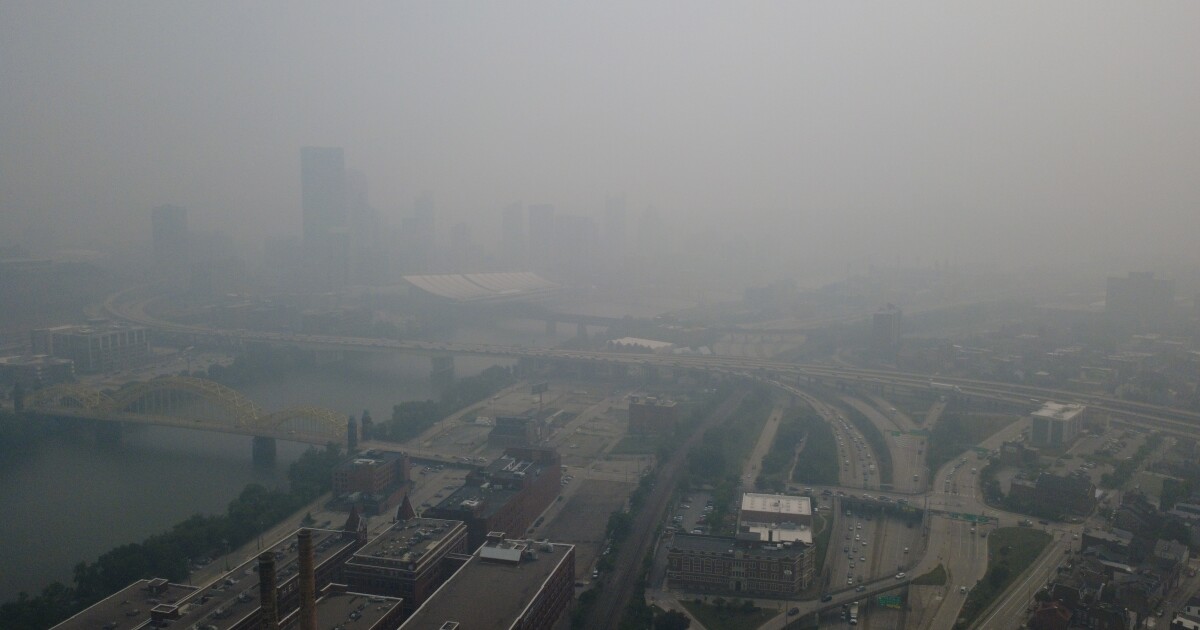
When smoke from northern wildfires pushed into the region last week, triggering a Code Maroon warning from the Allegheny County Health Department, some residents wondered if pollution levels had ever reached such levels.
The grim numbers are in, and last week’s smoke event nearly topped the air pollution charts: On Thursday, July 16, at the county’s Harrison Township monitoring station, instruments registered the second-highest level of fine particulate matter pollution Allegheny County has seen since it started measuring in 1999.
The 24-hour average for fine particulate matter, also known as PM 2.5, was 129 micrograms per cubic meter — squarely in the “Very Unhealthy” range under the U.S. Air Quality Index system.
But the highest level of fine particulate matter pollution was measured during the last severe wildfire smoke event in 2023. On June 29, 2023, the county’s Parkway East monitoring station registered a 24-hour average of 160 micrograms per cubic meter of PM 2.5, also in the “Very Unhealthy” range.
PM 2.5 pollution is made up of tiny soot particles, so small that 30 of them could fit inside the cross section of a single strand of human hair. Its size is what makes it so dangerous: The particles are small enough to penetrate deep into the lungs, and even enter the bloodstream, where they can affect other organ systems.
Acute effects of breathing wildfire smoke include respiratory symptoms, such as irritation of the airways, asthma aggravation and coughing. Long-term effects are systemic, and can result in premature death.
The 2023 wildfire smoke event also got the number three spot on the PM 2.5 ranking list, according to David Good, program manager for air monitoring at the Allegheny County Health Department.
Highest 24-hour average fine particulate matter (PM 2.5) pollution levels measured in Allegheny County since 1999June 29, 2023, 160 µg/m³, Parkway East monitor — Very UnhealthyJuly 16, 2026, 129 µg/m³, Harrison Township monitor — Very UnhealthyJune 28, 2023, 123 µg/m³, Parkway East monitor — Very Unhealthy
U.S. fire officials have raised the national wildfire preparedness level to its most severe level — level 5 out of 5 — indicating high potential for fires in multiple areas. The average preparedness level in July in recent years is 3.
An international fire assessment agency shows large swaths of the western U.S., northern Canada, and even the southern U.S. with increased potential for wildfire activity throughout July and August.