
By Michael Thomas Leibrandt
More than 235 years after his death in 1790, it’s easy to imagine Benjamin Franklin as a man constantly on the move — writing, inventing, publishing, experimenting, negotiating and helping shape a new nation.
Yet even Franklin needed a place to slow down.
The famed author, scientist, inventor and longtime Philadelphia resident appreciated William Penn’s vision of a city filled with peaceful public green spaces, where residents could escape the bustle of everyday life.
Today, that same spirit lives on at Franklin Square.
On summer evenings from June through August, the park is transformed by the dazzling Chinese Lantern Festival, when hundreds of handcrafted lanterns light up one of Philadelphia’s oldest public squares. Although the festival has been a Philadelphia tradition for just over a decade, it traces its origins to Chinese celebrations dating back thousands of years.
Franklin Square itself has an equally fascinating history.
Originally known as North East Publick Square, it was one of the five public squares included in William Penn’s original plan for Philadelphia, alongside Centre Square (now the site of City Hall), Washington Square, Rittenhouse Square and Logan Square. Penn envisioned these open spaces as the “greene countrie towne.”
The square’s purpose evolved over the centuries. In 1741, Thomas Penn allowed the land of Franklin Square to be leased to the First German Church, where it was utilized as a cemetery for nearly 3,000 people.
Franklin Square had military significance for Philadelphia as well. During the American Revolution before the capture of the city by the British — who utilized the space as a cemetery and for cattle — the Square was a vital magazine depot for ammunition for the Continental Army. It served the same vital purpose during the War of 1812 , and even as a training ground for the US Military.
In 1825, 35 years after Benjamin Franklin’s death, the square was officially renamed in his honor.
In 1975, a significant archeological dig uncovered a wall from the munitions depot building of the American Revolution, representing one of the oldest surviving structures in Philadelphia. Like many areas nearly 350 years old around Philadelphia , Franklin Square once fell into neglect. In 1915, it was purchased by the City of Philadelphia.
Franklin Square has a past with wildlife as well. In 1947, eastern gray squirrels were introduced to the park, while nearby Sassafras Street — now Race Street — was one of the largest horse-racing locations in the city.
Like many historic public spaces, Franklin Square experienced decades of decline before being revitalized. A major restoration completed in 2006 transformed the park into the vibrant destination visitors enjoy today.
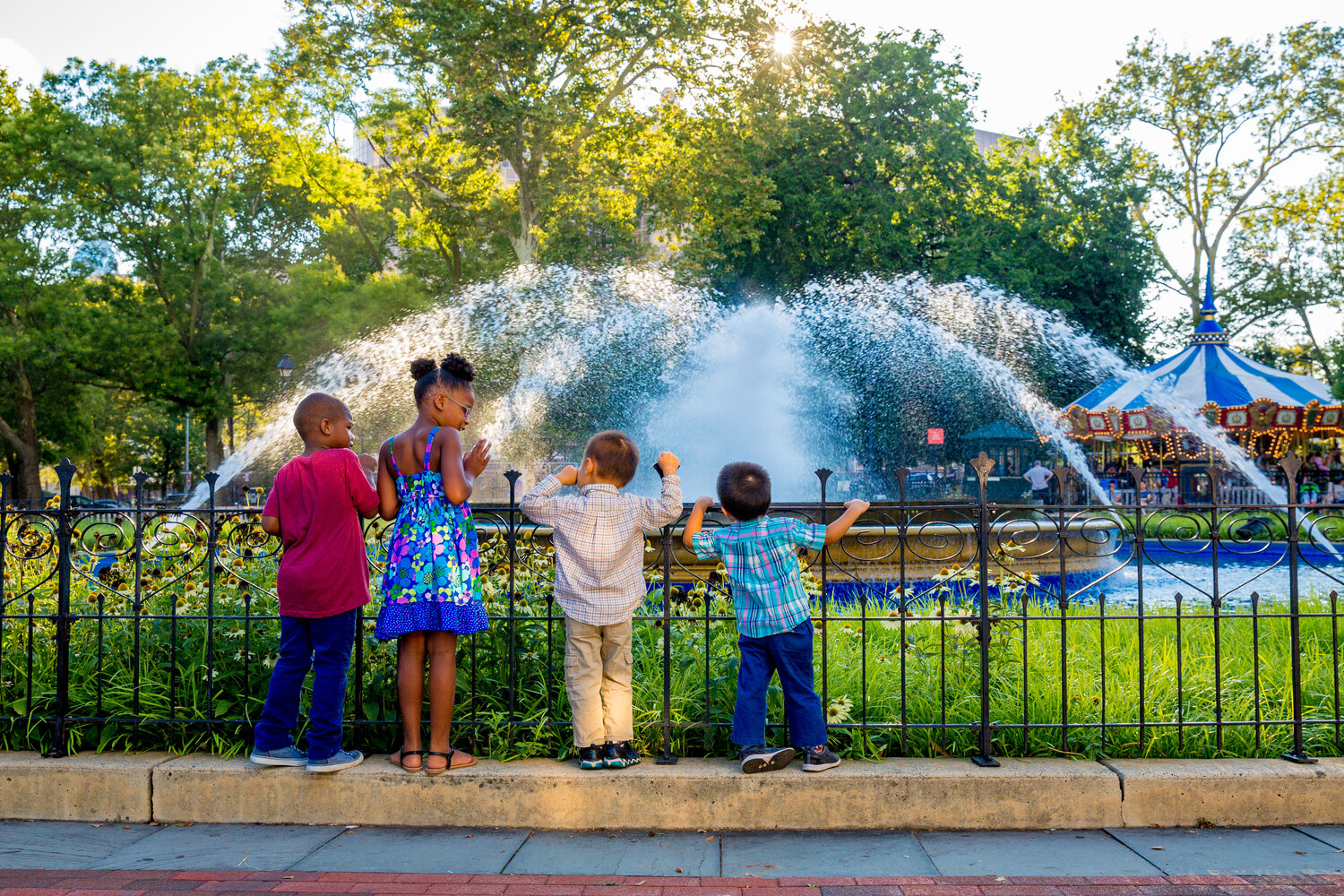
Franklin Square in Philadelphia is everything that William Penn had dreamed of. Throughout the year, Franklin Square hosts attractions and events including the Chinese Lantern Festival, the Electrical Spectacle Holiday Light Show, Chilly Philly Mini Golf, Storytime in the Square and seasonal family programming. Visitors can also enjoy Philly Mini Golf, the Parx Liberty Carousel, fountain shows and a meal at SquareBurger.
As Franklin Square celebrates 20 years since its renovation — nearly 350 years after William Penn first envisioned Philadelphia’s network of public squares — the space continues to fulfill its original purpose: offering residents and visitors a place to gather, relax and enjoy the city.
No doubt that Benjamin Franklin would have loved it today, too.
MORE: Franklin Square celebrates 20th anniversary with free birthday party
Keywords
Franklin Square,
Philadelphia,
history,
Benjamin Franklin,
William Penn