
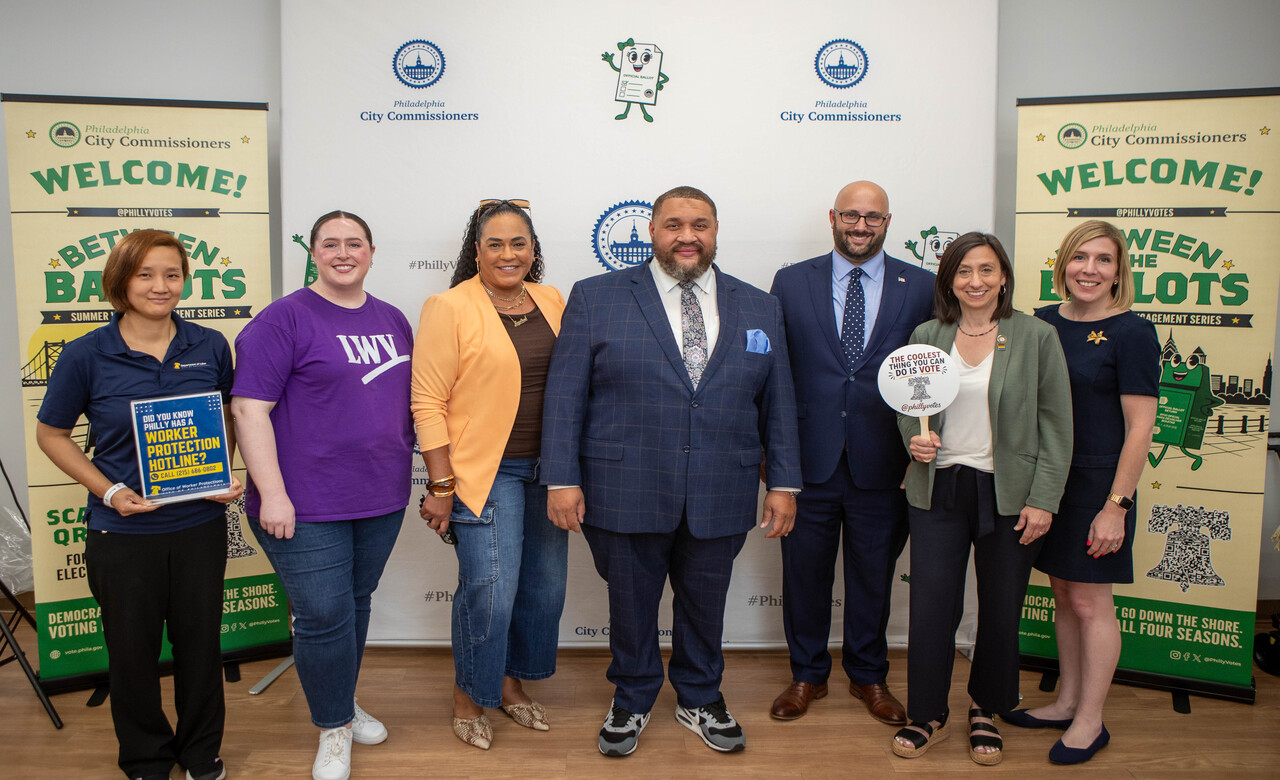
As the United States prepares for another general election that is expected to test public confidence in democratic institutions once again, Philadelphia is sending a clear message: democracy cannot be confined to Election Day. It must be cultivated year-round—in neighborhoods, among families, young people, and community organizations. With that goal in mind, the Philadelphia City Commissioners this week launched “Between the Ballots: No Days Off for Democracy,” a citywide civic engagement campaign designed to bring voter services directly into local communities.
The initiative, unveiled on July 23 and running through the end of August, comes at a particularly symbolic moment for Philadelphia. The city where the Declaration of Independence was signed and the U.S. Constitution was drafted is commemorating the 250th anniversary of the nation’s democratic founding. But city officials say the campaign is about much more than honoring history. Their message is that safeguarding democratic institutions requires informed, engaged citizens—even when there is no election underway.
The effort also reflects a broader national reality. Over the past decade, debates over election misinformation, political polarization, and declining public trust have reshaped the conversation around civic participation. Rather than focusing voter outreach exclusively in the weeks leading up to an election, Philadelphia is investing in a year-round strategy that encourages continuous engagement with residents.
The campaign officially kicked off at the Fourth District Satellite Election Office on Lancaster Avenue, where residents of all ages gathered for an event that blended music, family activities, voter education, mail ballot application assistance, voter registration services, and recruitment for paid poll workers. Organizers intentionally transformed what is often viewed as a routine government process into a neighborhood celebration designed to make civic participation more accessible and inviting.
Philadelphia City Commissioners Chairman Omar Sabir said the initiative recognizes a simple truth: elections only work because ordinary people choose to participate. His goal, he said, is to ensure that every neighborhood and every block has an opportunity to become actively involved in what he described as a secure, accessible, and trustworthy electoral system.
Political scientists have long documented the reasoning behind this approach. Research consistently shows that voter participation increases when governments reduce barriers to access and engage directly with residents. Making voter registration easier, answering questions face-to-face, and providing election resources within local communities have proven especially effective in reaching young voters, first-time participants, and historically underrepresented populations.
Commissioner Seth Bluestein reinforced that message during the launch, arguing that civic engagement should not begin and end with campaign season. In his view, democracy depends on sustained citizen participation throughout the year, which is why the City Commissioners are taking election services into neighborhoods across Philadelphia during the summer months.
The initiative also illustrates a broader shift in how public institutions approach civic engagement. Running fair and efficient elections remains essential, but officials increasingly recognize that building public trust requires maintaining an ongoing presence in the communities they serve rather than appearing only when votes are about to be cast.
Over the coming weeks, the program will travel to all ten Satellite Election Offices across Philadelphia. At each stop, residents will have opportunities to register to vote, update their voter information, apply for mail ballots, learn about paid poll worker positions, and connect with nonprofit organizations dedicated to civic education and voter participation. The events will continue through August 27 as part of the city’s preparation for the November 3, 2026 General Election.
One of the program’s defining features is its strictly nonpartisan approach. Organizers have established clear guidelines prohibiting any promotion of political candidates or parties. The objective is to expand access to the electoral process and strengthen civic participation without favoring any political viewpoint—an essential principle for preserving public confidence in the officials responsible for administering elections.
The campaign also complements Philadelphia’s broader commemoration of America’s 250th anniversary. In recent months, the city has launched several initiatives highlighting its historic role as the birthplace of American democracy, including educational programs and interactive experiences that connect the nation’s founding ideals with today’s civic challenges.
For a city that has long occupied a central place in American political history, the challenge today is to demonstrate that its democratic legacy extends far beyond museums and historic landmarks. At a time when public confidence in institutions faces growing pressures, initiatives like “Between the Ballots” serve as a reminder that democracy depends less on historic buildings than on the everyday participation of the people who sustain it.
Philadelphia’s message may resonate well beyond its own borders. City leaders argue that civic engagement should become a lasting habit rather than a temporary response to election campaigns. In an era shaped by misinformation, political polarization, and declining public trust, bringing democratic institutions directly into neighborhoods may prove just as important as administering elections that are technically sound and secure.