
Editor’s Note: This column is part of an ongoing series by Made by History and LNP | LancasterOnline to commemorate the 250-year anniversary of the signing of the Declaration of Independence. To read more about this series go here.
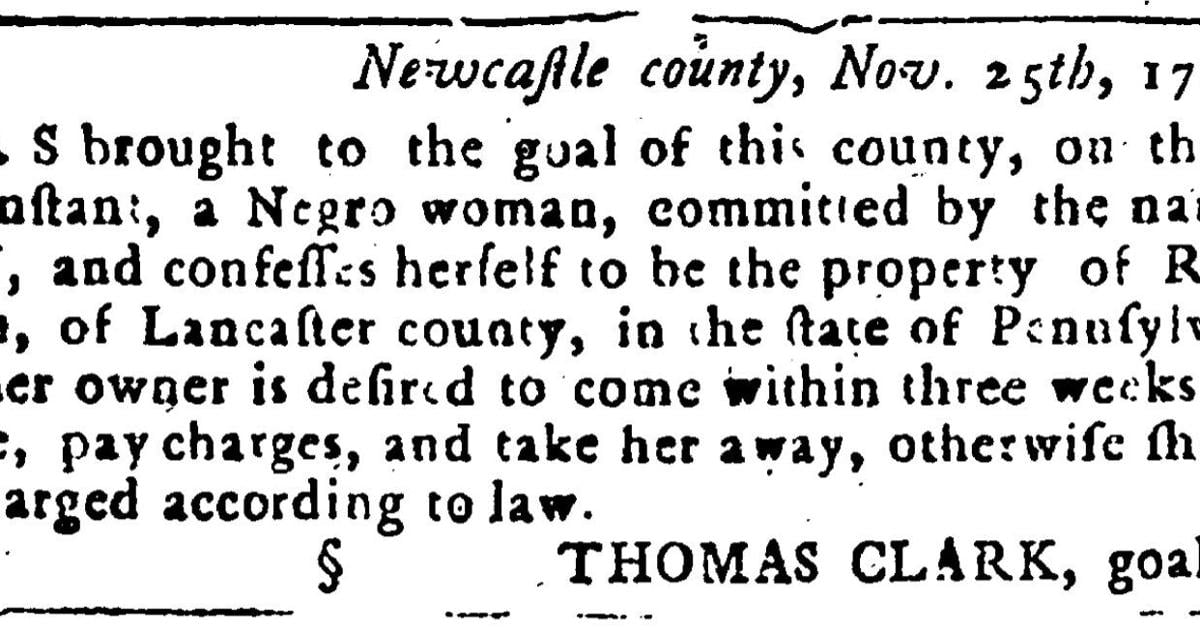
In the fall of 1780 — halfway through the American Revolution — an enslaved woman named Jenny declared her own independence. She escaped from her Lancaster County enslaver and headed southeast in search of freedom.
We know about her story because of official slave records. Earlier this year, I published “A Just and True Return: A Database of Pennsylvania’s Surviving County Slave Registrations” in collaboration with the University of Iowa’s Digital Scholarship and Publishing Studio.
It contains information about 9,000 people that has been culled from 3,500 surviving registrations of enslaved people and their unfree children.
Although the slave records suggest that cases like hers were rare, Jenny’s flight revealed how the ideas of liberty swirling around the Revolution resonated with enslaved people. Even so, the same records expose the politics of enslaved people as not always straightforward or uniform when it came to the Revolution.
The timing of Jenny’s escape was curious.
Previously in this series:
• International sport in Hershey: Not quite the sweetest place on earth
• William Parker, the Fugitive Slave Act and the Christiana Resistance
• When the Ku Klux Klan marched in Lancaster County
• The Revolution, Pa.’s German peace churches and the limits of liberty
• The making of York’s 1969 racial uprising
Earlier that year, Pennsylvania had become the first U.S. state to implement a program for the gradual abolition of slavery. The bill’s lofty preamble identified justice, duty and opportunity as reasons to aid the roughly 6,000 “persons so unhappily circumstanced” who were the objects of the legislation.
In short, 34 lawmakers declared their intention to sunder the shackles of chattel slavery within Pennsylvania just as they had sundered the shackles of political slavery with respect to Britain.
With abolition forthcoming, why then did Jenny choose to run?
A law’s limitations
One possible answer is that the law did not actually or immediately emancipate anyone.
Instead, it granted Pennsylvania enslavers until Nov. 1, 1780, to register any people they already enslaved with their county clerk. If they complied, they could continue to hold their bondspeople as property for life. If they failed to comply, those bondspeople would become free.
The law did have more immediate provisions. It banned the importation of enslaved people into the state by land or by sea. It directed that any children born to enslaved mothers after its passage would not be enslaved for life, but rather until they turned 28. It even abolished the segregated court system that had existed in Pennsylvania for nearly a century.
“An Act for the Gradual Abolition of Slavery” took concrete steps to eliminate the institution — but that did not actually help enslaved people like Jenny.
Despite the law’s limitations, and the fact that they found slavery offensive, the architects of Pennsylvania’s gradual abolition program were hostile toward women and men who attempted to emancipate themselves. The bill expressly denied “Relief or Shelter to any absconding or Runaway Negroe or Mulatto Slave or Servant,” setting aside the registration deadline and granting their enslavers five years to locate, capture, and claim them at the courthouse.
Freedom was to be meted out from above, not seized from below.
Scores flee
Jenny appears to have been on the run when the registration deadline came and went. Under the law, that had little bearing on her freedom.
On Nov. 7, 1780, Jenny was jailed in New Castle, Delaware, on suspicion of being a runaway. Records show she “confesse[d] herself to be the property of Robert Coleman, of Lancaster County.”
Yet, the records leave Jenny’s fate an open question.
Coleman did not register her in 1780, nor does she appear in any of his subsequent registrations. It is possible, then, that Jenny became free per Pennsylvania’s emancipation law due to lack of registration at the stroke of midnight on Nov. 2. If so, she was being improperly detained in the New Castle jail.
It’s unclear whether officials returned Jenny to Coleman. Even if they did, she may well have tried another escape to Delaware, which was not without precedent.
One thing we know for sure: Jenny was far from alone in fleeing despite Pennsylvania taking steps to end slavery.
Promises of freedom
Scores of Pennsylvanians attempted to secure their freedom through flight during the Revolution.
For instance, Coleman’s business associate, the ironmaster Curtis Grubb, did not bother tracking down an enslaved person named Caesar before registering him as a slave in Lancaster. Instead, Grubb chose to assert his ownership over a person he did not possess, clarifying in his paperwork that the 25-year-old skilled laborer had “runaway.”

Pennsylvania’s surviving county slave registrations and records show a dogged pursuit of life, liberty, and perhaps even happiness.
File photo
Caesar likely succeeded in obtaining his freedom. In the summer of 1782, Grubb was still searching for him, lamenting that “Caesar has been gone near three years.”
Perhaps he was among the at least 20,000 enslaved people who historians estimate made their way to British lines during the Revolution. Twice during the war, British officials promised freedom to Black people who abandoned their American enslavers.
If Caesar did make it to British lines, he would have found other Pennsylvanians there. In Bucks County, a group of six people ranging in age from five to 40 were “supposed to be in New York with the Enemy” when their enslaver, James Morgan, registered them in 1780.
Morgan was one of the proprietors of the Durham Iron Furnace, which supplied “shot and shell” to the Continental Army. By going to New York, the Durham freedom seekers not only provided material support to the British, they also set back the American war effort by withholding their labor.
Yet while enslaved people tried to ensure that they too bore the fruits of the freedom for which the colonists were fighting, not all approached the Revolution from the same political perspective.
An additional Lancaster County registration suggests the diversity of enslaved people’s politics at the time.
Twenty-four-year-old Cato, who was enslaved by William and Grace Parr, had “runaway and [was] supposed to be gone to the enemy,” either Loyalists or Redcoats. However, a second man the Parrs enslaved, 26-year-old Jack, was “at Sea on board the vessel call’d the Jolly Trooper,” a Pennsylvania brig aligned with the Patriots.
Jack was one of roughly 5,000 Black people who took up arms for the revolutionaries. Those who were enslaved hoped that that they might be rewarded with their freedom for serving. While there was no guarantee, seeking out the protection of the British Army posed serious risks as well.
While Jack sailed on behalf of the United States — either because he wanted to, or perhaps because the Parrs had volunteered him — Cato decided to cast his lot with the British. Their actions diverged, but both signaled how Black people were thinking about the cause of freedom, personal and political.
While enslaved people saw their choices constrained, the actions of Jenny, Caesar, the Durham freedom seekers, Cato and Jack reveal the great risks that Black people undertook to secure freedom during the Revolution.
Through their actions, this cohort staked a claim to the right of self-government that should have been recognizable to their revolutionary neighbors. After all, the very ideas were embedded in the Gradual Abolition Act, although Pennsylvania’s legislature subordinated them to protecting property rights.
To study the history of slavery is to study the history of a people who understood inherently the power of self-determination. Even in an archive like Pennsylvania’s surviving county slave registrations, one can glimpse the dogged pursuit of life, liberty, and perhaps even happiness.
Cory James Young is an assistant professor of history at the University of Iowa. He is at work on a book about the history of Pennsylvania slavery during the age of gradual abolition and recently published a companion website, A Just and True Return.
Success! An email has been sent to with a link to confirm list signup.
Error! There was an error processing your request.