
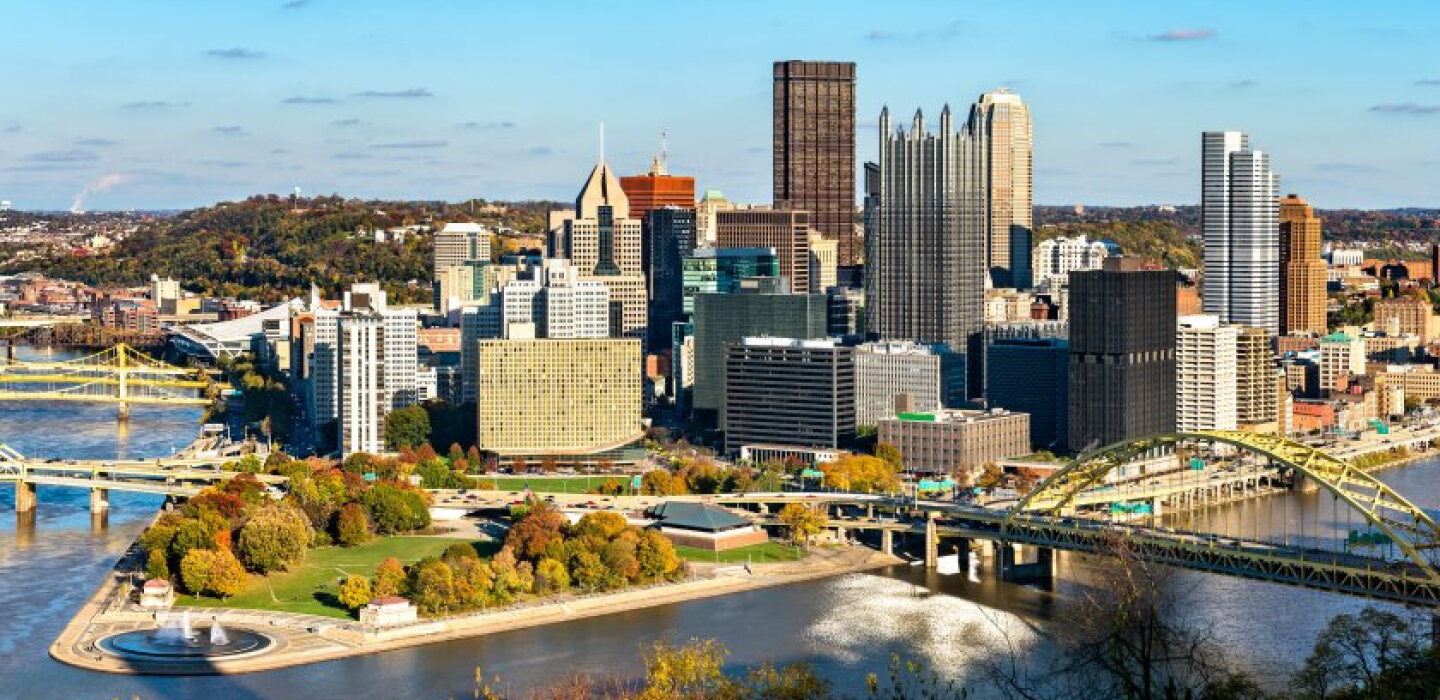
The city of Pittsburgh always seems to be in the middle of an urban revival campaign — or else brooding about the shortcomings of the last one and betting on something new.
In the early 1950s, under the autocratically powerful Mayor David Lawrence, the city government declared war on the smoke and soot that made the steelmaking city’s downtown unlivable for many residents and businesses. It also spent millions to make the central area, known as “the Golden Triangle,” a green oasis. That was called “the Pittsburgh Miracle.” But it wasn’t a panacea. Industry continued to leave and population declined to an alarming degree.
Then, beginning in the ‘70s, Pittsburgh’s leaders took advantage of the city’s plethora of excellent universities and hospitals and promoted what came to be known and admired nationally as an “eds and meds” strategy of urban revival. But the population drain continued.
In the past decade, realizing that eds and meds wasn’t the answer to everything, the charismatic Mayor Bill Peduto launched a development crusade that saw building cranes and new cultural amenities springing up throughout the center of the city.
Now, alas, downtown seems to be in trouble again. Office buildings that date back to the earlier renaissance periods are emptying out, and the downtown vacancy rate has been hovering around 20 percent. That isn’t necessarily a disaster — Austin, San Francisco and Seattle have office vacancy rates closer to 25 percent, and Pittsburgh’s 20 percent exceeds the national average by only a couple of points.
Still, the status of downtown has become a major civic issue, and — Pittsburgh being Pittsburgh — the time has come for yet another downtown renaissance. This one involves the creation of a Transit Revitalization Reinvestment District (TRID) and the use of tax increment financing to reinvigorate a downtown corridor to be energized by public transportation and the issuance of millions of dollars of investment. The goal is to jumpstart new construction and turn the Golden Triangle into the urban showplace that many of the city’s residents have always wanted it to be.
IT’S TRUE THAT DOWNTOWN PITTSBURGH has seen a lot of new building in the last decade or so. It’s also true that the city center suffers from uncomfortably narrow sidewalks, long distances between street crossings and, in many spots, inadequate lighting and an absence of places for workers and visitors to sit down and relax. There aren’t many cafés or food stands for the downtown workforce — there aren’t as many small consumer-oriented businesses of any sort as the city’s planners think downtown ought to have.
Although exact numbers are hard to come by, the TRID program, built on a 2024 vision plan approved by all major city authorities, could generate an estimated $600 million in downtown reinvestment, with about a tenth of its funding coming from state government but most of the rest generated from private sources such as bond sales.
Pittsburgh’s current mayor, Corey O’Connor, has been the program’s biggest booster. “Downtown is the economic heart of our whole region,” the mayor said earlier this year, “and we need to provide it with resources to make growth happen.” The mayor’s local allies have been equally enthusiastic.
Supporters argue that TRID will avoid the gentrification pitfalls that have bedeviled central city revival programs in other cities because the new development will largely occur in vacant office buildings, mostly converted to residential use, rather than displacing existing residents. “Downtown has millions of square feet of underused office space,” says Yarone Zober, director of redevelopment for the city’s Urban Redevelopment Authority. “These buildings will languish without public support.”
NOT EVERYONE IN TOWN is quite so happy about the idea. Of the more than $600 million projected to come into the city treasury through the TRID program, it’s estimated that about three-quarters will be plowed into downtown and two small adjoining districts. Activists in neighborhoods elsewhere in the city are asking why they won’t get a bigger piece of the pie, says Danielle Wenner, a professor at the Center for Ethics and Public Policy at Carnegie Mellon University. In the view of Wenner and a core group of local neighborhood leaders, the money is mostly going to be extracted from one central district and plowed right back into the same place.
But in the view of those who support the program, the eventual result of TRID will be a central residential neighborhood with tens of thousands of new taxpaying residents. Downtown currently provides about a quarter of the city’s real-estate-tax revenue; TRID enthusiasts believe that figure needs to be substantially higher.
Neighborhood activists dispute that the restoration of underused office buildings will be sufficient to fend off gentrification. They think that gentrification, and displacement of low- income residents, will be an inevitable component of the new central Pittsburgh that TRID is being designed to produce.
In many ways, TRID is a variant of the tax increment financing schemes that have sprouted in large American cities in the last few decades. The city government borrows money on the prospect of new development; the new development enhances the urban experience; the new projects financed with TIF money, the argument goes, more than pay for the city’s initial investment.
But TRID is a little different. It is tied more closely than most to transit improvements, which is why transit is the first word in its name. Its new infrastructure will be tied to transit stops; every trip in the transit corridor will begin or end in the downtown district; the new residents will ride public transportation to and from work or leisure activities; they will be the centerpiece of the new downtown.
THE TRID CONTROVERSY isn’t just a new chapter in Pittsburgh’s unending search for central city vitality; it is a new installment in the rivalry between the center and the periphery that has become a predictable element in present-day urban politics throughout the country. City leadership tends to alternate between politicians who promise to reinvigorate downtown and others who feel the emphasis on downtown is shortchanging neighborhoods.
Some of this is merely tactical politics. If you are running to succeed a mayor who focused attention downtown, then staking out a position as a neighborhood advocate is a good way to portray yourself as different. But much of it is ideological. If you have spent the past several years watching glitzy new buildings sprout up downtown with help from city funding, and your neighborhood remains down at the heels and devoid of new commercial and retail investment, you may have a legitimate grievance to express.
This tends to catch up with even the most successful big-city leadership. The most conspicuous early exemplar of neighborhood politics probably was Atlanta’s Maynard Jackson. After Atlanta underwent a modest center-city boom in the 1960s, Jackson vaulted into City Hall in 1974 on a campaign that stressed neglect of the neighborhoods, particularly those with big minority populations.
Chicago blossomed into a glittering center-focused metropolis under the leadership of mayors Richard M. Daley and later, Rahm Emanuel, a genuine achievement but one that left an opening for maverick candidate Lori Lightfoot, crusading in 2019 as a neighborhood activist. “We need fairness,” Lightfoot said, “which means paying as much attention to our neighborhood business as we do to the businesses downtown. Our neighborhoods have been neglected for too long. They cannot be any more.”
And in Pittsburgh, Mayor Bill Peduto, a leader of demonstrated accomplishment with a national reputation as a builder and an architect of the city’s most recent resurgence, lost his bid for reelection unexpectedly in 2021 to an underdog challenger, Ed Gainey, who complained that the mayor was neglecting too many sections of the city.
Neighborhood crusaders can be remarkably effective candidates; they tend to be less successful once in office. Lightfoot and Gainey were both voted out after a single term.
There are many reasons why this happens, but one of them stands out. Reviving a struggling city center is difficult, but to a great extent, we know how to do it: Pour tax money into downtown construction, spend on physical amenities, promote new forms of entertainment and recreation, and within a few years you have a good chance of producing something impressive. Pittsburgh has done that more than once, and is now seeking to do it again.
Neighborhoods are much different creatures. The neediest of them are largely dependent on the initiative of underclass and working-class residents, and this can prove especially hard to generate. Neighborhood retail and commercial development does not always respond very well to mayoral encouragement, even when there is money for it on the table.
Downtowns are, when you come right down to it, clusters of buildings and subsidized amenities. Work hard enough, and you can make them look and feel a lot better. Neighborhoods are aggregations of people, often people who are struggling with their day-to-day lives. One neighborhood expert, Seth Kaplan, writes that more than 36,000 Americans now live in neighborhoods that have grown poorer since 2000. He has established what he calls “a collaborative platform,” Flourishing Neighborhoods, to try to reverse that trajectory.
It’s an admirable effort. Perhaps it will succeed. But barring an influx of affluent newcomers, these places do not change rapidly or dramatically. Gainey and Lightfoot have learned that in recent years. Others are likely to learn it in the years to come.
Governing’s opinion columns reflect the views of their authors and not necessarily those of Governing’s editors or management.