
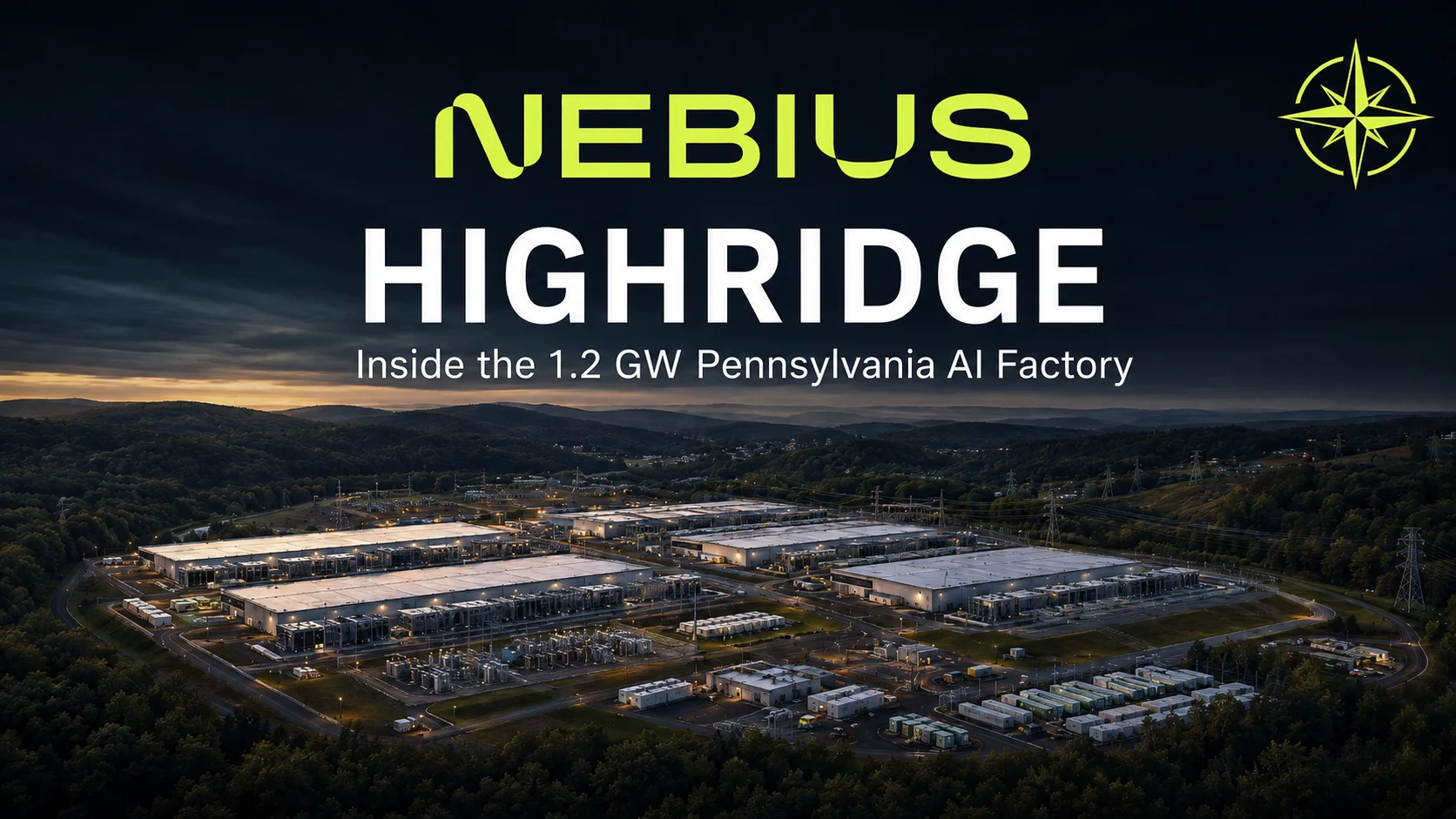
Nebius has assembled land, zoning, permits, and a utility pathway for a gigawatt-scale campus in Schuylkill County. No megawatt has been energized. Everything of consequence happens in the distance between those two facts.
The 1.2 GW Nebius Pennsylvania Headline and What Exists Today
Nebius disclosed its Pennsylvania project in May 2026 as its second owned gigawatt-scale AI factory in the United States, alongside the 1.2 GW campus underway in Independence, Missouri. The site covers roughly 600 planned acres inside Highridge Business Park in Schuylkill County, sits in PPL Electric Utilities territory, and connects to the PJM grid. Nebius reported contracted capacity above 3.5 GW in Q1 2026, with more than 75% of that total owned, and has since raised its year-end contracted-power target above 4 GW.
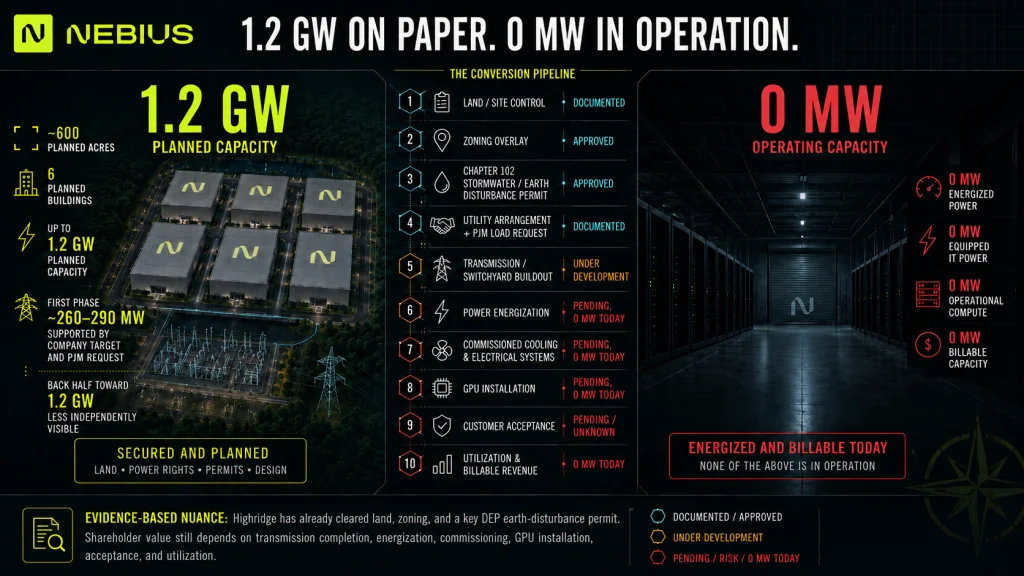
Highridge currently operates 0 MW.
Nebius can place 1.2 GW in an investor presentation today. Billing a single Pennsylvania GPU remains years away, and the distance between those two positions runs through a long sequence of physical gates that only move in one direction.
Site control leads to zoning, zoning to environmental approvals, environmental approvals to transmission construction, transmission to switchyards and substations, switchyards to energization, energization to commissioned cooling and electrical systems, commissioning to installed GPUs, GPUs to customer acceptance, and acceptance to utilization. Revenue arrives at the end. Each stage can slip independently, and a delay at any point strands every dollar committed to the stages before it.
Here is where the Pennsylvania project sits along that chain today.
StageHighridge statusContracted and secured powerUp to 1.2 GWUtility infrastructureUnder developmentEnergized power0 MWEquipped IT power0 MWOperational compute0 MWBillable revenue capacity0 MW
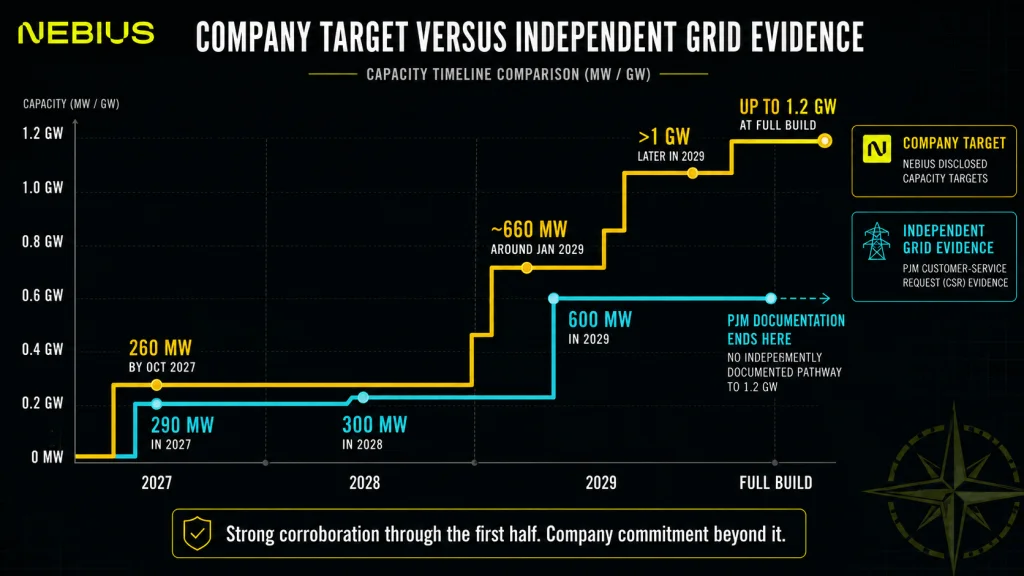
The published ramp targets 260 MW by October 2027, roughly 660 MW around January 2029, more than 1 GW later in 2029, and up to 1.2 GW at full build. Broader company guidance has framed the opening phase as a 250 MW to 350 MW range, with 260 MW standing as the most specific current target. Intermediate 2028 capacity has not been specified, and the date of full completion should be treated as open.
Two shortcuts dominate how projects like this get discussed. The first treats 1.2 GW as compute available now, which overstates the position by several years. The second dismisses the campus as a land and power announcement dressed up for investors, which ignores how many physical gates the opening phase has already cleared. Sorting between them requires walking the actual record of land, zoning, permits, and grid work, which is what the rest of this piece does.
 What Highridge Is and Why Schuylkill County
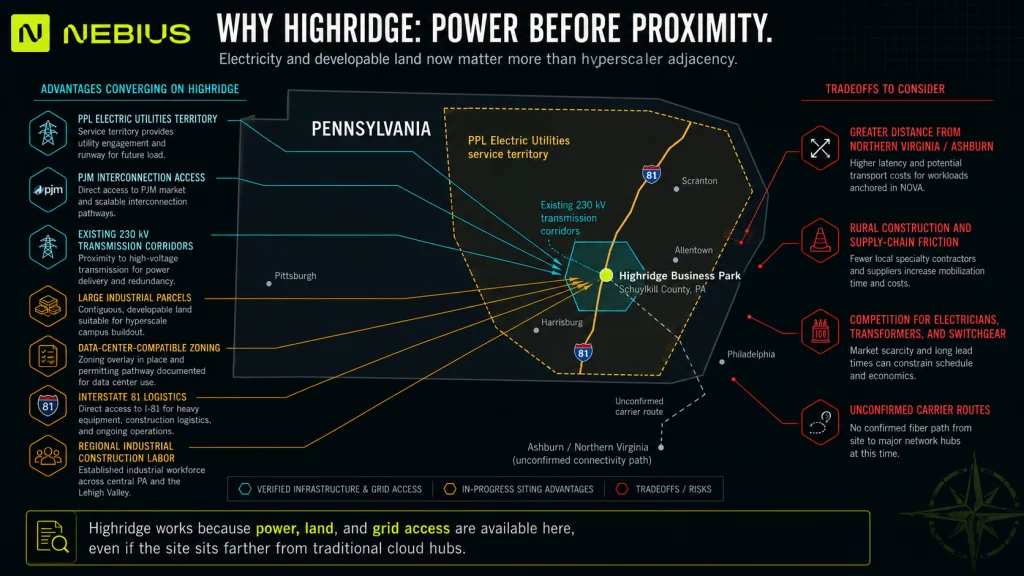
Highridge Business Park sits near the Interstate 81 interchange at Gordon Mountain Road, spanning Butler, Cass, and Foster Townships, with the Nebius development concentrated on Butler-side parcels. The park already houses operations for Walmart, Wegmans, Lowe’s, Tyson Foods, and JELD-WEN, along with a travel plaza and proximity to Schuylkill Regional Airport. Nebius is not dropping a hyperscale campus into a residential township. It is adding a very large electrical load to a corridor already organized around heavy industry, trucking, and parcels measured in the hundreds of acres.
The site itself runs to just under a square mile of planned footprint. The current concept fills it with 6 single-story data center buildings, which would work out to roughly 200 MW each at full scale, supported by large mechanical yards, high-voltage equipment, customer substations, battery storage, and setbacks sized for acoustic mitigation. Any one of those buildings would be a substantial data center on its own terms. The 6-building layout reflects a draft design and should not be read as a locked configuration.
Three characteristics separate Highridge from most capacity Nebius has used to date. The campus is purpose-built for accelerated compute, not converted from an existing warehouse. It is designed at gigawatt scale. And Nebius owns it directly, without a third-party operator in between.
The siting logic starts with electricity. Schuylkill County offers PPL service territory, PJM interconnection, transmission corridors, large industrial parcels, direct highway access, and established economic-development support. None of that makes the region a premier cloud market in any conventional sense. It makes the region available at a moment when power and land have become scarcer inputs than proximity to Ashburn.
There is a certain symmetry to the location. Schuylkill County built its economy on anthracite coal, and gigawatt-scale digital infrastructure now arriving on the same ground represents a fairly direct handoff from one energy-intensive industrial base to another. Penn State Schuylkill, the Schuylkill Technology Center, and the existing industrial construction trades give the project a plausible local labor pool, though none has been confirmed as a formal Nebius partnership.
The tradeoffs are real. Highridge sits farther from Northern Virginia than the established East Coast cluster, which lengthens some network routes, and rural construction logistics add friction. Competition for electricians, transformers, and switchgear has intensified across Pennsylvania as data center demand has grown, and Highridge draws from the same constrained pool as every other project in the state.
Secondary research asserts specific fiber corridor advantages and low-latency paths into Ashburn. We treat those as plausible geography until carrier routes are separately confirmed.
Land, Zoning, and the Entitlement Position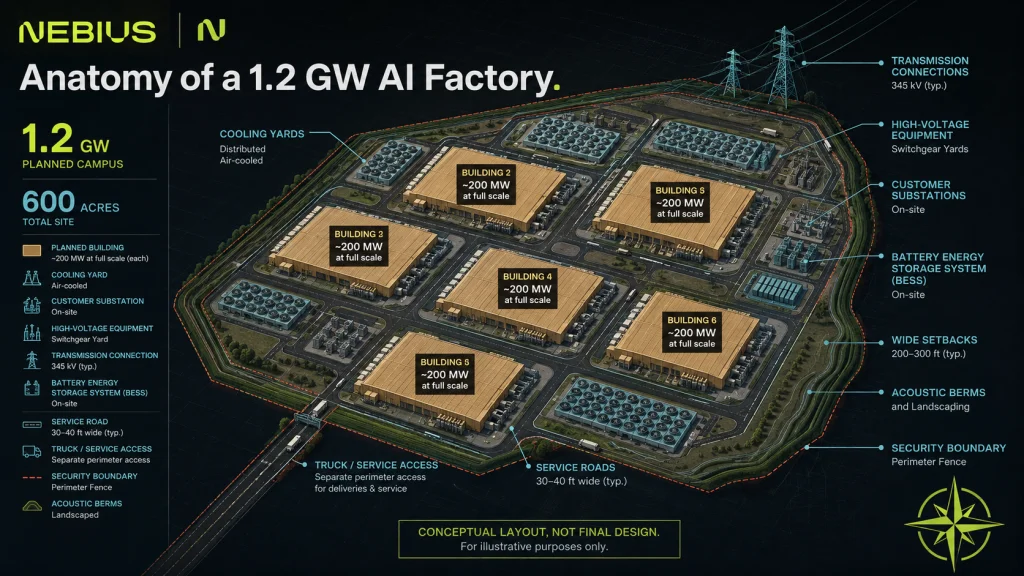
The parcel history runs through the Schuylkill Economic Development Corporation and NorthPoint Development. NorthPoint’s vehicle, NP Highridge Park LLC, held key Butler parcels following a reported March 2025 purchase from SEDCO for approximately $6 million. That trail explains why parcel databases continued showing NorthPoint well after Nebius described Highridge as an owned site.
Local and trade reporting places a major land closing around May 1, 2026 for approximately $187.5 million, though the acreage covered by that transaction remains unresolved in public records. One research path attributes roughly 358 acres to the closing, with additional parcels required to reach the 600-acre target. Another treats the full 600 acres as acquired in the single transaction. Both cannot be correct, and neither carries deed-level confirmation.
A more useful breadcrumb appears in the Pennsylvania DEP permit trail, which now names Highridge DC Propco LLC in place of NorthPoint. The entity name, timing, location, and project context make a Nebius connection highly probable, though no public filing has yet confirmed the ownership relationship.
Zoning is where the project holds a genuine structural advantage. Butler Township adopted two measures in September 2025. Ordinance 2025-3 reportedly moved relevant land from Woodland Conservation into an interchange and industrial designation. Ordinance 2025-4 created a dedicated Data Center Overlay covering 5 parcels along with an accompanying regulatory framework.
The township did not open itself to data centers generally. Officials framed the overlay as a mechanism for concentrating this category of development inside the industrial Highridge area and keeping it away from residential portions of Butler Township. Nebius therefore entered a jurisdiction that had already decided where these facilities belong, which removes the single largest source of delay in most large data center projects.
The overlay carries conditions, including buffer yards and berms, sound and traffic studies, emergency responder training, demonstrated evidence of sufficient electrical capacity, and heightened scrutiny of water-intensive cooling designs. Air-cooled and closed-loop architectures sit comfortably inside that framework, which likely shaped the campus cooling strategy from an early stage. What the overlay does not deliver is final land development approval, building permits, wetland clearances, or completed transmission.
Permitting has advanced further than an early reading of the project suggested. Pennsylvania DEP records from June 2026 list permit PAD540030, a Chapter 102 Individual NPDES permit, issued to Highridge DC Propco LLC in Butler Township. A greenfield campus of this scale cannot move dirt without stormwater and earth-disturbance controls, so this is a meaningful gate cleared.
The permit’s lineage adds something. Research traces PAD540030 back to the pre-Nebius Highridge development under NorthPoint, which means the data center project appears to inherit at least part of the environmental groundwork completed for the broader business park. Beginning from an existing permit file compresses timeline in a way that rarely shows up in headline coverage.
Environmental clearance is a different matter. Public records do not yet show the water obstruction and encroachment approvals, wetlands and water quality permits, final delineations, or endangered-species screening that a footprint of this size would typically require, and building, fire, and land development approvals remain outstanding. No project-specific PNDI receipt has surfaced, which makes species risk unknown, not absent. One parcel in the development area carries a FEMA B/X designation implying moderate flood hazard, though a single parcel says little about 600 acres, and county mapping shows wetlands and soils features that could complicate grading, utility routing, or transmission alignment.
The Power Pathway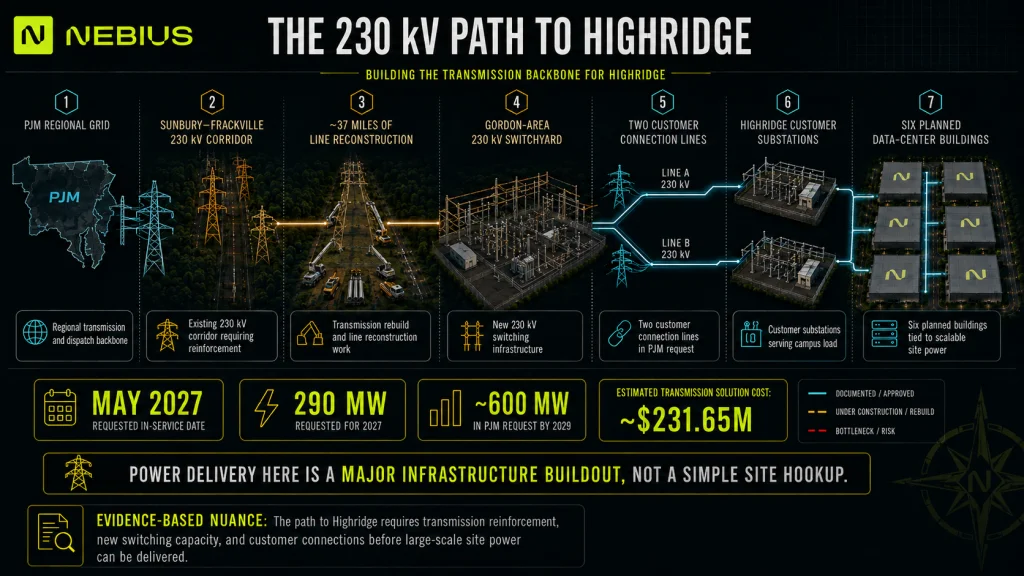
Nebius has announced up to 1.2 GW for Pennsylvania under a dedicated utility arrangement with PPL, with phased delivery beginning in 2027. That is the company’s account of the project. The more interesting evidence arrives from PJM, which documents the same load from an entirely independent direction and without any obligation to Nebius investor relations.
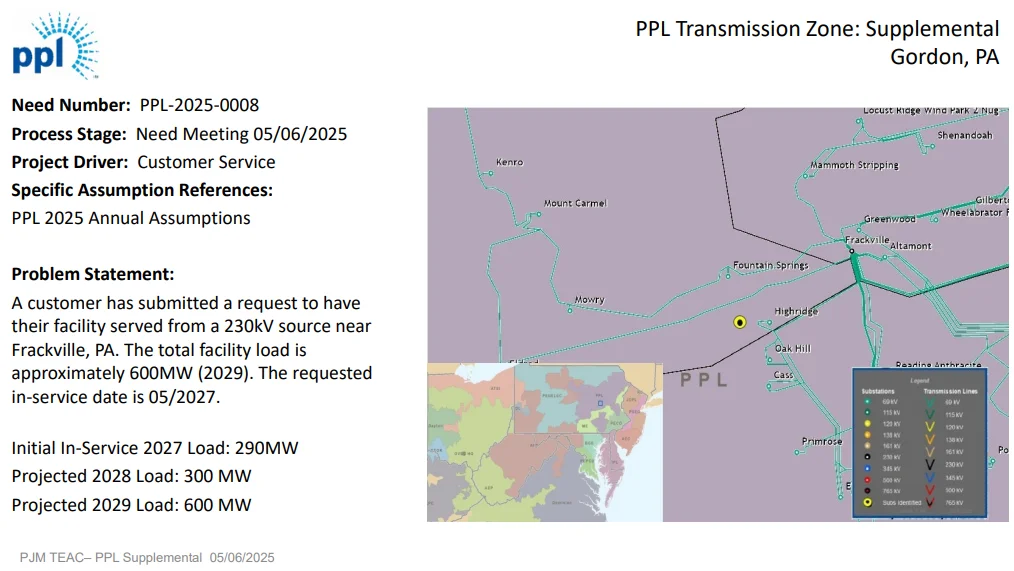
PJM records include queue item PPL-2025-0008, a customer service request located in Gordon, Pennsylvania near Frackville, requesting 230 kV service with a May 2027 in-service date. The requested facility load ramps from 290 MW in 2027 to 300 MW in 2028 and 600 MW in 2029, with PJM describing total facility load around 600 MW by the end of that period.
Set against the company’s own targets, the overlap is close enough to be difficult to dismiss.
MilestoneNebius targetPJM customer request2027260 MW by October290 MW2028Not specified300 MW2029660 MW by January600 MWFull buildUp to 1.2 GWNot documented
Location, scale, and timing all align. Neither Nebius, PPL, nor PJM has publicly named the customer, which makes the Gordon request strongly consistent with Highridge and almost certainly associated with it, short of formal identification.
The physical work behind that request is substantial. The pathway requires a new Gordon-area 230 kV switchyard, transmission yard construction, customer connection lines, and upgrades around Frackville, Eldred, and Sunbury. PPL has separately stated plans to rebuild approximately 37 miles of the existing Sunbury-Frackville 230 kV transmission line to support rising demand including a new customer facility, and research references 2 new 230 kV connections tied to the Butler-area load.
The PJM solution discussed during project development carried an estimated transmission cost near $231.65 million. That number is worth sitting with. Delivering electricity to Highridge costs more than the ground the campus sits on, and utilities do not develop regional transmission at that scale against speculative load.
 The Record Predates the Announcement
Nebius disclosed the Pennsylvania project in May 2026. The Gordon load request reached PJM’s advisory committee on May 6, 2025, a full year earlier.
Working backward from that date produces a sequence worth laying out, since it reframes what the announcement actually was.
DateEventWhere it was visibleMarch 2025NorthPoint vehicle reportedly acquires key Butler parcels from SEDCO for approximately $6 millionCounty property recordsMay 2025PPL brings a 600 MW Gordon load request to PJM’s advisory committeePJM TEAC filingSeptember 2025Butler Township rezones the land and adopts a Data Center OverlayTownship ordinancesMay 2026Land closing reported near $187.5 millionLocal and trade reportingMay 2026Nebius publicly discloses the Pennsylvania projectCompany disclosureJune 2026Chapter 102 NPDES permit issued to Highridge DC Propco LLCPennsylvania DEP records
By the time the company said anything, the land was assembled and closed, the township had rezoned the ground and written a data center framework around it, and the utility had carried a 600 MW request through the opening stage of PJM’s regional planning process. The announcement disclosed groundwork that was already finished.
That pattern is useful well beyond this project. Utility filings and municipal ordinances are public, searchable, and roughly a year ahead of corporate disclosure, which makes them the earliest reliable place to check whether an infrastructure company is building what it claims to be building. Anyone tracking this sector can watch grid paperwork instead of waiting for press releases.
The sequence also puts a clock on the near term. PPL requested a May 2027 in-service date back in May 2025, a 24-month lead time of which roughly 15 months have already elapsed. Nebius targets 260 MW by October 2027, about 5 months after the requested utility date, and that spacing is roughly what commissioning, GPU installation, and customer acceptance would consume. The ramp has an internal consistency the headline capacity numbers do not reveal on their own.
 The First 600 MW and the Second 600 MW
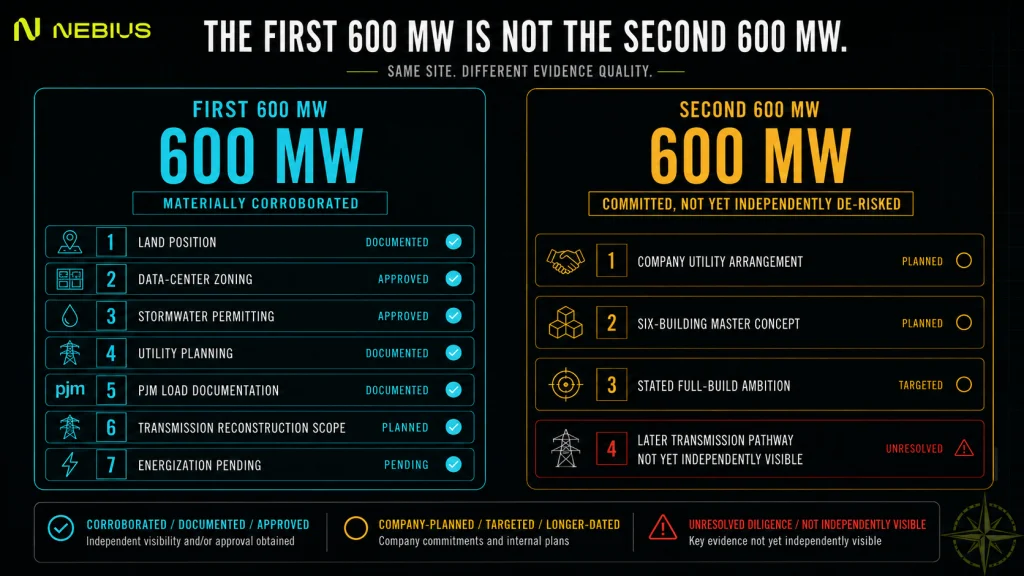
Walking the record back through in sequence produces a hierarchy across the campus, and the split falls almost exactly in the middle.
The opening phase of roughly 260 MW to 290 MW carries the strongest visibility. Nebius has published an explicit target, PJM documents a closely matching load request, the 2027 timeline is consistent across both sources, and an actual grid project is under construction to serve it. Land, zoning, and stormwater permitting are behind it.
The 600 MW to 660 MW threshold is materially supported. PJM explicitly models 600 MW by 2029, Nebius targets approximately 660 MW around the start of that year, and the transmission work required to deliver that load is a live PPL project with published scope.
The final increment toward 1.2 GW rests on company commitment. Nebius holds the power arrangement and has articulated the full ambition through a 6-building master concept and a stated target above 1 GW by November 2029. The PJM documentation surfaced to date models roughly half of that total.
The public record independently de-risks the first half of Highridge far more thoroughly than the second.
That does not make the back half fictional. Nebius holds a utility arrangement covering the full 1.2 GW, and later transmission phases may simply not have reached public planning documents yet. Evidence quality nonetheless differs sharply across the two halves, and any model of the campus should apply different confidence to each.
The first 600 MW has cleared land, zoning, environmental permitting, utility planning, PJM load documentation, and transmission scoping, with energization pending. The second 600 MW has site vision, a company power commitment, and a master plan, with the grid pathway not yet independently visible.
Design, Cooling, and Local Constraints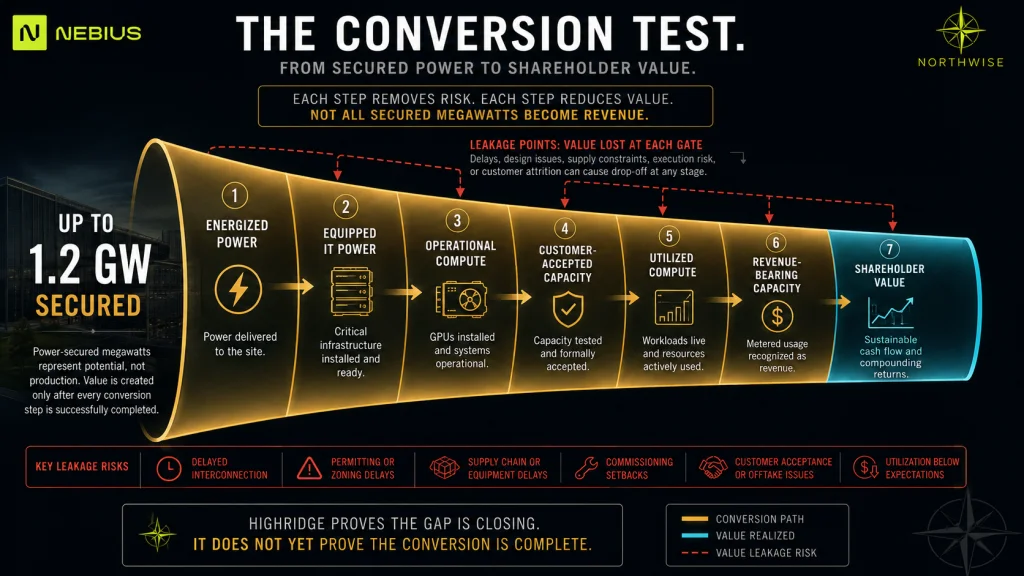
The current concept describes a facility purpose-built for accelerated compute: 6 single-story buildings, large mechanical yards, substantial substation infrastructure, closed-loop cooling, battery storage, and high rack density relative to conventional data centers.
Single-story construction fits the engineering problem. Dense AI racks impose heavy floor loads, require large cooling distribution systems, demand substantial power distribution, benefit from short networking paths, and need generous service access. A flat layout simplifies all of it. That reasoning describes what facilities of this type generally require and is not a rationale Nebius has publicly disclosed.
Several technical details circulating in secondary research go well beyond what has been established for the site. Rack densities in the 40 kW to 100 kW range, overhead busway configurations, InfiniBand fabric, specific cold-plate layouts, diesel backup architecture, and a 1.15 site PUE are all reasonable expectations for a modern AI campus, and none is a confirmed Highridge specification.
Cooling strategy points toward air cooling with liquid capability, running closed-loop to minimize consumptive water use. Nebius has compared expected operational water requirements to ordinary commercial uses on the basis that the system recirculates after initial fill. The company has not disclosed a final site water balance, a WUE target, a gallons-per-day figure, or a site PUE, and one research source indicating municipal supply from the Schuylkill County Municipal Authority remains an open diligence item.
Noise mitigation runs through quieter fan systems, acoustic barriers, equipment placement, terrain buffering, and setbacks, with research referencing a 75 dBA property-line threshold as the governing local design constraint.
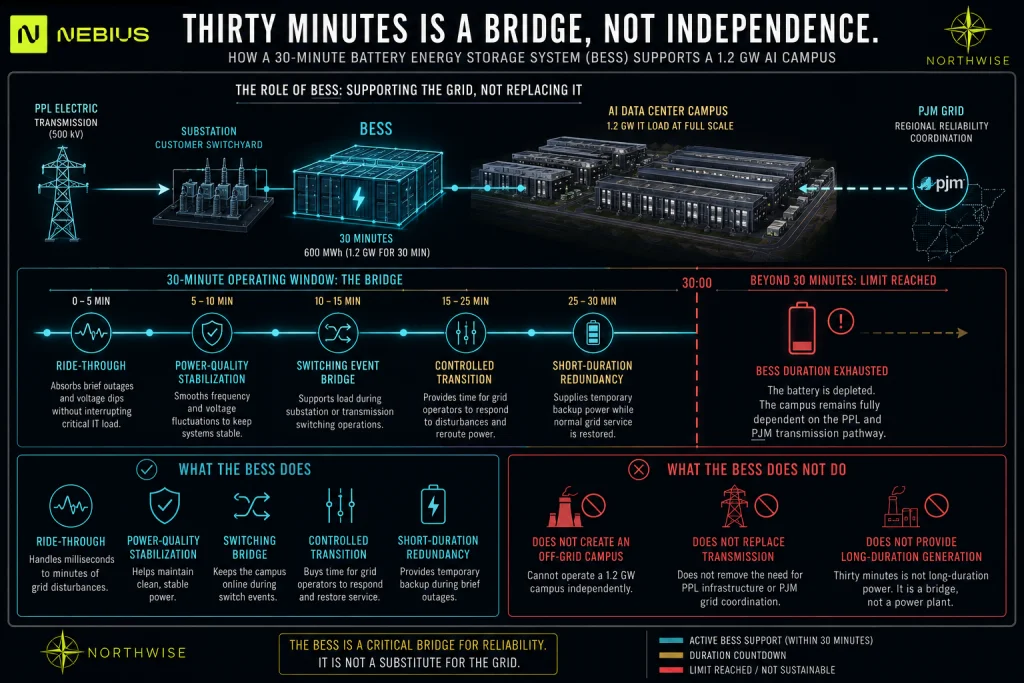
The battery system deserves precision. Site design indicates a BESS capable of roughly 30 minutes of backup or redundant power, supporting short-duration ride-through, power quality stabilization, bridging during switching events, and controlled transitions through grid disturbances. Half an hour of storage does not create an off-grid campus.
No Pennsylvania-specific behind-the-meter generation, site PPA, dedicated gas plant, nuclear agreement, or fuel cell system has been confirmed. Highridge therefore depends entirely on the PPL and PJM pathway, which separates it from several large U.S. AI campuses pursuing co-located generation and concentrates the project’s execution risk squarely on the transmission timeline.
 Who Uses the Capacity
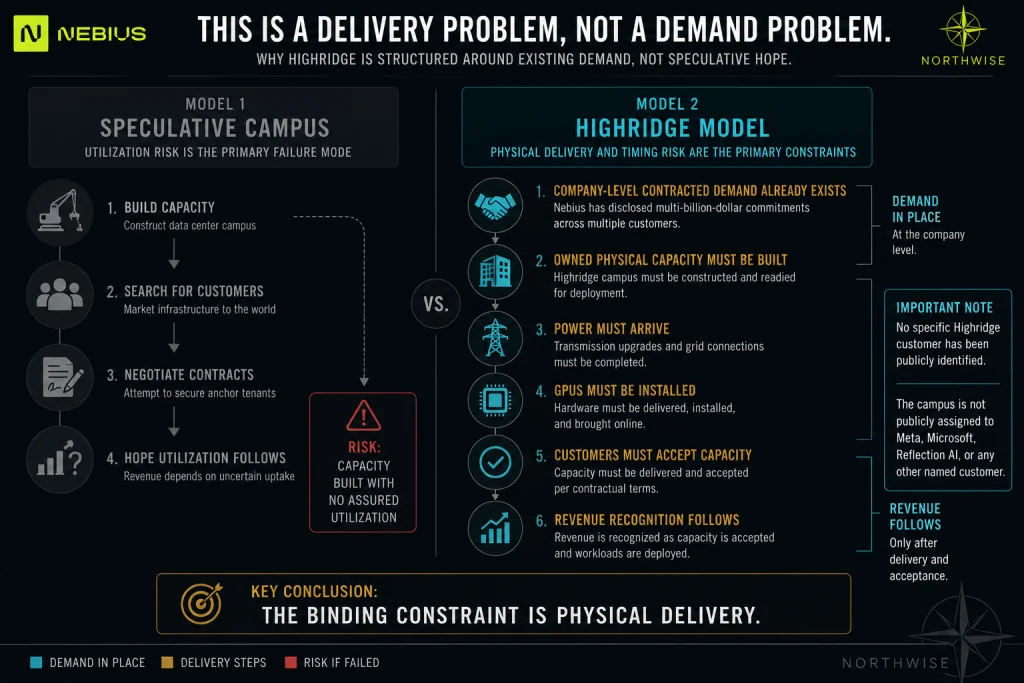
No Highridge customer has been publicly identified, and any analysis assigning the Pennsylvania campus to a named counterparty is inference.
At the company level, Nebius holds substantial contracted demand across hyperscale, AI-native, and enterprise customers, including relationships with Meta, Microsoft, and Reflection AI. The Meta agreement alone is worth up to approximately $27 billion across 5 years. Capacity of that magnitude has to be physically delivered somewhere, and Nebius needs large owned footprints to fulfill it, though connecting that logic directly to Highridge is a leap the public evidence does not support.
The campus could reasonably serve large-scale model training, fine-tuning, high-throughput inference, reserved capacity commitments, and general Nebius AI Cloud demand. Those describe intended use, which sits well short of a customer assignment.
The distinction reshapes the risk profile considerably. Nebius is not searching for tenants to justify a speculative gigawatt campus. Contracted demand at the company level already exceeds what Highridge would supply, which makes the binding question whether physical infrastructure arrives in time to monetize agreements that already exist. That is a delivery problem, and delivery problems fail differently than demand problems.
 Ownership, Missouri, and the Capital Question
Nebius entered the AI infrastructure cycle strong on the software side and thin on the physical side. It had a mature cloud platform, deep engineering heritage, GPU orchestration capability, developer tooling, and customer relationships. What it lacked relative to power-first competitors was owned infrastructure at scale.
Our existing framework on this sector holds that IREN owns the physical layer, Nebius owns more of the software layer, and both are moving toward the middle. Highridge is Nebius moving toward the physical side at a scale that changes the company’s structural position.
The owned footprint now includes Independence, Missouri at approximately 1.2 GW planned, Pennsylvania at up to 1.2 GW, and a 310 MW location in Finland, with more than 75% of contracted power owned as of Q1 2026. Missouri broke ground in May 2026 and appears physically further along. The 2 U.S. campuses together represent 2.4 GW of planned owned AI-factory capacity, a hyperscale footprint by any reasonable definition.
Ownership buys control over deployment schedule, electrical architecture, cooling design, rack density, and hardware refresh cadence, which compounds meaningfully across a decade of GPU generations. It also imports capital intensity, construction exposure, permitting risk, and grid dependency that a leasing model pushes onto somebody else. Highridge tests whether Nebius can carry that burden repeatedly, across multiple concurrent gigawatt projects, without the schedule slipping.
Capital is where the test gets expensive. Company-wide 2026 capex guidance sits near $20 billion to $25 billion, covering GPUs, servers, networking, data centers, electrical infrastructure, cooling, and expansion across every site. No Pennsylvania-specific budget has been disclosed, and manufacturing one would be an invention.
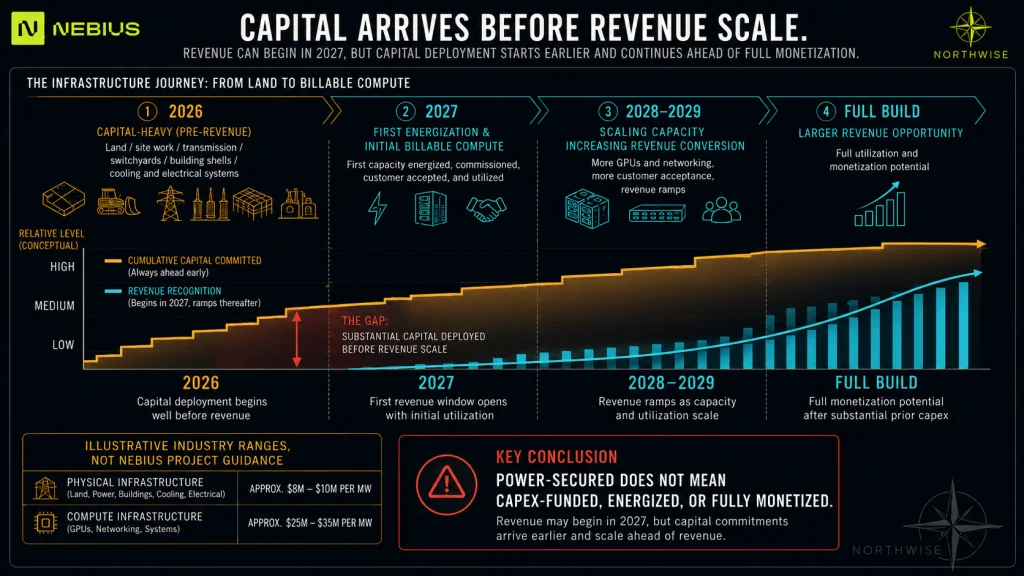
Industry benchmarks give a sense of scale without pretending to precision. Physical infrastructure for AI campuses generally runs $8 million to $10 million per MW, with compute adding $25 million to $35 million per MW. Applied across 1.2 GW, those benchmarks produce figures in the tens of billions. They are not Nebius guidance and should not be treated as a project budget, though they do clarify why gigawatt announcements are capital events long before they are real estate events.
Funding channels at the company level include operating cash flow, corporate cash, customer contracts and prepayments, equity, corporate debt, GPU and asset-backed financing, and strategic capital from NVIDIA, with research referencing a $775 million secured facility backed by GPU assets. All of that is company-level resource rather than Pennsylvania-specific financing.
The campus is power-secured and nowhere close to capex-free. Owning infrastructure improves long-run unit economics only when construction can be funded without damaging shareholder economics along the way, and that condition holds only when energization keeps pace with spending.
What Can Break the Ramp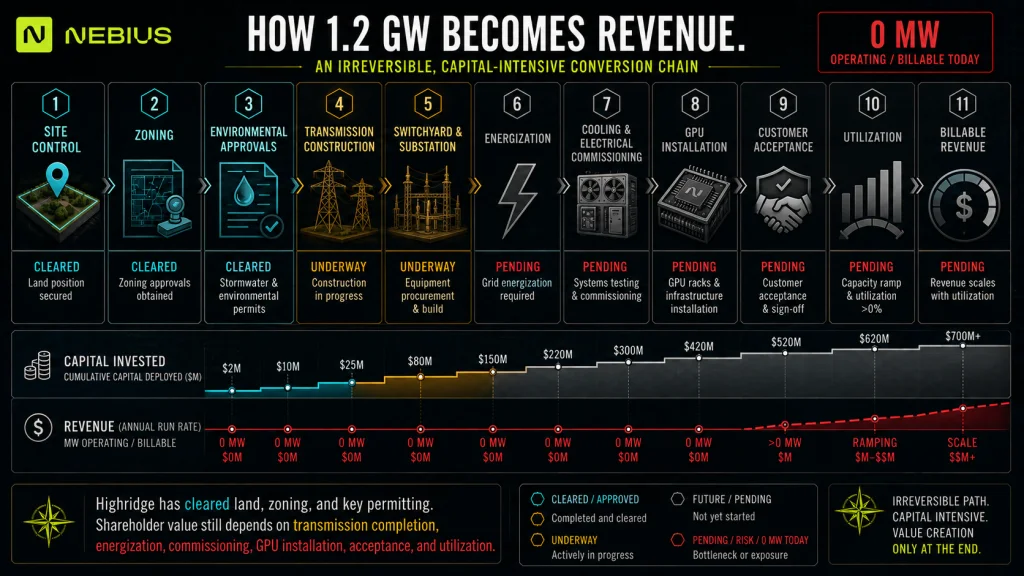
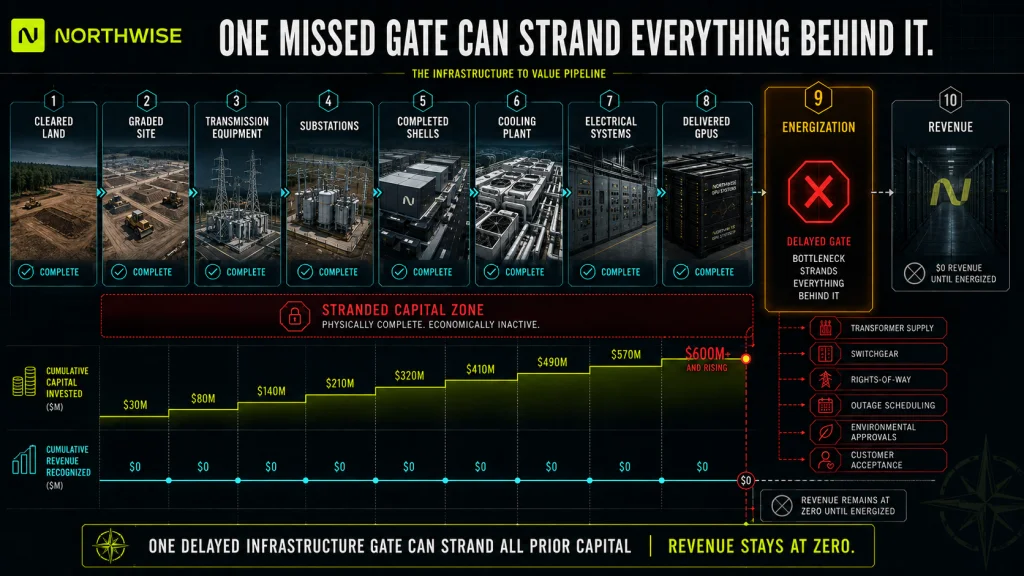
Transmission timing is the highest-impact risk on the board. PPL’s work is a real project with published scope, though 230 kV schedules are exposed to permitting, right-of-way acquisition, construction sequencing, outage windows, transformer availability, and switchgear lead times. Rebuilding 37 miles of line is a linear construction project across populated terrain, and those do not compress well under pressure.
Long-lead equipment supply compounds it. High-voltage transformers and switchgear remain globally constrained, and a campus can be fully constructed and still unable to energize. Shells, cooling systems, and electrical plant are sunk capital producing nothing at all until power arrives.
Full 1.2 GW delivery depends on transmission capacity, equipment, and grid work beyond what public documentation currently covers, along with sustained capital access. Remaining environmental gates include wetlands, streams, floodways, species screening, local site plan approvals, and building permits.
Community response is a factor without yet being a legal one. More than 75 residents reportedly attended the 2025 Butler Township hearing, raising concerns about forest clearing, water use, noise, and whether facilities of this type belong in the area. No Pennsylvania-specific legal challenge has surfaced. Opposition and litigation are different things, and neither the presence of one nor the absence of the other should be overread.
Capex sequencing introduces a tension with no clean solution. Nebius has to order GPUs far enough ahead to fill halls on schedule and late enough to avoid hardware depreciating in a warehouse. Committing compute too early against a slipping site pushes equipment into service later in its economic life, degrading returns on the single most expensive component of the build. Large hyperscale agreements sharpen this further by making contract timing and capacity readiness mutually dependent.
The absence of disclosed PUE and WUE targets limits what can be modeled at all. Without those figures, gross site MW cannot be translated into net IT MW with any precision, which constrains any revenue density estimate built on the campus.
What to Watch and What Remains Unknown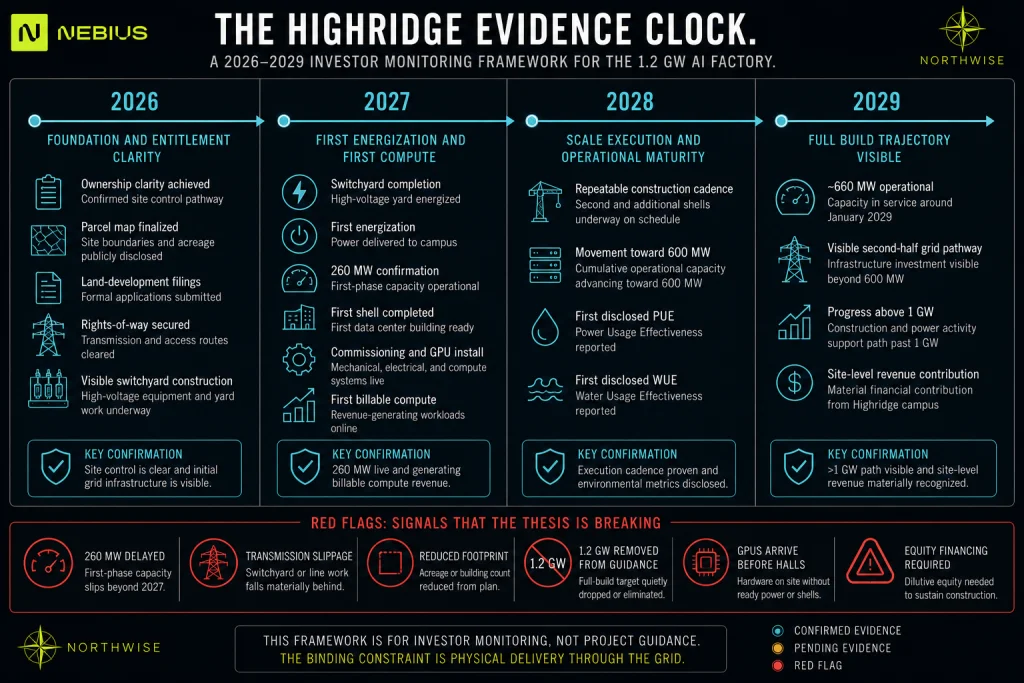
The project produces testable evidence on a fairly predictable cadence, and each year answers a different question.
YearSignals to trackWhat confirmation would establish2026Highridge DC Propco ownership clarity, confirmed parcel map and acreage, land development filings, PPL right-of-way progress, visible switchyard constructionThat entitlement and grid work are advancing on the stated schedule2027Switchyard completion, first energization, 260 MW confirmation, first shell delivery, commissioning, GPU installation, first billable computeThat Nebius can convert an owned site into revenue-bearing capacity at all2028Repeatable construction cadence, movement toward the 600 MW threshold, first disclosed PUE and WUEThat the opening phase was a process instead of a one-off2029The 660 MW milestone, a visible second-half grid pathway, progress above 1 GW, site-level revenue contributionThat the back half of the campus is real
Several developments would qualify as red flags: the 260 MW target pushed materially to the right, switchyard or transmission delays, a reduced site footprint, quiet removal of 1.2 GW from company guidance, GPU commitments running well ahead of hall readiness, or new equity financing required simply to keep construction moving.
A set of questions remains genuinely open, and holding them open is more useful than resolving them through speculation. On land, we still do not know how many acres the $187.5 million transaction acquired, who holds the remaining parcels, or whether Highridge DC Propco is directly controlled by Nebius. On power, the unresolved items are what additional transmission work carries the project from the visible 600 MW pathway to 1.2 GW and whether later phases fall under a single energy service agreement.
The design questions matter most for anyone building a model. No EPC contractor has been named, vertical construction has no confirmed start date, and shell-by-shell delivery dates are unpublished. Target PUE, target WUE, planned rack density, launch GPU generation, and network fabric all remain undisclosed, which is precisely what prevents a credible translation from gross site MW into billable IT MW.
The commercial questions follow from there. Nobody outside the company knows who takes the first 260 MW, what capex per MW will run on either infrastructure or compute, how much customer prepayment offsets hardware spend, or how quickly acceptance follows energization.
The Conversion Test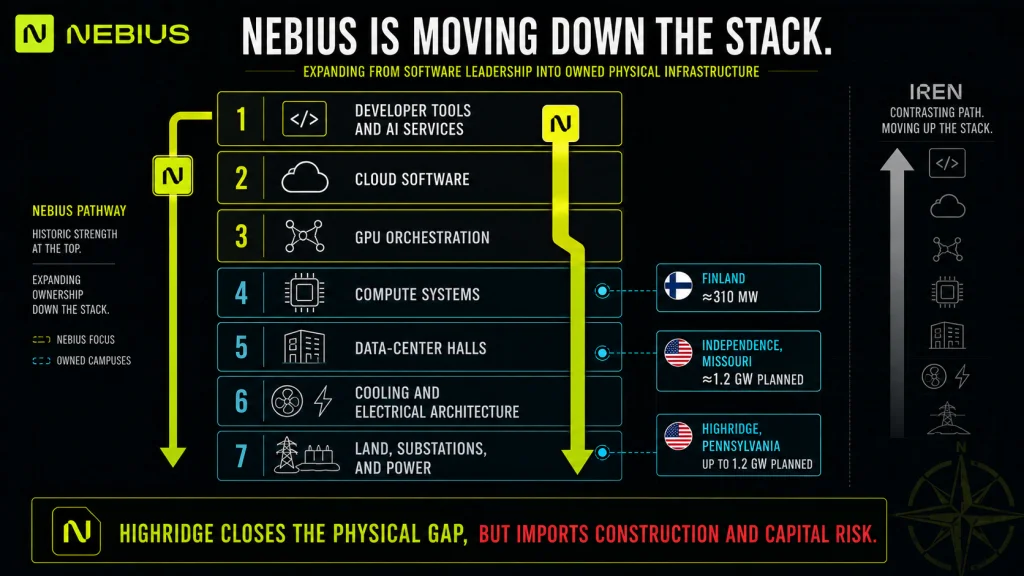
Highridge shows Nebius’s infrastructure expansion becoming physically measurable. The company has moved past signing leases and announcing power positions into a documented multi-year sequence involving land acquisition, zoning ordinances, environmental permitting, transmission reconstruction, substation development, purpose-built halls, and a staged 2027 to 2029 ramp. Very few announced gigawatt projects generate this much independent corroboration this early.
The discipline matters as much as the progress. Zero MW operates today, the first 600 MW carries considerably stronger external evidence than the second, and full delivery still requires years of capital and execution across multiple concurrent campuses.
Value does not accrue to shareholders due to Nebius controlling 1.2 GW. It accrues when those megawatts travel the full conversion chain and emerge as utilized compute at attractive revenue density. Every gate cleared between now and 2029 moves capacity closer to that point, and every gate missed strands capital at an earlier stage of the sequence.
Nebius is attempting to close the physical infrastructure gap that has historically separated its cloud and software capabilities from the most vertically integrated AI operators. Highridge is evidence that the gap is closing. It is not yet proof that the gap has closed.
Northwise Related Premium Content
 Northwise Related Content
CIFR Stock Data Center Analysis
An overview of CIFR’s transition from mining to HPC hyperscale leasing and a site by site analysis of its current portfolio and where it actually stands throughout its massive transition.
NBIS Stock Data Center Analysis
A site-by-site infrastructure audit of Nebius’ global data center footprint, examining power access, cooling design, and sovereignty as the core drivers of long-term execution.
IREN Data Center Overview Map
A site-by-site infrastructure analysis of the sites behind IREN’s massive hoard of land, power, and capacity potential across British Columbia and the American South.
NBIS Stock Software Analysis
Nebius is not a “GPU for Rent” company. They are building the software platform to capture value all the way up the stack. We analyze Aether and Tokenfactory to understand the true source of future profitability for Nebius.
NBIS Stock Sum of the Parts Valuation Analysis
A foundational equity analysis of Nebius that focuses on evaluating the business from a sum of its strategic investments, cash, and AI cloud business.
NBIS Avride Robotics Strategy
An analysis of the state of robotics development within Avride, as well as future Nebius optionality in physical AI.
The information provided in this report is for general informational and educational purposes only. Northwise is not a registered investment advisor, broker-dealer, or financial planner, and the analysis presented here should not be construed as financial, investment, legal, or tax advice. Readers should conduct their own research and consult with qualified financial professionals before making any investment decisions. Past performance is not indicative of future results, and all investments carry risk of loss.