
By Jay Sorgi • Posted November 5, 2025
The Catholic Church’s effort to evangelize young people continues to evolve, as today it adopts a more interpersonal, pastoral approach in response to the needs of youth.
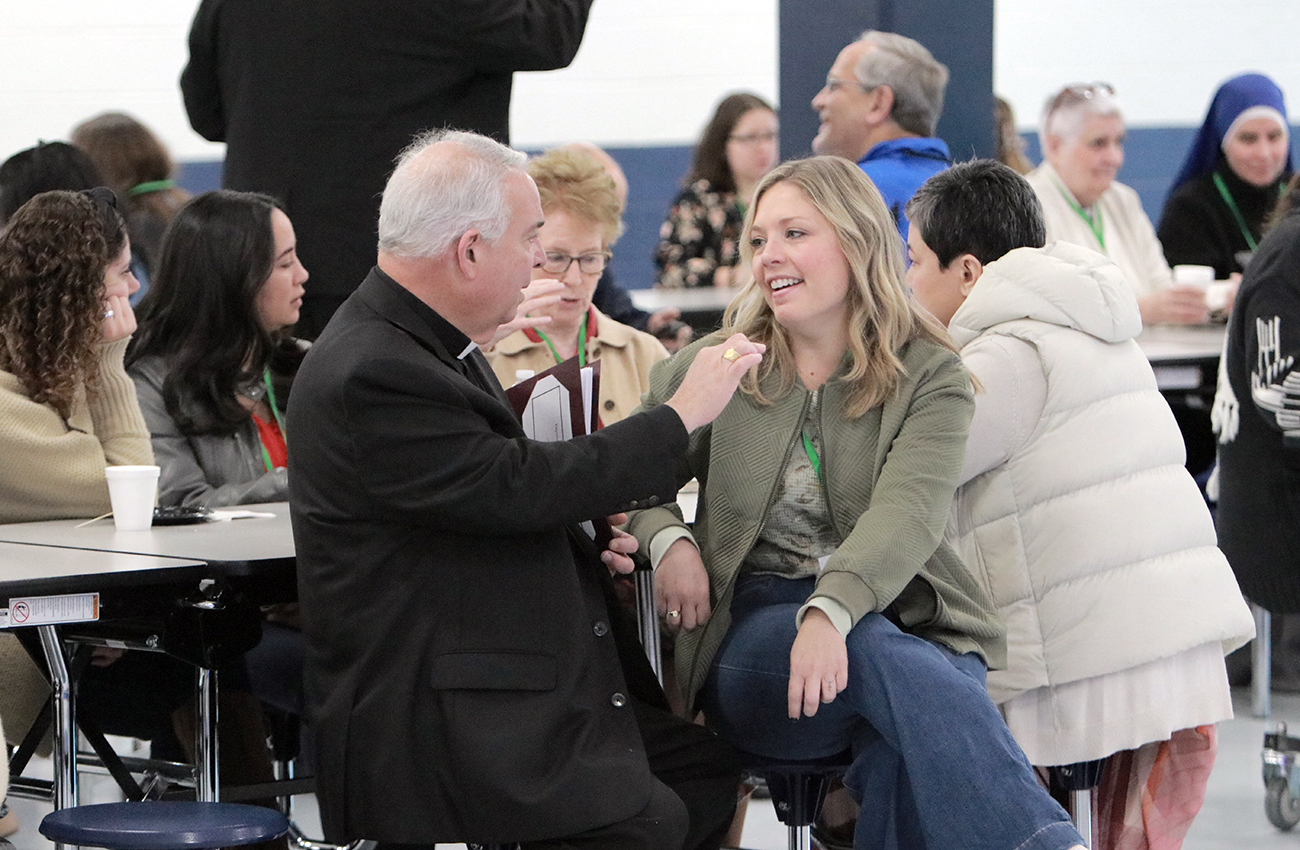
About 60 youth and young-adult leaders from within and beyond the Philadelphia area discerned how to offer a more present, humanizing, three-step way of accompanying and leading young people to Christ — “Listen, Teach, Send” — during the Empowering Gen Now conference held Friday and Saturday, Oct. 24-25, at Cardinal O’Hara High School in Springfield, Delaware County.
The event was hosted by the United States Conference of Catholic Bishops in partnership with the Office for Faith Formation with Youth and Young Adults of the Archdiocese of Philadelphia.
>>> PHOTOS: Archbishop Pérez Leads Youth Ministers in Prayer at ‘Empowering Gen Now’ Conference
Maria Parker, an official with the USCCB Secretariat of Laity, Marriage, Family Life and Youth, says that Gen Z has grown in enthusiasm “bubbling up” in faith, but to engage them, those in pastoral ministry need to truly listen well to them.
“We all need to be understanding, asking, ‘What is important to you? How can we connect you with Jesus more?’” said Parker, a former teacher at Cardinal O’Hara.
“The bishops just put out this ‘Listen, Teach, Send’ document last June at their plenary in Louisville to say, ‘Let’s talk to, let’s listen to, let’s understand our young people today, our youth and young adults.’”
“How do we equip our adults to see and to know how to work with young people to equip them to be leaders now?” said Marisally Santiago, the director of the archdiocesan Office of Ministry with Youth.
“The document is inspired by Pope Francis’ apostolic exhortation, Christus Vivit, which translates to ‘Christ is Alive,’ an exhortation which was for young people and the whole Church.”
The 24-hour conference at Cardinal O’Hara brought Archbishop Nelson J. Pérez and Auxiliary Bishop Keith J. Chylinski to join with local and national youth ministry leaders in mentoring leaders for greater effectiveness in reaching young people.
“We’re really happy to bring this conference together in collaboration with the USCCB,” said Pauline Father Timothy Tarnacki, director of the Office for Ministry with Young Adults.
“We have diocesan directors of the neighboring dioceses, but we also have a lot of youth and young adult ministers and leaders, and also parish staff and anyone who’s really working with youth and young adults.”
>>>SEE RELATED: One Woman’s ‘Yes’ Leads to Thriving Young Adult Group in Conshohocken
Organizers began the process of showcasing the fruits of the three-word philosophy of evangelization by helping ministers work on tilling their own soil of faith, beginning with eucharistic adoration and the sacrament of penance and reconciliation.
“Our own relationship with God impacts our ministry,” said Father Stephen DeLacy, the archdiocesan vicar for Faith Formation with Youth and Young Adults, who heard confessions and offered a one-hour talk Friday night.
“In a lot of ministry, a lot of preaching — and I’m pointing the finger at myself — the call to repentance is oftentimes very absent. Yet it’s foundational for the success of any ministry. If we want to listen, teach, and send in the name of Jesus, where Jesus is doing this through us, in order for us to get there, one key is our own effective repentance.”
On Saturday after lectio divina prayer with the Archbishop, attendees heard a talk about the first part of the youth-ministry formula, listening, by Christopher Wesley, the founder of Marathon Youth Ministry, before breaking into small-group workshops.
“How do we listen to young people in the mode that Christ listened to the apostles on their way to Emmaus, where he inserted himself in their conversation, never corrected them at the beginning?” said Santiago.
“He didn’t say, ‘Guys, hello, it’s me.’ He just walked as they were journeying in the wrong direction and just embedded himself in their story, in their situation, what they were going through.”
A session on teaching, the second part of the formula, was led by Dr. Carmina Chapp, the dean of the School of Theological Studies and an associate professor in the Department of Systematic Theology at St. Charles Borromeo Seminary.
“Teaching is really forming and accompanying, walking with people on that journey closer to Christ,” said Parker of the USCCB. “They have this moment with Christ, this transformative experience that sets their hearts on fire, and then they want to go out and be missionary disciples, bringing others closer to Christ, too.”
The final part of the trinity of youth ministry, the “send,” was presented Saturday afternoon by Christina Lamas, the executive director of the National Federation for Catholic Youth Ministry.
“The Gospel is alive, and the heart becomes inflamed with passion and desire to go,” said Santiago. “How do we equip our young people to actually go and help evangelize, especially their peers? Because no one can be better at evangelizing young people than their peers.”
Santiago believes the key to making this type of ministry effective is simply being there, being present to young people and in relationship with them.
“For missionary discipleship, it means, ‘How do we go out of our parishes, go out of ourselves and literally go to the path where they’re going? How do we capture them there by listening first and foremost?’” she said.
“As we gain their trust through listening, how do we then have the conversation about deep faith? Because until they trust you, they won’t talk to you about that. But if they trust you, they will.”
For Parker, the work of evangelizing youth is not limited to the professional ministers in parishes. It is meant for every Catholic to join in the mission.
“If we’re trying to bridge everyone together, the bishops are saying this is all of our work,” said Parker. “We’re all in this.”