
By Steve Jeffries
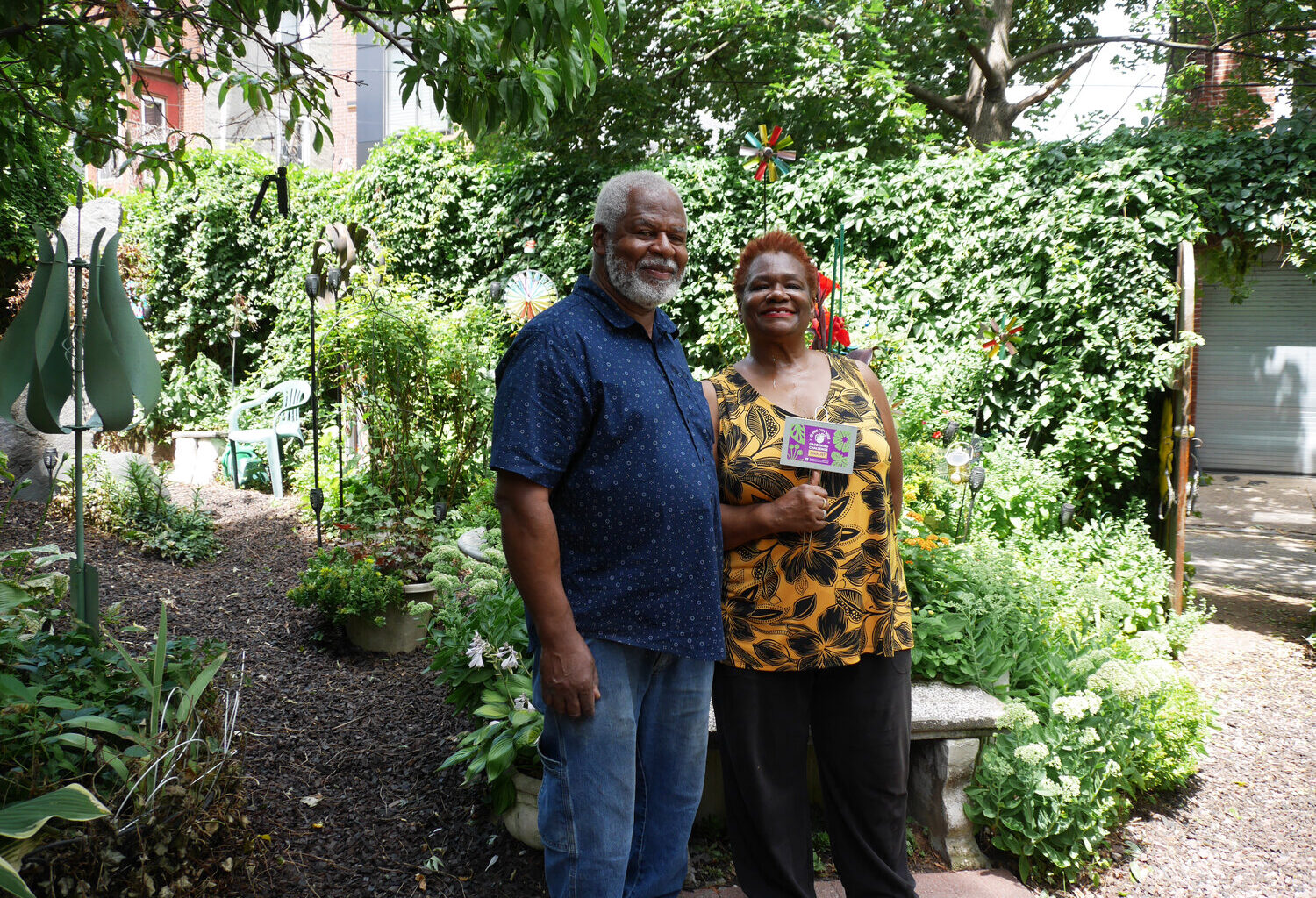
It’s been decades since Bill and Bernadette Briscoe moved into their home on Cabot Street in North Philadelphia. When they first bought the house, it was one in a row of abandoned buildings. But Bill, still in technical school to become a plumber, was determined to make it a livable home again.
“I was still learning,” laughed Bill, who is now a professional plumber. “I didn’t know how to do any of it, but I just said, I got it. I had enough nerve to say it. I did the plumbing, the electric, the masonry, everything.”
Over the years, the Briscoes requested the city tear down the dilapidated houses next to their home. They bought each of the parcels of land and slowly transformed the area into their own personal paradise in the city.
“When you have nothing, you have to create,” said Bernadette. “So this is an extension of all of that. There was a three-foot space behind our house, where my husband was growing roses. And he was wanting a larger area. That’s when I started writing letters to the city.”
The Briscoes brought in soil and plants to cover the bricks and concrete. The old torn-up curb stones became part of the landscaping. They erected a gazebo next to the house and put benches along their gardens’ winding paths. At one point they even had ducks, from which they harvested eggs.
“Within that timeframe, we’ve torn down, built up, had several areas that used to be vegetable gardens; this used to be a flower garden. It’s morphed, before children, after children, going through different iterations each year.”
Citywide garden challenge
The Briscoes were picked as finalists for the PHS Garden Challenge, which returned this year for the first time since the pandemic. PHS says the citywide challenge is about “honoring the creativity, care, and cultural traditions that make Philadelphia’s home gardens special.”
In the first round of the competition, candidates are evaluated based on photos and write-ups they submit about their gardens. Narrowing it down from over 100 entries, the finalists are then visited in person by a team of judges from PHS. In-person judging will take place through Aug. 15, with the winners to be announced and celebrated in early September.
With such a diverse variety of personal gardens (community gardens are not accepted in the competition), there are multiple categories to help sort the contestants. Everything from entire backyards to front porch container gardens can be submitted.
The competition used to accept entries from the surrounding suburbs and New Jersey, but now includes only gardens within city limits.
“You’re getting more backyard container gardens,” said Jill Braid, who has judged the PHS garden challenge for many years. “We haven’t seen any vegetables today, although I have seen some vegetable gardens in the city.”
Creating art with plants
Kimberly West has similarly worked to transform her backyard into a space for peaceful relaxation. She’s been gardening since the fall of 2019, steadily adding pots and plants each year and taking them into the basement during the cold winter months.
“My backyard was barren,” said West. “So I thought I have to do something with this space. I just started with four shrubs, and then I added some containers here and there. I didn’t have grass to plant in. So I added a raised bed and went from there. And every year it just grows. There’s not going to be enough room to sit eventually!”
She follows PHS on social media and heard about the challenge, but wasn’t sure about entering. Friends and family encouraged her to enter her first garden challenge — she, too, has been named a finalist.
“I’ve never really had anyone come in and look at the garden, even though I post things on social media,” said West. “It makes you very vulnerable to have people in a space that you cultivate and you’re not used to having anybody look at or judge.”
While she remembers a school project planting flowers around Eastern State Penitentiary, West said she had no idea that she’d enjoy gardening so much. As a graphic designer, she naturally has an eye for layout and color and thinks of gardening as creating art with plants.
“She made the best use of her space out back,” said Colleen Wortley, a PHS judge. “It made a lot of sense how she had the back planted along the fence and then the pots were movable. It’s well thought out.”
New gardens for new homes
Shakeda Gaines only moved into her newly built home in 2025. Through the Turn the Key program, Gaines now owns her first home, something she said she never thought she’d do.
Gaines lost no time in beautifying her space. While her mother and grandmother both gardened, Gaines only started her own garden journey recently. She started with decorations, and soon expanded to flowers and some crops like tomatoes, carrots, and cucumbers.
“I always thought I didn’t have a green thumb,” explained Gaines. “I tried it in the house, and everything always died. This time around, I said I would take the time out to try something that was different.”
Recent storms destroyed her first attempts to grow food. Undeterred, she’s started from scratch, planting new crops to complement her flowers. Gaines says she sees the setback as a learning lesson.
“I realized I didn’t have enough ventilation going through,” said Gaines. “It’s just things that you just don’t know you’re supposed to have as a gardener. So now I know better.”
Gaines not only owns land in front of her yard, but also in the back. Committed to community beautification, she hopes to turn it into a community garden, where her neighbors can harvest food and have a space to relax.
“I think one thing people don’t remember is that gardening helps our nervous system,” said Gaines. “It actually brings us down – brings our heart rates down.”
The greater good
While Gaines only started her gardening journey months ago, her enthusiasm and vision of expanding her space to be one for the community is exemplary of PHS’s mission statement “Gardening for the Greater Good,” and helped make Gaines one of the competition’s finalists. According to Braid, PHS’s mission statement and initiatives have changed through the years.
“I think PHS has evolved,” said Braid. “Probably 10 years ago, that was not their mission. What I remember from flower shows and the PHS in the 60s, 70s, and 80s is certainly not what we have today.”
Wortley says that as a judge this year, she loves meeting other gardeners and learning something from each garden they visit. PHS facilitates a culture of sharing knowledge and material by arranging plant swaps, seedling distribution, workshops, and an active blog.
“I dug up hellebores for PHS’s sharing program. You would have thought I was giving them a gold bouillon,” said Wortley. “But that’s what it’s about. Gardeners are really nice people. I also quilt, and quilters are nice people. I feel like it comes from having that crafty side.”
The PHS Garden Challenge isn’t all about the prettiest or cleanest or most impressive garden, according to the judges. The horticultural practices, imagination, and suitability to terrain are also taken into account.
“Every space is different,” said Wortley. “It’s interesting to see other people’s perspectives, and what they do with space.”
“It’s more about where they live and what they are trying to contribute,” added Braid. “I think it’s so much fun to see everybody’s love of gardening.”
MORE: Philly opens new hub for community gardens, urban farming
Keywords
Pennsylvania Horticultural Society,
PHS Garden Challenge,
Philadelphia gardens,
urban gardening,
home gardening,
North Philadelphia,
backyard gardens,
community gardening,
Philadelphia lifestyle,
gardening