
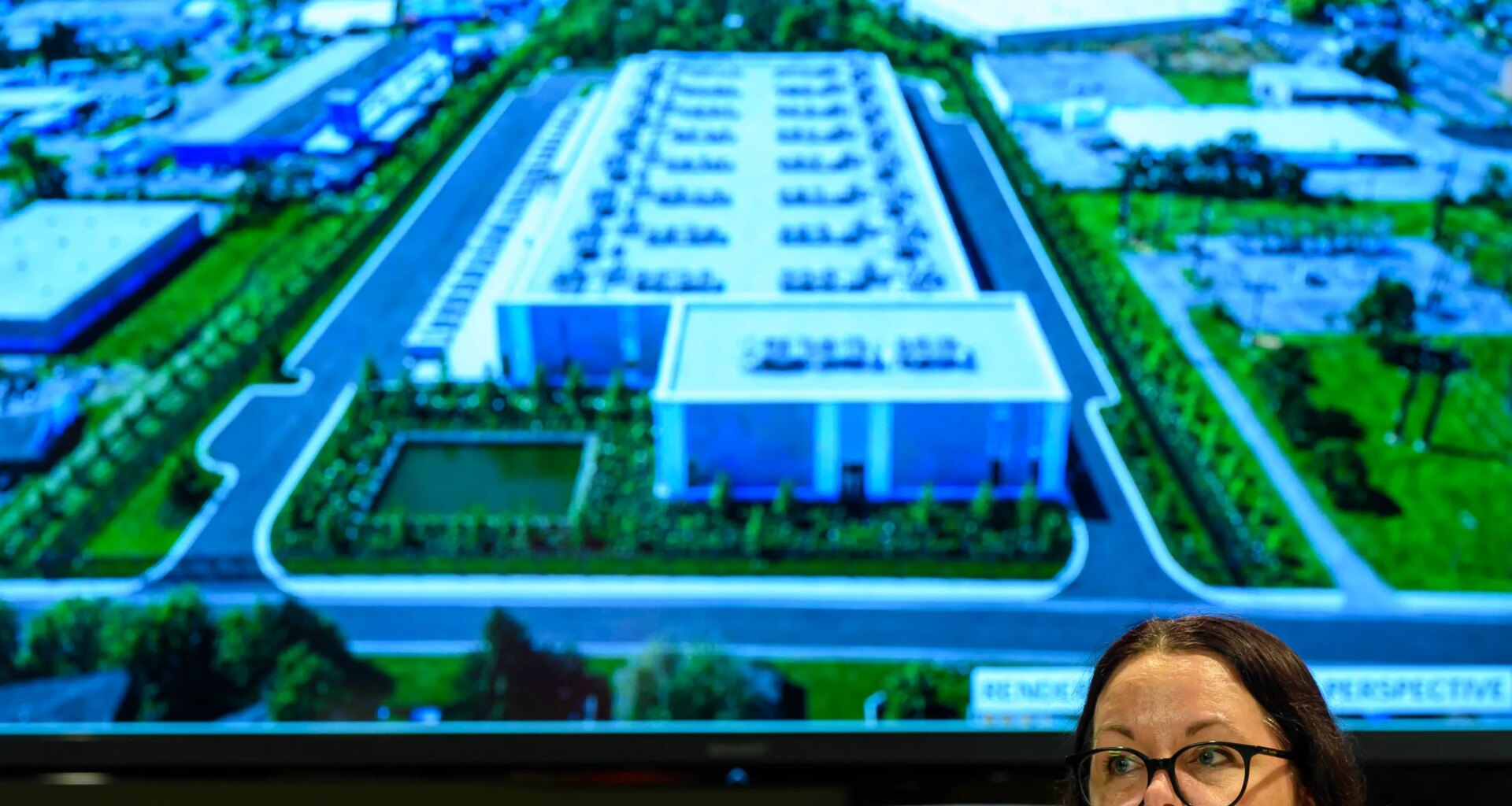
Emails between Allentown officials and the developer of a data center reveal that the city is facing pressure to quickly review and approve the data center plans, including a possible “curative amendment” legal challenge.
Quantm LLC, a Philadelphia data center development company, has submitted plans to convert a 224,000-square-foot warehouse building at 2401 W. Emmaus Ave. into a data center.
The proposed data center is still awaiting a vote from the city’s planning commission on whether it may move forward. But in response to a request from the developer, city zoning officers in October determined that a data center would be a permitted building type on the property.
Neighbors and other data center opponents have shown up to meetings in droves to ask the city not to approve the facility. Camelot for Children, a nonprofit that helps chronically ill children and is across the street from the proposed data center, has filed a legal challenge against the city’s zoning determination for the site.
Across Lehigh and Northampton counties, at least six data centers, ranging from 100,000 to 5 million square feet, are in varying stages of the land development approval process. The so-called data center boom in the Lehigh Valley and nationwide is due in large part to the rapid growth in the artificial intelligence industry, which has led to higher demand for data centers.
The emails and letters referenced in this story are among a number of documents received by The Morning Call in response to a Right-to-Know Law request seeking all documented communications between city staff, elected officials and the Emmaus Avenue data center developers.
Morning Call reporters have submitted similar public records requests to all cities and towns in the Lehigh Valley where such facilities are proposed.
Data center plans emerged in August
Data center developers reached out to the city announcing their plans to convert the warehouse into a data center in August 2025, email records show, around 10 months before the public learned about the plans when they appeared on an Allentown Environmental Advisory Council agenda.
The city has since introduced new requirements that would require the city to inform the public about any data center plans, including hosting a public informational meeting about the plans prior to any vote.
Quantm developer Anthony Maras first reached out to Mayor Matt Tuerk about submitting a proposed data center. Tuerk directed him to Allentown’s zoning officer, Michael Handzo.
Handzo on Aug. 12 wrote to Maras that the city must issue a “formal written determination” on the legality of the data center. “Data center” is not a defined use in the city’s zoning ordinance, Handzo wrote, so the city’s zoning staff are tasked with making a determination based on the “closest available use” that is defined.
Handzo asked Maras to send all relevant information about the plans to help city staff make a determination.
On Oct. 3, Langan Engineering, a firm representing developer Quantm, emailed an “operational and environmental narrative” of data center plans to the city. In that email, Keith Ottes, principal engineer at Langan, argued that a data center use “is consistent with the intent and character” of the zoning designation where the Emmaus Avenue site is located.
While the property is surrounded by other industrial-use buildings, the eastern portion of the site is across the street from several residential buildings, which anti-data center advocates say could be subject to excess noise and air pollution by nature of their proximity.
Langan’s letter argued that “the presence of the roadway and the intervening distance provides a natural separation that helps mitigate potential impacts.”
“The industrial character of the surrounding area, combined with the infrastructure already in place, makes this site an ideal location for a data center,” the letter said.
But emails also show that city officials had early concerns about the plans.
According to a letter from the city’s sustainability coordinator, the proposed wattage of the new data center “is equivalent to powering 60,000-80,000 average homes simultaneously, representing a significant load increase within the City of Allentown.”
The Emmaus Avenue data center would use 75 megawatts of electricity. Developers have plans to build a 23,000-square-foot PPL substation on the site to accommodate the spike in energy demand. Quantm would pay for the PPL substation upgrade, which would cost around $2.5 million, and would help prevent electric rate increases for local residents, Maras said at a public meeting.
Developer stresses urgency, frustrating city officials
The emails also show that Allentown officials are facing pressure from the developers to quickly review the plans, and that pressure includes a possible legal challenge to the city’s zoning ordinance.
On Oct. 10, Maras emailed city staff with a note from a consultant regarding the anticipated noise levels of the data center.
Three days later, Maras followed up on the same email chain, asking staff to “Please call me after you review the sound info.” He also asked when staff might schedule a hearing on the project.
Handzo then forwarded Maras’ email to city Planning Director Jennifer Gomez and Deputy Director of Economic Development Mark Hartney, adding that Maras is “becoming extremely pushy and needs to understand we need to be allowed to review his application,” and suggesting the three of them should meet and discuss how to respond.
In an email dated Oct. 14, Maras told Handzo he would prefer to avoid a hearing before the Allentown Zoning Hearing Board, and said “timing is critical” because the developer has plans to spend around $10 million on some of the necessary equipment upgrades if the data center is approved.
“We know that you all are working on this very diligently,” Maras wrote. “We have been working closely with our seller on this project. We just want to make sure that we can always demonstrate to them that we are moving as fast as we can.”
Handzo responded: “As a City employee, my emails are public record. Please feel free to forward them to the seller at any time if they can demonstrate good faith and promptness on your part.”
Two days later, on Oct. 16, Handzo issued a letter to Quantm with the decision that the data center is a “by-right” permitted use at 2401 W. Emmaus Ave., meaning that it would not need a special zoning permit or zoning board hearing to move the project forward.
The proposed data center still requires review and approval from the city planning commission, which is ongoing. The planning commission reviewed the data center application last month, but did not hold a vote, at the developer’s request. The planning commission will hold another review of the application in the fall, and Maras has vowed to disclose the “end user,” the company that would ultimately use the facility, if approved.
AI ‘arms race’
Maras’ urgency reflects a broader conflict in the data center economy landscape — data center developers are trying to build as quickly as possible in order to meet booming demand for artificial intelligence capabilities, and compete with countries like China and Russia that also are trying to cash in.
During the first planning commission review, Maras invoked the “arms race” between technology companies in the U.S. and China to make his case for approval of the Emmaus Avenue data center.
“If you believe the experts, we are roughly 20 to 24 months ahead of China in the development of AI technology and data center technology,” Maras said. “If you believe that, then question why people are asking for an 18-month moratorium [on data center development]. If you were a coach of a team, and you were up by 24 points, if you were an athlete running a marathon, and you were 24 minutes ahead of your competitor, would you stop and let that competitor continue to run against you?”
On the other hand, developers are facing pushback from neighbors who don’t want to see data centers in their communities, and delays from municipal planners who have never faced developments like large data centers before.
While data centers have existed for years, including in the Lehigh Valley, the size and scale of data center development is unprecedented.
Cities and towns in Pennsylvania are not legally allowed to bar data centers entirely — state law requires that municipalities allow for all types of building uses within their borders, though they have control over where building types may be placed and can impose regulations and requirements for developers.
The Lehigh Valley’s largest city amended its data center ordinance to allow such facilities in only one of its three “industrial” zoning district via a special exception zoning permit. Under the ordinance, data centers are not allowed within 75 feet of the right of way of a public street, or 500 feet of any residential, civic or childcare areas.
The ordinance also requires robust landscaping around the perimeter, and thorough environmental, noise and waterway studies and reviews from the developer before any approval from the city.
However, because the ordinance passed after Quantm submitted its proposal, the requirements do not apply to that application.
Melissa Velez, chief city planner for Allentown, has said that while the city has recognized that the data center is a legally permitted use on the site, a data center use “may not represent the highest and best land use for this site when evaluated against long-term planning objectives, particularly those related to job creation, land efficiency and compatibility with nearby residential uses.”
Curative amendment challenge
In May 2026, lawyers for Quantm filed a “curative amendment request,” a formal legal challenge that seeks to declare a city’s zoning ordinance invalid, despite the city’s affirmation that a data center is a legally permitted building use on the site.
In a letter, Maras disclosed that Quantm decided to hire a lawyer to file the curative amendment because of the rewrite of the city’s zoning code, which took effect in January and changed the zoning district of the property from “I3” to “IG.” The comprehensive rewrite, which city planning staff worked on for years before it was finalized late last year, aims to increase housing availability, promote job growth and maintain traditional neighborhood characters throughout the city.
In the email, Maras said the developers opted to file the curative amendment “in order to protect our legal positions” regarding the data center.
The email also reveals that Woodmont Properties, the former owner of the 2401 W. Emmaus Ave. property and developer of the former Merchants Square Mall building in Allentown, which could also become a data center, also filed a curative amendment for the same reason.
Hartney, the deputy community and economic development director, wrote to Maras that city staff “were surprised to get the curative amendment request and prefer a more collaborative approach.”
In response, Maras said that he would also prefer to remain collaborative rather than combative with the data center application, but that the curative amendment was an insurance measure against possible challenges to the project resulting from the zoning change.
“Without prejudice, nor waiving any rights, we just wanted to make sure that there was no further erosion from what we believed to be the case in October,” Maras wrote.
The curative amendment challenge, as of June 4, has been put on hold pending the planning commission’s decision on the project, according to an email from an attorney representing Quantm LLC.
The planning commission is expected to review the data center plans again in the fall.
See the data center emails below.
Reporter Lindsay Weber can be reached at Liweber@mcall.com.