
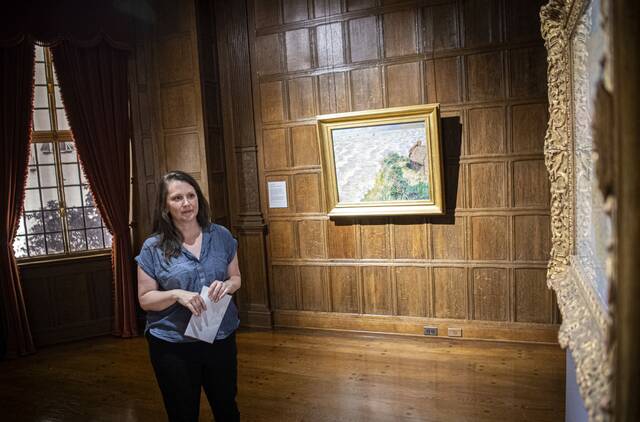
The Frick Pittsburgh Museums & Gardens has added three Claude Monet paintings to its exhibition “French Moderns: Matisse, Renoir, Degas.”
Beginning Friday, the paintings will be on view inside the museum’s Jacobean Gallery. The public will be able to visit the three Monets as part of the ticketed “French Moderns” exhibition, on view through Oct. 11.
The newly added paintings include Claude Monet’s “Banks of the Seine at Lavacourt,” “Rising Tide at Pourville” and “Houses of Parliament, Sunlight Effect.”
Due to what the museum described as a “travel coincidence,” the Frick Pittsburgh was given the opportunity to display the Monets — one of which is part of its in-house collection — as they returned to the East Coast. The paintings arrived in Pittsburgh after being featured at the “Monet and Venice” exhibition, which ran at the de Young Museum in San Francisco, co-organized by the Brooklyn Museum and the Fine Arts Museums of San Francisco.
“French Moderns,” which opened at the Frick Pittsburgh in June, features 56 artworks highlighting France as an artistic hub from the mid-19th to mid-20th centuries across multiple avant-garde movements, including Impressionism, Cubism and Surrealism. The touring exhibition was curated by the Brooklyn Museum from its collection.
The addition of the Monets lets visitors see not only the artist’s evolution, but also why Impressionism once looked revolutionary, said Dawn Brean, chief curator and director of collections at The Frick Pittsburgh.
“Monet is on every umbrella, mousepad, T-shirt and pencil,” Brean said. “It’s easy to forget just how radical the (Impressionists) were in their particular moment.”
The three paintings span nearly 25 years, from 1879 to 1903, tracing Monet’s career from years of financial uncertainty and critical skepticism to international acclaim. But throughout them all, Brean said, runs the same obsession: light and atmosphere.
“How can you depict that with paint on a canvas? How can you evoke a time of day, a sense of the color just through brushstrokes?” she asked.
Painted with quick, visible brushstrokes and focused on ordinary landscapes rather than history or mythology, Impressionist works challenged the “academic” painting that dominated the late 19th century. At the time, they sparked debate about which subjects were worthy of art.
Monet’s “Banks of the Seine at Lavacourt” (1879) depicts a view of the Seine northwest of Paris. To modern viewers, it might register as little more than a pleasant landscape.
“But there is such skill and inquiry, belied by what seems like an easy technique and process,” Brean said. “It’s not as easy as it looks.”
The painting also has a direct connection to Pittsburgh. After appearing in the Carnegie International in 1901, the painting was purchased by Henry Clay Frick. Like all three of the paintings on view, it reached the United States courtesy of French art dealer Paul Durand-Ruel, whose support of Monet and other Impressionists kept them financially afloat.
“It’s a minor miracle they didn’t go into bankruptcy and their names are not obliterated from history,” Brean said.
In the museum’s Jacobean Gallery, “Banks of the Seine” appears on a mauve wall, pulling in a color from Monet’s paintings that might not seem as naturalistic.
“But there are so many different colors that make up how your eye perceives color and motion,” Brean said.
“Rising Tide at Pourville,” painted in 1882 in a flattened, even disorienting perspective, shows a sea with cresting waves along the Normandy coast, set against an abandoned customhouse. Seen up close, Monet’s brushstrokes and pigments are forcefully mixed together to produce a choppy effect.
“I feel like I can hear this painting. I can feel the wind blowing all of the shrubs and sedges on the hillside,” Brean said.
Pittsburghers might feel a special affinity for Monet’s “Houses of Parliament, Sunlight Effect,” due to an unexpected resemblance to PPG Place. But what fascinated Monet wasn’t the architecture, but London’s industrial haze, which presented a new challenge in capturing light and color. The painting is one in a series of 19 that Monet created from a vantage point at Saint Thomas’s Hospital across the River Thames.
In one corner of the painting depicting sunlight, thick ridges of paint rise off the canvas. The effect is created through impasto, a technique used heavily by the Impressionists that leaves each brushstroke visible — a quality critics of the day often dismissed as crude or slapdash.
This visibility, perhaps more than anything, was scandalizing, Brean said.
More than a century later, she believes that’s still one of the revelations of standing before an original Monet: thick paint and brushstrokes that reveal the hand of the artist.
“So it’s not an illusion anymore,” Brean said. “At its core, a painting is a handmade object by a maker. But that’s too close to craft, and that’s not how people in the 1800s were talking about painting.”
As familiar, even ubiquitous, as Monet’s landscapes have become, Brean said, every work of modern art was once the art of its own moment.
“You walk through and ask, ‘But why is that modern? Why was that so radical?’ ” Brean said. “It’s easy to forget Monet was really pushing new ideas.”
If you go
“French Moderns: Matisse, Renoir, Degas”
Friday through Oct. 11
The Frick Pittsburgh Museums & Gardens, 7227 Reynolds St., Point Breeze