
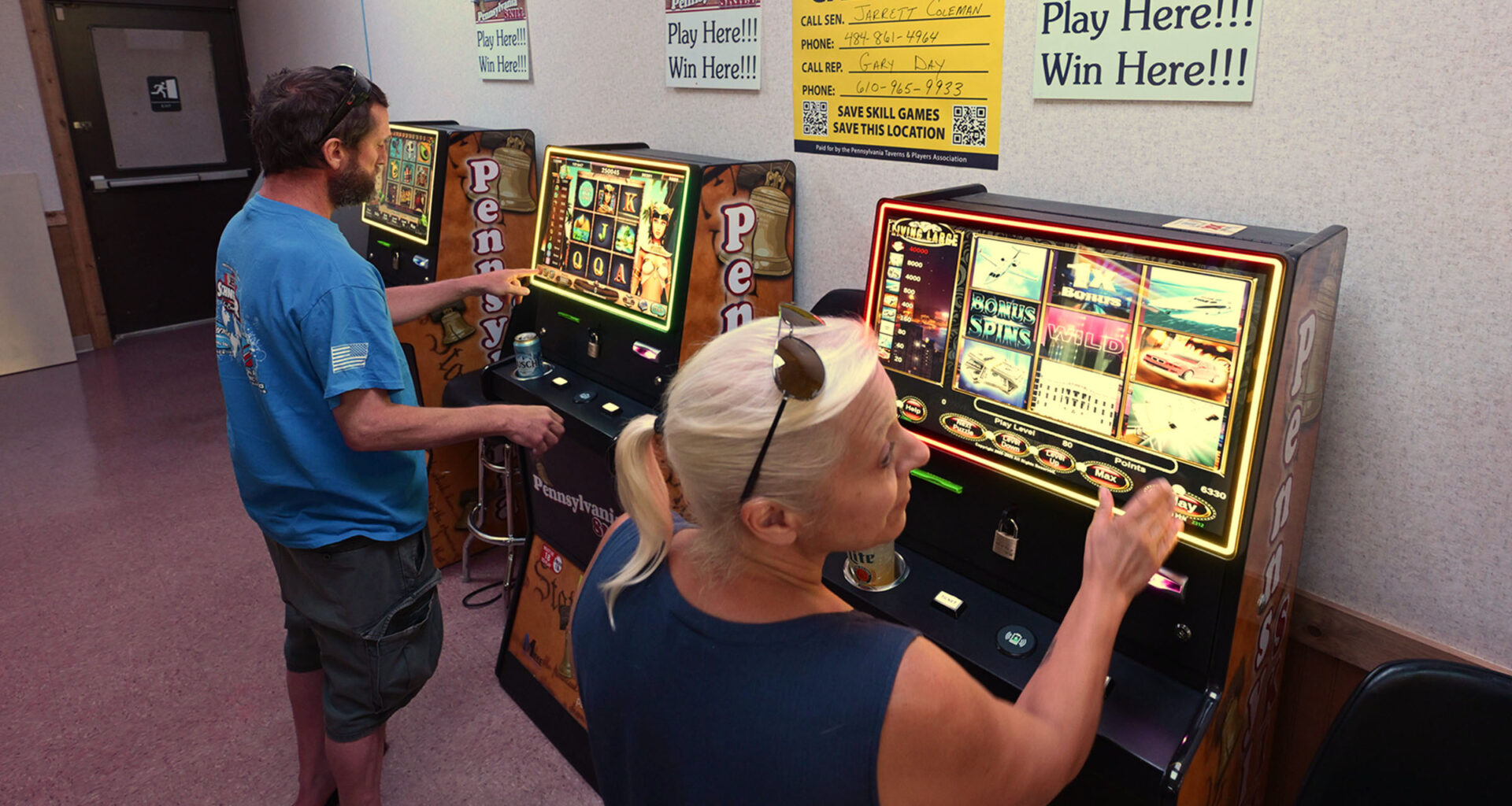
Members of several area social clubs rallied in Macungie on Thursday to save the skill game machines they say are keeping the lights on and allowing them to give back to the community.
They are hoping to get the attention of the state legislature, which must regulate the devices before a state Supreme Court ruling makes them illegal this fall.
For Daniel Lee, president of the Macungie Veterans Association, losing the machines would be a financial blow to a club already struggling after an April 2025 fire at their Lehigh Street clubhouse forced it to close for nearly a year. The clubhouse is a meeting place for local veterans.
On a good month, Lee said, the machines bring in around $1,000 for the club. That money is being used for post-fire renovations, and also to pay the electric bill.
“These skill machines are a big advantage for us for revenue, to try to get us back on our feet,” Lee said.
The state Supreme Court in June ruled that skill games are essentially slot machines and should be subject to gambling laws. That means the devices, which have operated in a legal gray area since 2014, are now prohibited outside casinos and can be confiscated by police.
The court put a 120-day stay on enforcement of their ruling, giving lawmakers until Oct. 13 to pass legislation regulating the machines.
Supporters want lawmakers to pass Senate Bill 1079, sponsored by Sens. Gene Yaw and Anthony Williams, and companion legislation, House Bill 2213, sponsored by Reps. Danilo Burgos and Jonathan Fritz. The proposed legislation will regulate skill games and place a monthly $500 per terminal fee on the games.
The measure will generate $300 million in state tax dollars in the first year of regulation, according to the Pennsylvania Taverns and Players Association, which organized Thursday’s rally.
David Lausterer, president of Lansdale Amusement Co., the firm that leases the games, said skill games bring in profits that other bar games like pinball machines and pool tables used to provide, until home video games made them less popular with patrons.
“Times change. Those things just don’t produce the revenue that they did back in the day. We’re very fortunate that skill games came out. They’ve resurrected an awful lot of clubs and small businesses and have really done a lot of good in our community,” Lausterer said.
Skill games work like a slot machine in a casino, but players can win all of their money back — up to 105% of what they put in — by solving a complicated puzzle. Proponents say that’s what makes them different from slot machines and other gambling devices.
Businesses that host skill game machines get 40% of the profit, according to Pace-O-Matic, a firm that writes software for the machines.
Bonnie Jeinnings, treasurer of the Sellersville American Legion Post in Bucks County, said the machines in her clubhouse provided money sorely needed after two floods damaged the building and forced them to cancel dances.
“If it wasn’t for the skill machines we’d probably be closed years ago,” she said.
Rochelle Miller, treasurer of the Mertztown Rod and and Gun Club in Longswamp Township, said skill machines brought in $38,000 in 2025, and $44,000 for the club so far this year. The money not only allowed members to renovate the 90-year-old clubhouse and buy a generator, but helps pay for community activities like the annual kids’ fish rodeo. It cost the club $38,000 to stock its pond, Miller said.
“If we didn’t have that extra revenue we would not be where we are today. We’d be getting by, but we would not have the ability to support our kids and teach them all about hunting and safety and all of that,” Miller said.
To drive home the point that skills games support the community, Lansdale Amusement presented the Macungie Veterans Association with a $5,000 donation, and gave the Allentown nonprofit Give a Blessing, Get a Blessing, a check for $2,500 at the rally.
There are about 70,000 skills games machines in Pennsylvania, not just in private clubs but in gas stations, bars and restaurants. State Sen. Jarrett Coleman, R-Lehigh, a supporter of the skill games industry, said the machines are helping small businesses weather stormy economic times.
“At a time when affordability is becoming such a talking point, let me be clear: If a restaurant or small bar doesn’t have the revenue from these games, what do you think is going to happen to the price of cheeseburgers and beer? It’s going to be passed on to the consumer,” he said.
To operate a slot machine, owners must hold a valid slot machine license issued by the Pennsylvania Gaming Control Board. There is no equivalent license for skill games. Critics, led by the state’s licensed casino industry, say the devices promote unregulated gambling that attracts crime and underage gamblers.
“This was completely pushed by the casinos. That’s what this is about,” Coleman said. “It’s critical that the General Assembly comes up with something before the deadline.”