
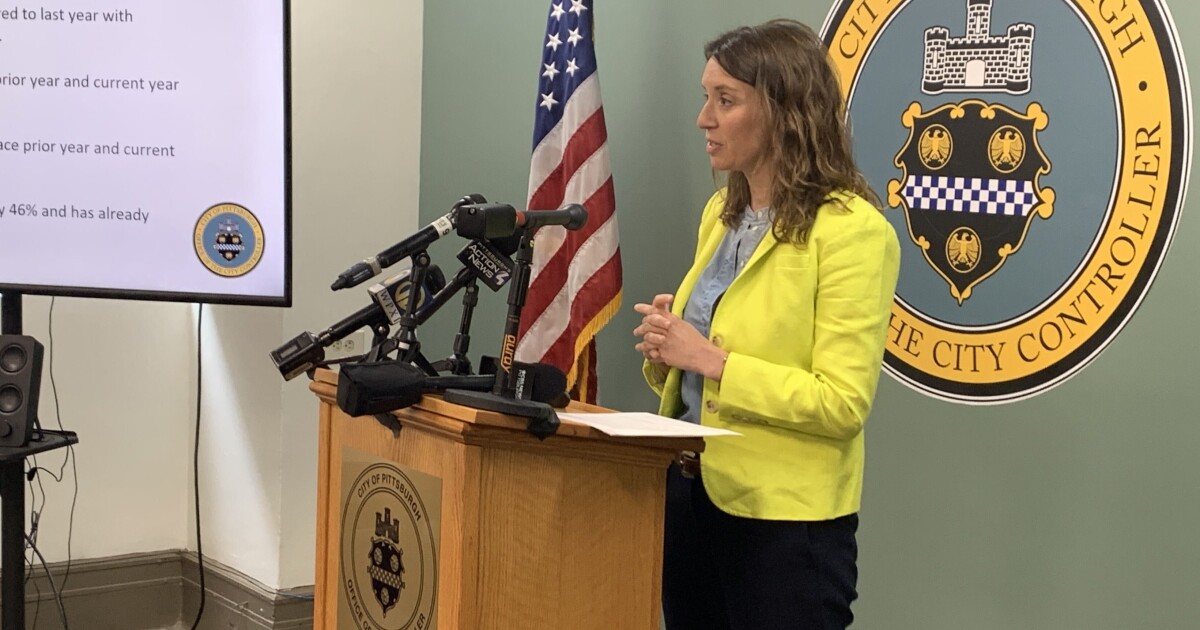
Pittsburgh City Controller Rachael Heisler offered a cautiously optimistic assessment of some aspects of city finances on Friday, though she said there were still reasons for concern.
At a press briefing, Heisler said that city revenues offered “very positive signs midway through 2026,” and indicated that the city’s overall budgetary woes — which she has been warning about for more than a year — are solvable.
“The situation we’re in is one that we can come out of,” Heisler told reporters. While the city was still struggling to rein in some expenses, she said she did not believe it was on the verge of returning to state financial receivership.
The city’s earned income, payroll preparation and deed transfer tax revenues all are outpacing last year’s collections and this year’s predictions, Heisler said. A property tax increase has generated additional real estate revenue as well.
But some other aspects of the city’s finances are still precarious, she said.
“The budget’s tight. We knew it would be,” she said. “There is not a lot of room for error moving forward, and we need to focus on cost containment where we can, [and] where we can bring in additional revenue.”
Overtime spending is still elevated: Police overtime in particular is currently costing 20% more than it did this time last year. That’s partly due to the NFL Draft this past spring, and some of the additional staff expense will be offset when the city receives an expected $2 million in reimbursement through the state. But other costs stemming from the draft — like a decline in parking tax revenues — won’t be reimbursed.
“When you look at the years and hours and time that went into planning the draft, it was a great event, right? Everybody had fun,” Heisler said. “But … it’s very expensive to host those events.”
Heisler argued that while spending has increased, the city is better prepared for overtime expenses, thanks to budget changes City Council months ago. The city has spent 55% of the money budgeted for overtime in 2026; by this point last year it had spent 76% of its annual allocation, because the 2025 spending plan set aside less money to cover the cost.
“I applaud [Mayor Corey O’Connor’s] administration for acknowledging those areas and budgeting appropriately,” Heisler said. “We need to make sure that we are adequately staffed in the bureaus where there’s a utilization of overtime.”
Some of the spike in overtime can be attributed to the need for the Department of Public Works to handle snow clearance after a massive snowstorm in January. Heisler said the city could no longer afford to think of those as one-of-a-kind events, given that climate change was making such storms more likely. She noted that last year saw a spike in overtime costs connected to the large wind storm in the spring.
“These aren’t just bumps. This is a trend caused by climate change that we can reasonably expect year over year,” she said.
Heisler said the city also had to reckon with the loss of revenue from the so-called “jock tax” — a tax that was once imposed on visiting entertainers who use city sports and arena facilities, but that was ruled illegal by the state Supreme Court. An upcoming collective bargaining agreement with city police could also mean increased expenses in the form of retroactive pay, Heisler warned, while tax-revenue increases could be erased if the economy takes a downward turn.
And while an anticipated decrease in bond repayments next year will free up some space in the budget, Heisler anticipates much of the money left over will be eaten up by inflation and fuel increases connected to global situations outside the city’s control, like the war in Iran.
Heisler praised the O’Connor administration for soliciting voluntary payments from UPMC and other large organizations in the city. Totalling $70 million over the next five years, the gifts will go to areas like the city’s aging vehicle fleet, recreation and sports equipment, Urban Redevelopment Authority programs, first responder recruitment, and more. Heisler called the payments a “big deal.”
“The voluntary payments that Mayor O’Connor negotiated reflect an acknowledgment of the city’s financial situation and a renewed interest in partnership and cooperation with our large institutions across the city,” she said. “These are needed investments. Every single dollar … takes some burden off of a city resident.”