
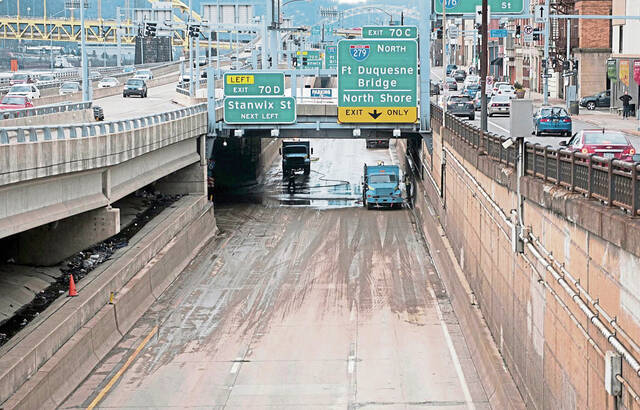
During severe storms, Pittsburgh commuters know to avoid the Parkway East’s so-called “bathtub” Downtown — a road below street level that earned its nickname from its longstanding struggles with flooding from the adjacent Monongahela River.
PennDOT is trying to retire the nickname for good, though, with a series of upgrades and corresponding traffic restrictions planned for this year.
Fort Pitt Boulevard was originally known as Water Street until it was widened and renamed in 1940.
The expanded, two-level street — designed to bypass traffic between the Point and Smithfield Street — created a depressed stretch of roadway in anticipation of a future connection to the Penn-Lincoln Parkway later known as the Parkway East, according to PennDOT spokeswoman Nicole Haney.
But officials soon realized that the sunken section of roadway was susceptible to flooding any time the Monongahela rose more than 18 feet.
By the 1980s, PennDOT had commissioned a series of floodwalls to raise the threshold to 25 feet and added pumps, sumps, sluice gates, and associated mechanical and electrical equipment to manage stormwater, Haney said.
The five wall structures range in length from 35 to 370 feet and are about 1,150 feet long in total. Four are positioned along I-376 westbound, and the fifth is along the ramp from Fort Pitt Boulevard to I-376 eastbound.
In 2012, the agency installed permanent pipes “to allow more rapid pumping to remove floodwaters” once the river’s water level receded to more normal levels, Haney said.
Draining the tub
The bathtub’s 1980s-era upgrades held up until recently, but severe storms have become more commonplace and necessitate further improvements, Haney said.
While the bathtub’s floodwall holds back stormwater, it runs the risk of flooding within minutes if the water level exceeds it and spills over, Haney said.
She compared the road to its only local peer, the 10th Street bypass on the other side of Downtown, which lacks a floodwall but takes on water more slowly instead of all at once.
Since removing the bathtub’s floodwall would be dangerous given its history, the new project will reconstruct and raise the wall to “reduce the frequency of flooding events” between the Grant Street interchange (Exit 71A) and the Fort Pitt Bridge, Haney said. PennDOT will raise the five walls by 2 to 5 feet, depending on their locations, according to the agency’s project documents.
PennDOT will also replace the structure’s pavement, pumps and piping systems and install steel-reinforced foundations called micropiles to strengthen it.
The agency plans to award the project to a contractor by mid-September and for work to begin later that month or in early October.
Commuters should expect a long-term westbound lane restriction and ramp closures, including the on-ramp to Grant Street and the off-ramp to Stanwix Street, Haney said. PennDOT is planning a full 12-day closure of the westbound Parkway East during the first half of 2027.
Pittsburgh Regional Transit spokesman Adam Brandolph did not anticipate closures affecting bus service because the agency does not operate any routes through the bathtub.
“Obviously, we’ll be paying attention to see if any of the closures impact the roads where we do have service,” Brandolph added, referring to nearby routes on Fort Pitt Boulevard, Wood Street and the Boulevard of the Allies.
PennDOT will release more details about the project closer to its start date.