
From Philly and the Pa. suburbs to South Jersey and Delaware, what would you like WHYY News to cover? Let us know!
Artificial intelligence is increasingly built into search engines, phones and office software. Now, a South Philadelphia librarian is teaching residents how to turn it off.
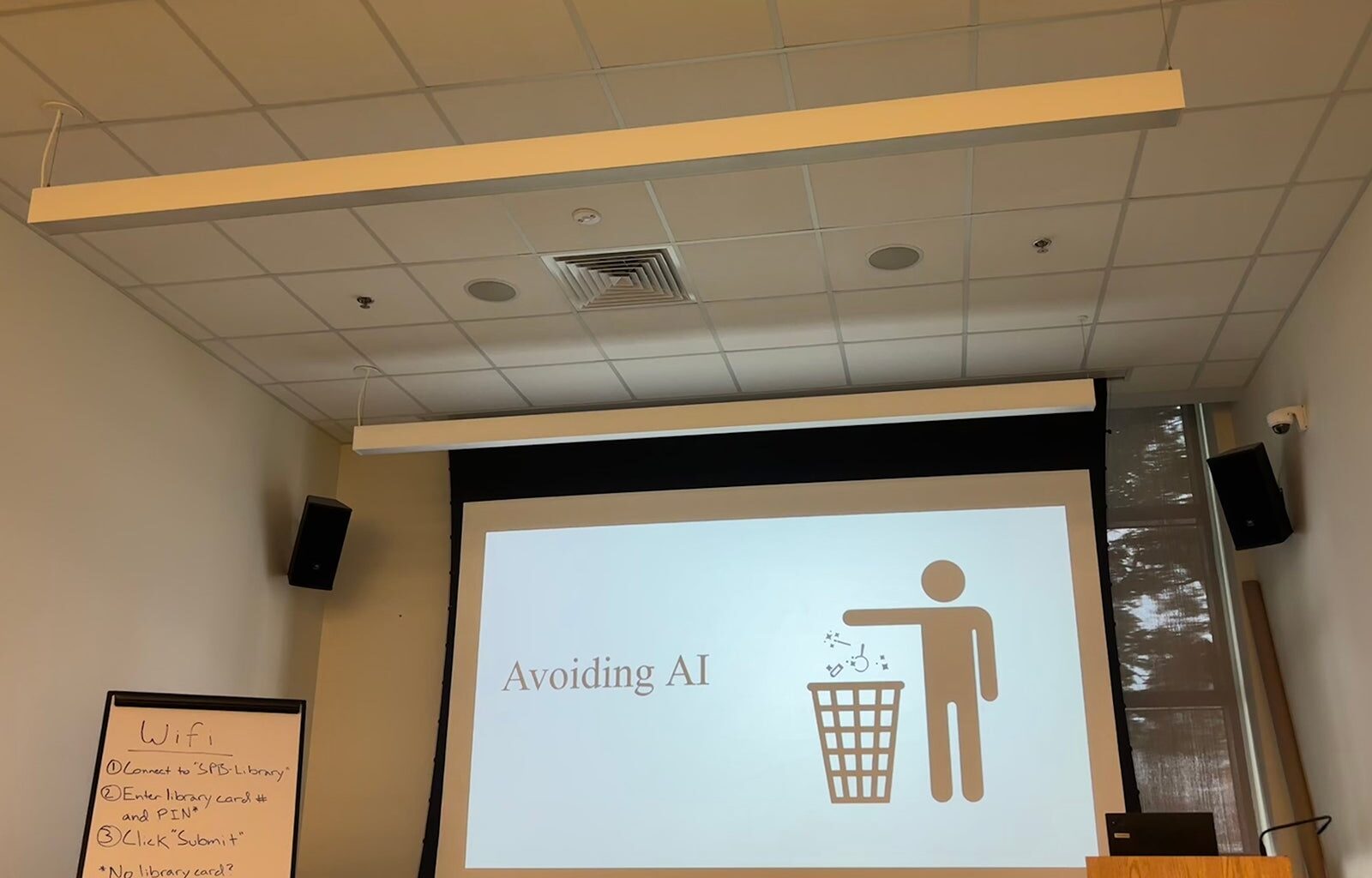
On Tuesday, the Free Library of Philadelphia hosted “Avoiding AI: A Hands-on Workshop,” the second event in its Critical AI Literacy series, showing participants how to disable unwanted AI features in operating systems and popular apps while protecting their privacy.
Charlie Bailey, a librarian at the South Philadelphia Library, said people are increasingly frustrated as AI features appear across websites and apps, altering familiar interfaces without users actively choosing them.
“With AI specifically, it feels like it’s everywhere all at once in places … and it’s not something that people are enabling or or actively turning on,” Bailey said.
He said that understanding how to avoid AI is becoming just as important as learning how to use it.
Bailey partnered with the Library Freedom Project on the series to help Philadelphians understand not only how AI works, but also the broader social, environmental and civic implications of its use.
Teaching critical AI literacy
Bailey said helping people understand AI’s risks is a natural extension of the library’s role as a resource that communities turn to for support.
“Part of educating the public about the pitfalls of AI and how using AI can be destructive, can help them protect their data and privacy,” Bailey said.
Alison Macrina, founder of the Library Freedom Project, said librarians increasingly find themselves helping patrons navigate confusion created by AI-generated information.
“[AI] is causing really fascinating issues for library workers,” Macrina said. “I think that library workers are seeing a lot of confusion about what is real and what libraries can help them find.”
Rather than treating AI as an abstract concept, the workshops focus on practical skills, from explaining technical terminology to showing participants how AI tools actually work and what they can and cannot do.
“[We’re] trying to break down what are the actual technical capabilities of the tools that you are using,” Macrina said. “We try to connect them with ways that they can get organized in their community.”