
Beth Ann Rosica’s writings are a blend of news, opinion, and analysis.
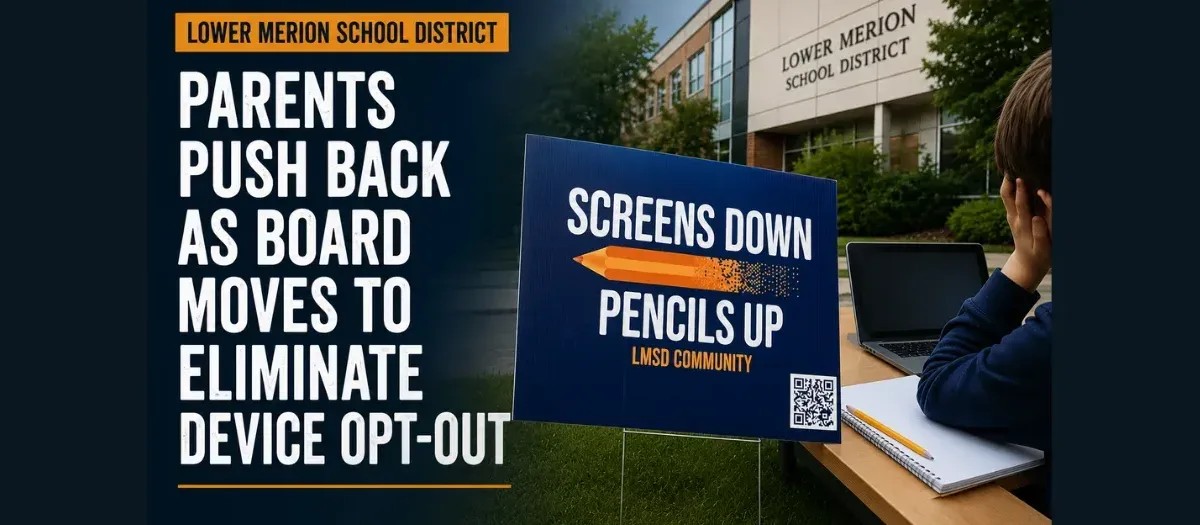
Last week, the Lower Merion School District Policy Committee voted 3-1 to advance a contentious technology policy that includes the elimination of parents’ ability to opt their children out of using district-issued devices. The proposal will advance to the full school board on August 17, 2026.
At least 50 community members showed up for the policy meeting last Monday, most of whom are parents and grandparents in the district. Many signed up prior to the start of the meeting to make a public comment — however several residents were denied the opportunity to speak.
Pencils Over Pixels, a grassroots organization of parents, teachers, and community members, founded in response to the district’s proposed policy changes, encouraged participation at the meeting.

Buttons worn by community members
School Board President Kerry Sautner announced at the start of the meeting that the committee would allocate only 45 minutes to public comment and discussion and those who did speak were limited to three minutes. Speakers were called to the podium in groups of five and after they finished making comments, board members and district administrators addressed some of the questions.
Comments focused on the opt-out process, content filtering, software, privacy, and screen time. Two comments criticized the board for appearing to acquiesce to Superintendent Frank Ranelli. Matt Posey, a parent in the district, alleged the superintendent was actually directing the board and referenced a Right to Know request submitted by parent Sunil Vulli that revealed an exchange between Superintendent Ranelli (in black below) and Board President Sautner (in red below)
During the meeting, Sautner stated that her “Got it” response did not necessarily convey agreement but rather understanding.
Posey disagreed with Sautner’s characterization of her response.
“We repeatedly tried to work constructively with the board only to be met with performative outreach,” said Posey. “The Right to Know records I read into public comment showed the decision to eliminate opt out originated with Superintendent Ranelli, and the board simply rubber-stamped it. School Board governance in Lower Merion is completely inverted; rather than holding the superintendent accountable to the voters who elected them, the board instead acts as his public relations firm. The explosion of support we’ve received this week shows that families are tired of this facade and demand real accountability.”
After 45 minutes of comments and discussion, the Board President announced that no further comments would be allowed and the committee would switch to discuss proposed changes to the draft. A woman in the audience spoke out and said the board was not engaging in collaboration. “The way you are responding is ridiculous and does not facilitate a conversation.”
As the board prepared to pivot, a community member walked up to the podium and attempted to make a comment. A district employee approached and stood next to him, and the superintendent called for a recess. Board President Sautner said, “cut his mike,” and then called for a recess.
The Board recessed and never returned to the meeting room, rather they scrambled to set up a zoom link and after technical difficulties finished the meeting remotely.
Parents were deeply troubled by the limitation of public comments.
“Shutting down the public comment period and abruptly ending Monday’s meeting midway is an alarming reflection of this administration’s transparency crisis,” said parent Sunil Vulli. “We were never asking to force a choice on the district majority; we were simply asking for a reasonable, inclusive accommodation for families seeking a print based, analog path. While the district publicly marketed the repeal as a routine modernization update, their internal communications prove the superintendent explicitly ordered staff behind closed doors to ensure parents could not ‘opt out’ of the 1:1 screen loop. This systematic effort to block an inclusive accommodation is a severe breach of public trust.”
Parents also questioned the rationale of Board President Sautner leading the meeting.
The Policy Committee is co-chaired by Anna Shurak and Juanita Kerber; yet, Board President Sautner led and facilitated the policy meeting. While Co-Chair Shurak was participating remotely from Canada, Co-Chair Kerber was in attendance.
Director of School and Community Relations Amy Buckman responded to a request for comment justifying the board’s actions.
“As Board President, Dr. Sautner is an ex-officio member of all committees,” wrote Buckman. “She was the Board Director with the most seniority in attendance.”
Pencils Over Pixels Co-Founder Yair Lev disputes the district’s explanation.
“For more than six months, Superintendent Ranelli, Board President Dr. Sautner, and Board Member Shurak have shut out meaningful community input while aggressively protecting the district’s technology agenda,” said Lev. “It was therefore deeply troubling, but consistent with this pattern, to see Dr. Sautner take over the Policy Committee meeting even though board member Kerber is a co-chair. It reinforces the concern that a small group of leaders is controlling the process while other voices — on the board and in the community — are marginalized.”
While the elimination of the opt out policy is central to Pencils Over Pixels mission, parents are focused on additional technology issues.
“K–12 education occurs during a critical period of neurodevelopment when children’s brains and bodies are particularly sensitive to environmental influences,” said Dr. Erin Amini, a pediatrician and a mother to four children in the district. “Emerging evidence associates prolonged technology and screen exposure with adverse mental and physical health outcomes, including anxiety, depression, attention and behavioral difficulties, body-image concerns, suicidal ideation, sleep disruption, obesity, myopia, and musculoskeletal/postural changes. Given the amount of time children spend in school, educational technology policies should not only be grounded in academic outcomes, but also in pediatric health, neurodevelopment, and long-term wellbeing.”
Despite the results of the policy committee vote, the Pencils Over Pixels community continues to advocate for a policy that includes opt out options in addition to addressing privacy, oversight, and excessive screen time concerns. The policy is on the board agenda for August 17, 2026, and it remains to be seen whether it will receive the requisite five votes to pass.
Michael Balkin, Pencils Over Pixels Co-Founder, summarized the group’s frustration and dismay.
“Our group was deeply disappointed by the results of last Monday’s policy meeting,” said Balkin. “Internal emails suggest the board’s decisions were predetermined and in direct conflict with LMSD’s own mission statement. To us, this indicates that the board’s past collaboration with our group was performative rather than a genuine effort to engage with concerned parents. The proposed replacement policies contain no concrete improvements like meaningful parental choice, independent oversight, approved-only internet access, device opt in, or strong limits on excessive screen use and gamified apps. If the board wants to restore public trust, it must now demonstrate it is acting in good faith. The national backlash against screens and internet-linked devices for learning purposes has only just begun.”
Beth Ann Rosica resides in West Chester, has a Ph.D. in Education, and has dedicated her career to advocating on behalf of at-risk children and families. She covers education issues for Broad + Liberty. Contact her at [email protected].