
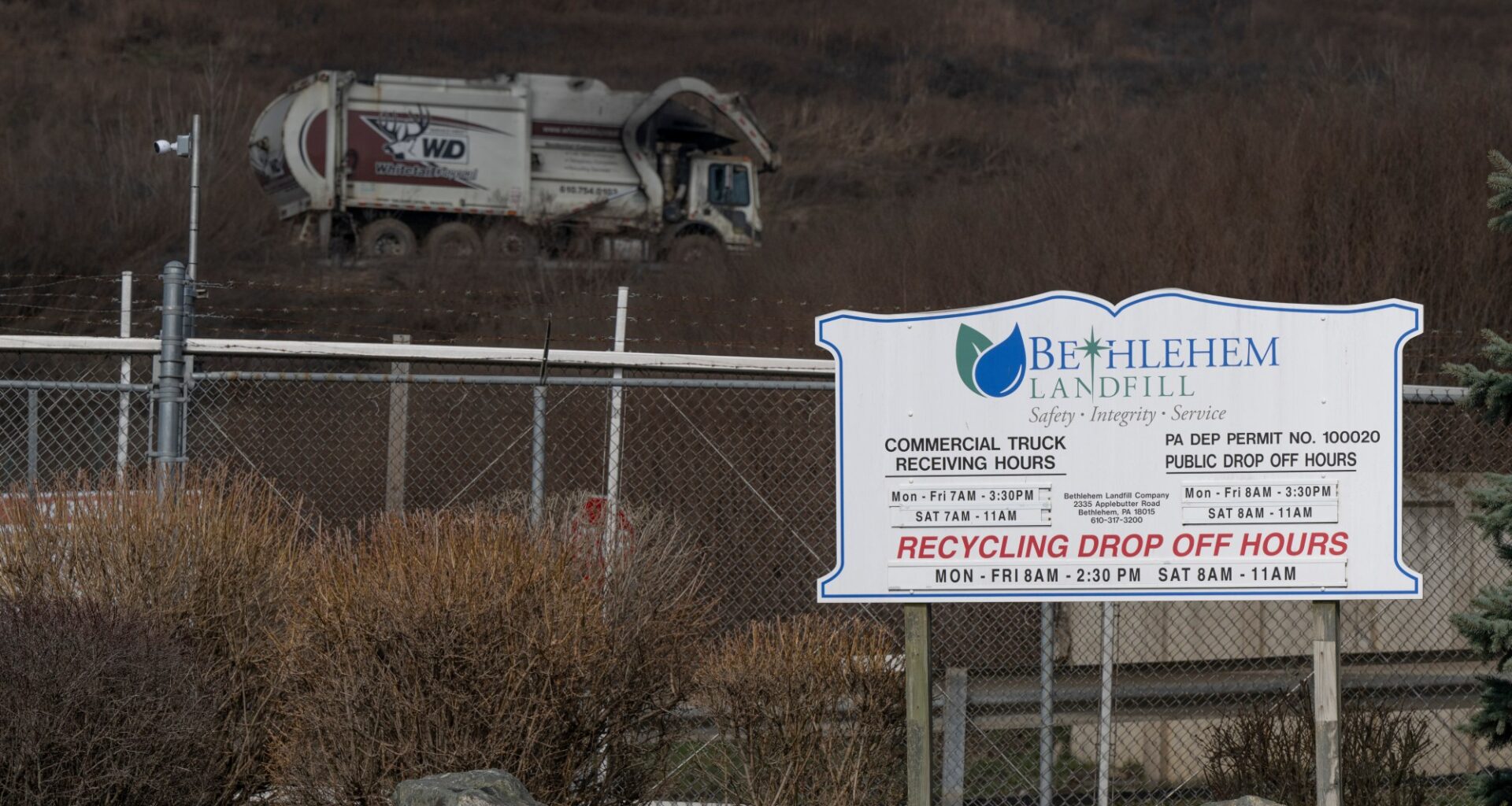
A survey measuring attitudes toward Bethlehem Landfill is already receiving pushback, even though the results won’t be revealed for two more weeks.
It’s the latest battle in a yearslong dispute over the landfill’s effort to expand that has played out in both court and the ballot box.
Bethlehem Landfill Co., in a news release, called the Lower Saucon Township community survey biased and unrepresentative.
Though the company targeted its concerns toward Lower Saucon Township Council, the survey was designed by the Lehigh Valley Planning Commission as part of a broader township-commissioned effort examining land use and township finances.
“They chose us because our expertise is planning, and we are neutral,” LVPC Managing Editor Matt Assad said. “Our motivation is only to give the township the best information they have to map out their future.”
“We didn’t develop any questions,” Victoria Opthof-Cordaro, president of Lower Saucon Township Council, said.
The survey asked respondents to pick up to three top priorities for the township’s future; what types of development they would be comfortable with; where development should be; what infrastructure is needed; and about environmental concerns, among other topics.
Of 481 responses to the survey, 11 came from nonresidents of Lower Saucon, according to Assad, who noted that those responses would be used in data collection.
“Decisions about the future of Lower Saucon should primarily reflect the views of Lower Saucon residents, and we question why individuals who do not live in the township were invited to participate in the survey,” Amanda Moley, a spokesperson for the landfill company, said in an email.
“It may have circulated through maybe the township social media a little bit,” said Jill Seitz, LVPC’s chief community and regional planner. “I think other people were able to find the survey, but it was really targeted to just folks living in and interacting in the Lower Saucon community.”
The latest dispute comes after a Northampton County judge ruled in December 2025 that a legal protection on part of the landfill’s land — which limits how it can be developed — should stay in place, blocking the company’s plan to expand there.
In addition to concerns about nonresident responses, Bethlehem Landfill Co. also took exception to the inclusion of a stock photograph of a landfill. The image in question appears in the survey as one of several building and land-use photos residents were asked to rate on a like-to-dislike scale, alongside images representing retail, office, agricultural and other development types.
“Including those images is like asking people to judge a hospital based on photographs taken in an operating room rather than the parts of the facility the public actually experiences,” Moley said.
The company also argued the survey failed to directly ask residents whether they’d rather continue receiving landfill-related revenue or face higher taxes and reduced services without it. The survey’s introduction began with information about financial benefits residents receive as a result of the landfill.
Christopher Borick, a political science professor at Lehigh University, said that though it was unusual to include nonresident respondents in data analysis, the core methodology of the survey was standard.
“At the end of the day, was the survey as constructed fatally flawed? I don’t see any evidence of that,” he said.
The survey is part of a broader township effort that also includes a separate, ongoing fiscal impact study by the Meyner Center for the Study of State and Local Government at Lafayette College, examining what the loss of landfill-related revenue would mean for township finances. Both the survey findings and the Meyner Center’s study are slated to be presented Aug. 26.
“I think that what’s happening here is an appropriate response to just in general what our community faces in the future,” Opthof-Cordaro said.
Benjamin White is a freelance writer.