
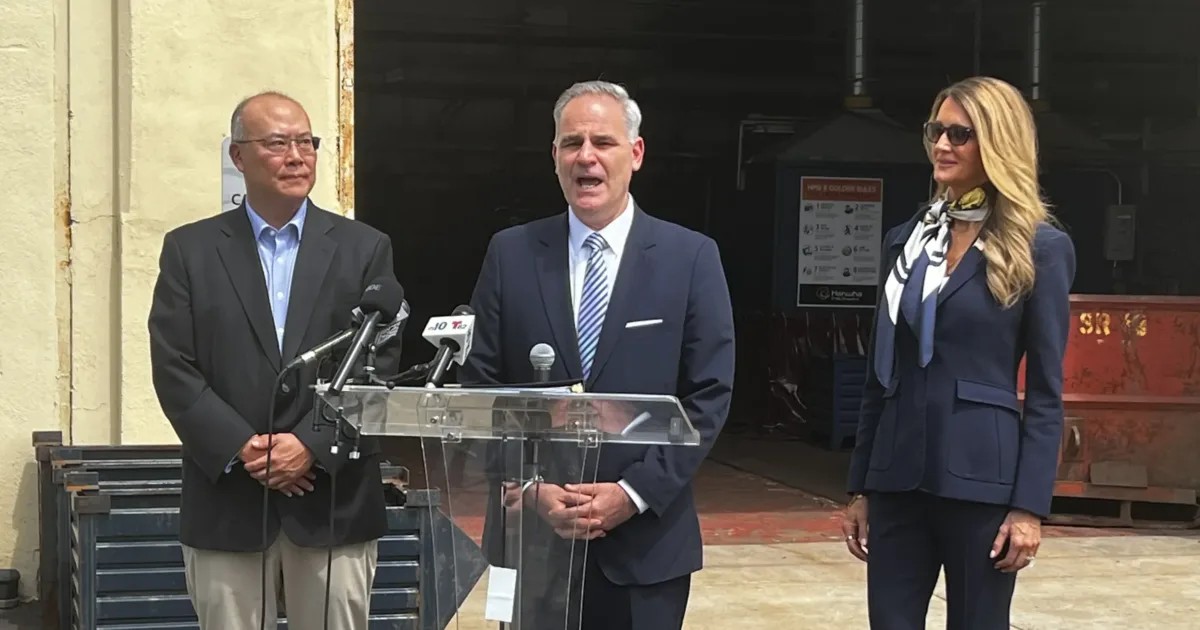
While the Hanwha Philly Shipyard is vital to national defense, federal officials touted the shipyard’s role as a job creator at a Monday press conference.
“We appreciate the administration’s support,” said Hanwha Philly Shipyard CEO David Kim.
“The president has been very clear that America is open for business,” said Chris Pilkerton, Assistant Secretary, Office of Investment Security, of the U.S. Treasury. Through the Committee on Foreign Investment in the United States (CFIUS), “our job is to ensure as we see international investment that comes into the United States, it’s done in a secure way, that’s its done in a transparent way, in a way that we can engage and help support the strategic vendors that help support this amazing business here in front of us.”
Pilkerton noted that the SBA is a “key partner” for the Treasury Department.
“America is back as a nation of builders,” Small Business Administrator Kelly Loeffler said. “We see it right here at Hansha Philly Shipyard. It’s incredible, already hundreds of millions of dollars of investment, hundreds of employees, an incredible apprenticeship class that now numbers about 200 and growing. But here’s what’s at stake: the future of America is not just building but economic strength and national security.”
The Small Business Administration began as the Small Defense Plants Administration, she said.
President Dwight Eisenhower started the SBA, “acknowledging the absolute critical nature of having a national supply chain, underpinned by small suppliers.”
Loeffler said that they’re “onshoring our supply chains.”
“That starts with America’s small businesses that make up 98 percent of all manufacturers across America, and that it’s absolutely critical that we have the policies in place to support their growth and we have to supply shipyards like this. And when you look at the Working Families tax cuts, that provide 100 percent expensing for made in America, that provides no tax on overtime for the hardworking men and women here, that we’re restoring our defense industrial base, making the war fighters of our nation stronger.”
The SBA put out billions in capital for manufacturers, with $32 million going to the shipbuilding industry, she said.
“President Trump has put in place fair trade, and that means tariffs,” she added, noting as she visits factories around the country, she’s seeing optimism. Tariffs “bring manufacturing back to America and create the jobs you see here that had lost out, hollowing out our industrial base for the last five decades, losing 5 million jobs. Now we’re going to have that strength back in America.”
“Economic security is national security,” said Pilkerton, echoing Trump and Treasury Secretary Scott Bessent.
“We want to be able to support shipbuilding, but we want to support communities,” he said. “And the reality is, growing this community. The plan that Hanwha has to grow and build more ships is only going to make us more secure.”
About 2,000 people work for Philly Shipyard, both vendors and employees. But they plan to grow to more than 10,000, said Kim.
Fideri News Network asked how many local suppliers and vendors service the Philly Shipyard. Kim said they have “roughly 1,000” suppliers.
“About three-quarters of them are local suppliers,” he said. “A meaningful number” are in Pennsylvania and “we continue to grow that base.”
Kim said as the company grows, it’s important to “grow our supplier base. We recently signed a MOU (memorandum of understanding) with the Philadelphia Chamber of Commerce (to) identify and grow our supplier base here in Philadelphia and in Pennsylvania.”
“Hanwha’s investment in our community will create up to 10,000 jobs and create tremendous opportunity throughout our regional economy, which is why we are proud to work with them to develop a local shipbuilding supply chain, identify and connect with local suppliers, address workforce shortages, and advocate for policies which position Greater Philadelphia as a shipbuilding hub,” said Shannon McLaughlin, a spokesperson for the Chamber of Commerce for Greater Philadelphia. “As the Greater Philadelphia shipbuilding ecosystem grows, this kind of local sourcing creates quality jobs, strengthens businesses, and increases economic mobility for our regional workforce.”
The Philly Shipyard has had a lot of support from the Trump administration, including “demand signals.” And the administration announced two more vessels to be built there at a recent christening ceremony, he noted. The government will spend $2 billion on those two ships.
“It’s that type of confidence that helps us to make investments,” he said. “That helps suppliers, as well.”
Loeffler said they’ve invested billions and not just in shipbuilding but in areas like [computer] chips and rare earth minerals.
Before the press conference, Hanwha Training Manager Megan Heileman said they plan to grow the current 200-member apprenticeship program to 500 trainees. They’re building a larger facility on the shipyard campus. Currently, they have 21 welding training booths. The new building will have 95. The apprentices rotate between the factory floor and the training facility during the three-year program, she said.
Once they’re proficient, they will receive an American Bureau of Shipping certification, she said.
Instructional Foreman Shawn Jenkins said the apprentices earn $24 an hour while they learn the skills needed to build ships. Welding was the hardest thing that he learned, he said.
“Welding is rough,” he said. “It’s like playing the piano.”
But Jenkins noted that women apprentices seem to learn welding techniques quicker than the men. The shipyard had 11 percent women workers in 2021, but that’s been increasing, said Heileman.
Hanwha Philly Shipyard currently builds one and a half ships per year, but plans to increase that output to 20 and is in the process of building more new dry docks, expanded quays, and advanced production facilities. Last year, it received a contract for a liquefied natural gas (LNG) carrier, the first U.S. order for that type of vessel in 50 years.
Before the press conference, Kim, Loeffler and Pilkerton held a roundtable discussion with elected officials and business leaders that was not open to the press.