
Most people would look at a stack of old newspapers and see recycling.
Sarai Najarro saw a runway-worthy skirt.
Najarro, 17, spent hours rolling and reinforcing hundreds of newspaper pieces with clear tape before assembling them into the sculptural skirt she paired with a top made from remnant fabric.
The painstaking process stretched the Reading High School senior’s creativity and technical skills.
“I really wanted to challenge myself with this piece,” she said. “I wanted to try something different, something new, something out of my comfort zone.”
Najarro, who is studying fashion manufacturing at Reading-Muhlenberg Career and Technology Center, was one of dozens of students who participated in Alvernia University’s Total Experience Learning Fashion and Sustainability Camp.
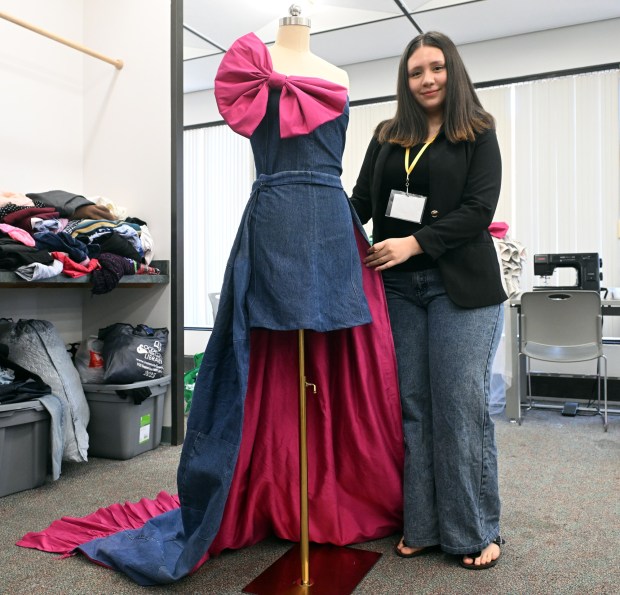 Sarai Martinez Najarro, 17, a senior at Reading High, displays a denim dress with train she created during Alvernia University’s Total Experience Learning Fashion and Sustainability Camp. (BILL UHRICH/READING EAGLE)
The group of fifth through 12th graders spent two four-day sessions learning that great fashion doesn’t have to come from brand-new materials.
Under the guidance of fashion designer and educator MeeAe Oh-Ranck, campers developed sewing and design skills while transforming donated clothing, fabric remnants and other discarded materials into original garments.
The campers also explored the environmental consequences of the global textile industry and learned how recycling and upcycling can reduce waste.
Like Najarro, several campers arrived with sewing experience.
Wyomissing High School freshman Emily Hoffecker was already sewing some of her own clothes before creating her first complete outfit at camp.
Estelle Machuzick, 15, a Wilson High School sophomore, and her sister Norah, 11, a sixth grader at Wilson West Middle School, were both taught by their grandmother and attended camp for the second year.
Others had never used a sewing machine before.
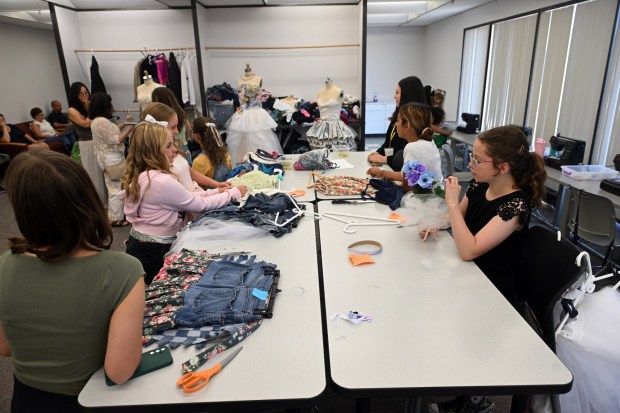 Students work on their projects during Alvernia University’s Total Learning Experience Fashion and Sustainability Camp. (BILL UHRICH/READING EAGLE)
All, regardless of skill level, brought imagination and ingenuity, Oh-Ranck said.
“The students have bright ideas, innovation and creativity,” she said.
Rather than directing the students, Oh-Ranck said she encouraged each to pursue individual ideas, stepping in only to provide occasional tips and advice.
The environmental lessons were woven into every project, Oh-Ranck said.
The textile industry consumes vast amounts of water and energy, generates chemical pollution through dyeing and finishing processes, and produces millions of tons of waste each year, campers learned.
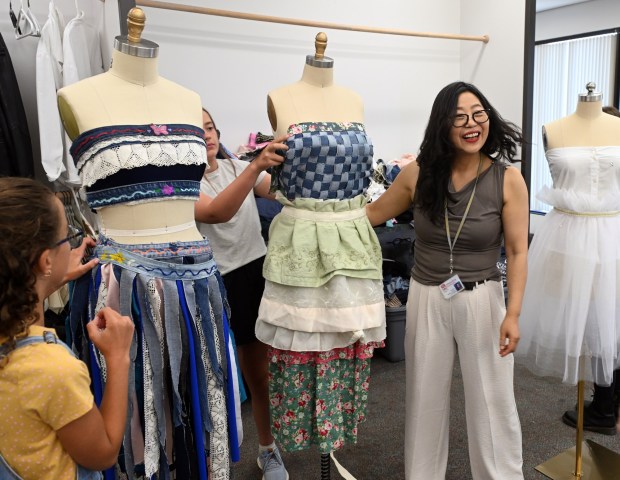 MeeAe Oh-Rank, director of the Fashion Sustainability Camp program at Alvernia University’s Total Learning Experience in the College Towne campus, helps students realize their fashion ideas. (BILL UHRICH/READING EAGLE)
Otylia Waholek, 12, a seventh grader at Conrad Weiser Middle School, said those lessons changed the way she thinks about clothing.
“I didn’t know that all of the dyes can go into the rivers and lakes and pollute them and kill animals,” she said.
Ten-year-old Pam Iswalt, a fifth grader at Gov. Mifflin Intermediate School, incorporated that knowledge into an allegorical design.
Working with a partner, she created a flowing outfit with dangling strips of denim, lace and ribbon, inspired by jellyfish. The movement of the fabric streamers symbolizes ocean life, she explained, while also serving as a reminder of the way textile production and waste can harm aquatic ecosystems.
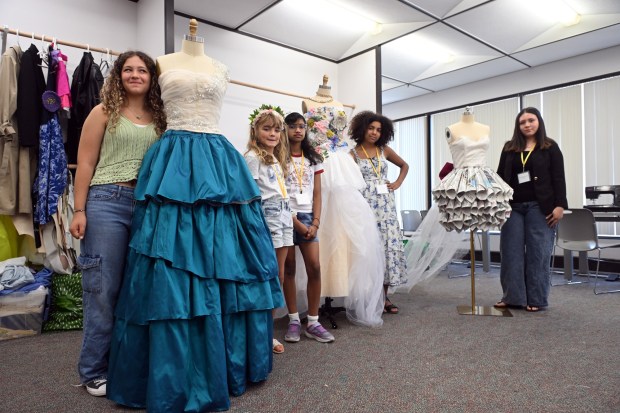 From left, Natalie Poe, 13, an eighth grader at Wilson Southern Middle School; Charlotte Hill, 10, a fifth grader at Cornwall Terrace Elementary School; Cherub Tixeira, 11, a sixth grader at St Ignatius Loyola; Novalee Raser, 13, and eighth grader at Wilson Southern; Sarai Martinez Najarro, 17, a senior at Reading High, display their creations during Alvernia University’s Total Learning Experience Fashion and Sustainability Camp. (BILL UHRICH/READING EAGLE)
The environmental lessons also shaped the work of sisters Grace, 11, and Hope McCalicher, 10, students at Gov. Mifflin Intermediate School.
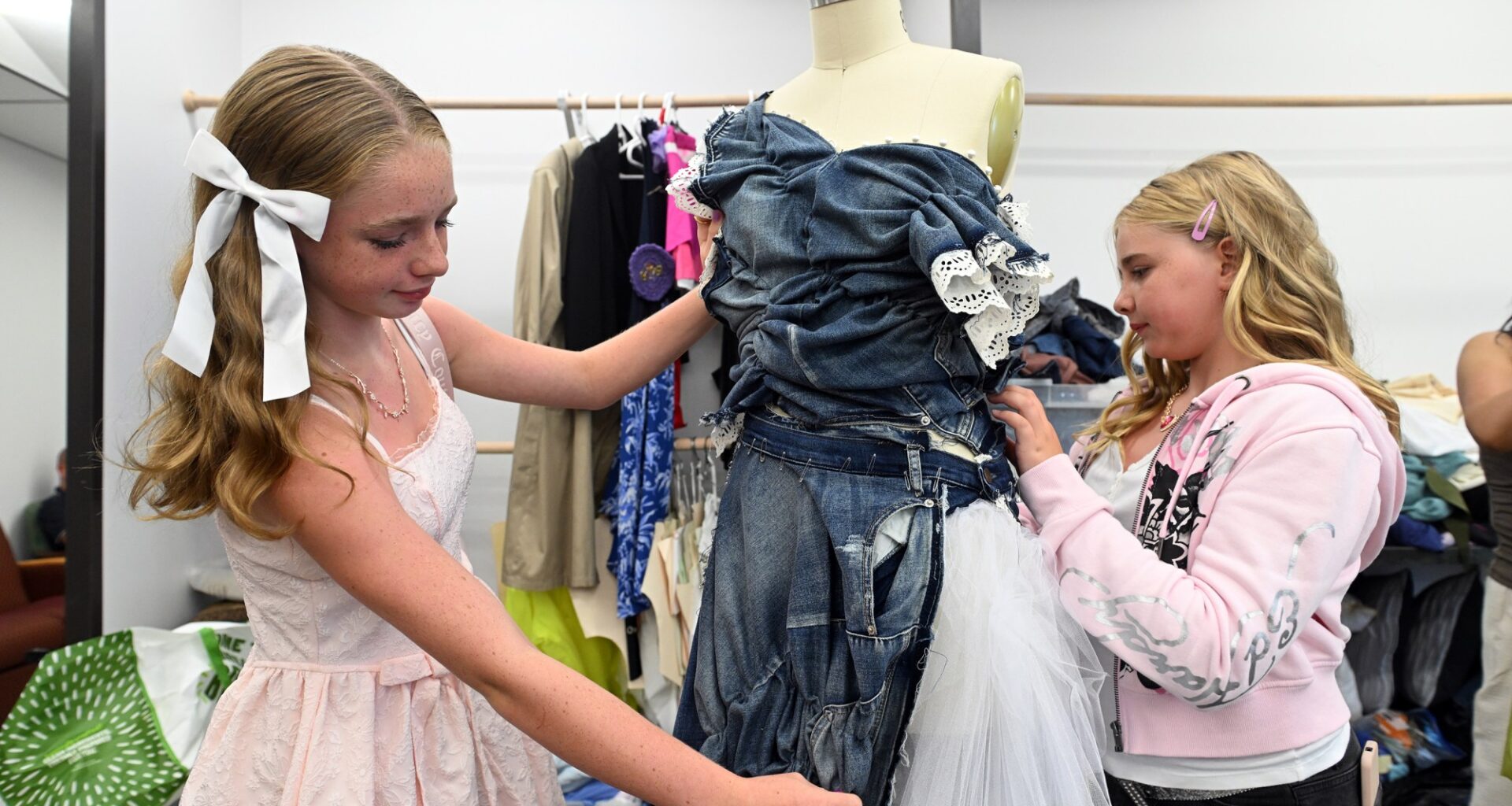
Inspired by the camp’s emphasis on reusing materials, the sisters started with two pairs of pre-owned jeans. They deconstructed and reshaped the denim into an avant-garde ensemble inspired by steampunk fashion, complete with ruching, lace and vintage-style safety pins.
“We’re trying to help the environment,” Grace said. “We’re reusing things and taking those scraps and making them something.”
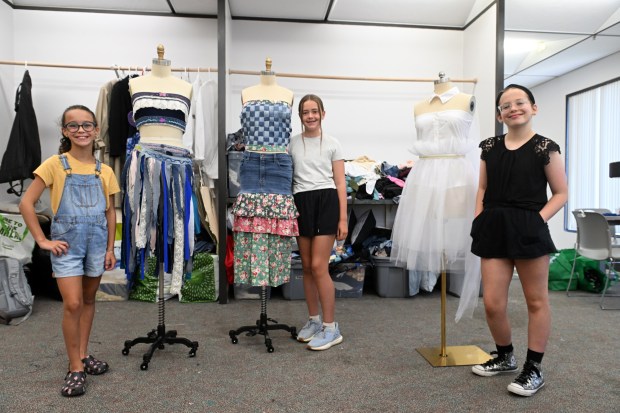 From left, Pam Iswalt, 10, a fifth grader at Gov. Mifflin Intermediate; Norah Machuzick, 11, a sixth grader at Wilson West; and Otylia Waholek, 12, a seventh grader at Conrad Weiser Middle School display their work during Alvernia University’s Total Learning Experience Fashion and Sustainability Camp. (BILL UHRICH/READING EAGLE)
Natalie Poe, 13, a Wilson Southern Middle School eighth grader, also incorporated environmental lessons into her design.
She and her partner, Quinn Kosher, a Wilson ninth grader, created a garment titled Beauty and the Beast, intended to represent both the creativity of fashion and its environmental costs.
Many of the camp’s materials came from Opportunity House’s OppShop warehouse, Oh-Ranck said. The donated clothing and textiles gave students a chance to rethink what others had discarded, she said.
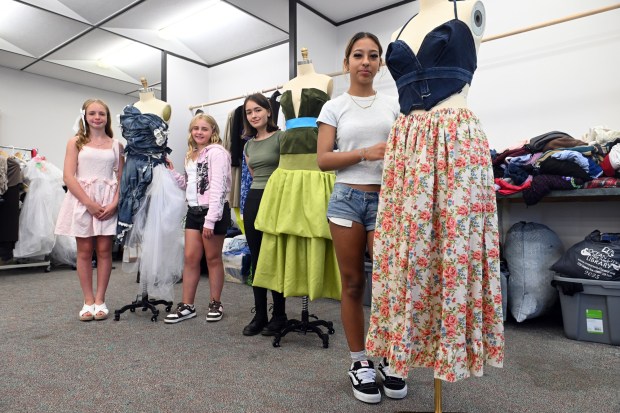 From left, sisters Grace, 11, and Hope, 10, McCalicher, sixth and fifth graders at Gov. Mifflin Intermediate; Estelle Machuzick, 15, a sophomore at Wilson; Emily Hossecker, a freshman at Wyomissing, display their creations during Alvernia University’s Total Learning Experience Fashion and Sustainability Camp. (BILL UHRICH/READING EAGLE)
Campers also learned about the nonprofit’s mission to aid those experiencing homelessness and how donated goods support people throughout the community.
For Oh-Ranck, learning to sew is only part of the campers’ experience.
“It’s all about creating a product using someone else’s trash,” she said. “We’re not just talking about fashion. We teach them environmental aspects, and we talk about how we can make a change.”
By the end of camp, old newspapers, worn denim and fabric remnants had become wearable art, and for the students, reminders that creativity and sustainability can go hand in hand.