
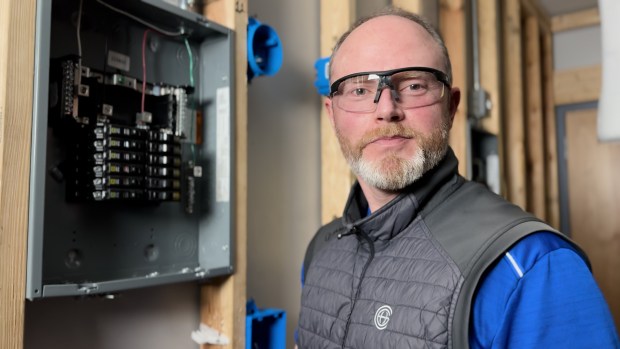
Charles Campbell earned a bachelor’s degree in business from Muhlenberg College and worked for more than 15 years as a commercial software field sales representative. But when his King of Prussia employer decided to strategically invest in artificial intelligence tools, positions like his were eliminated.
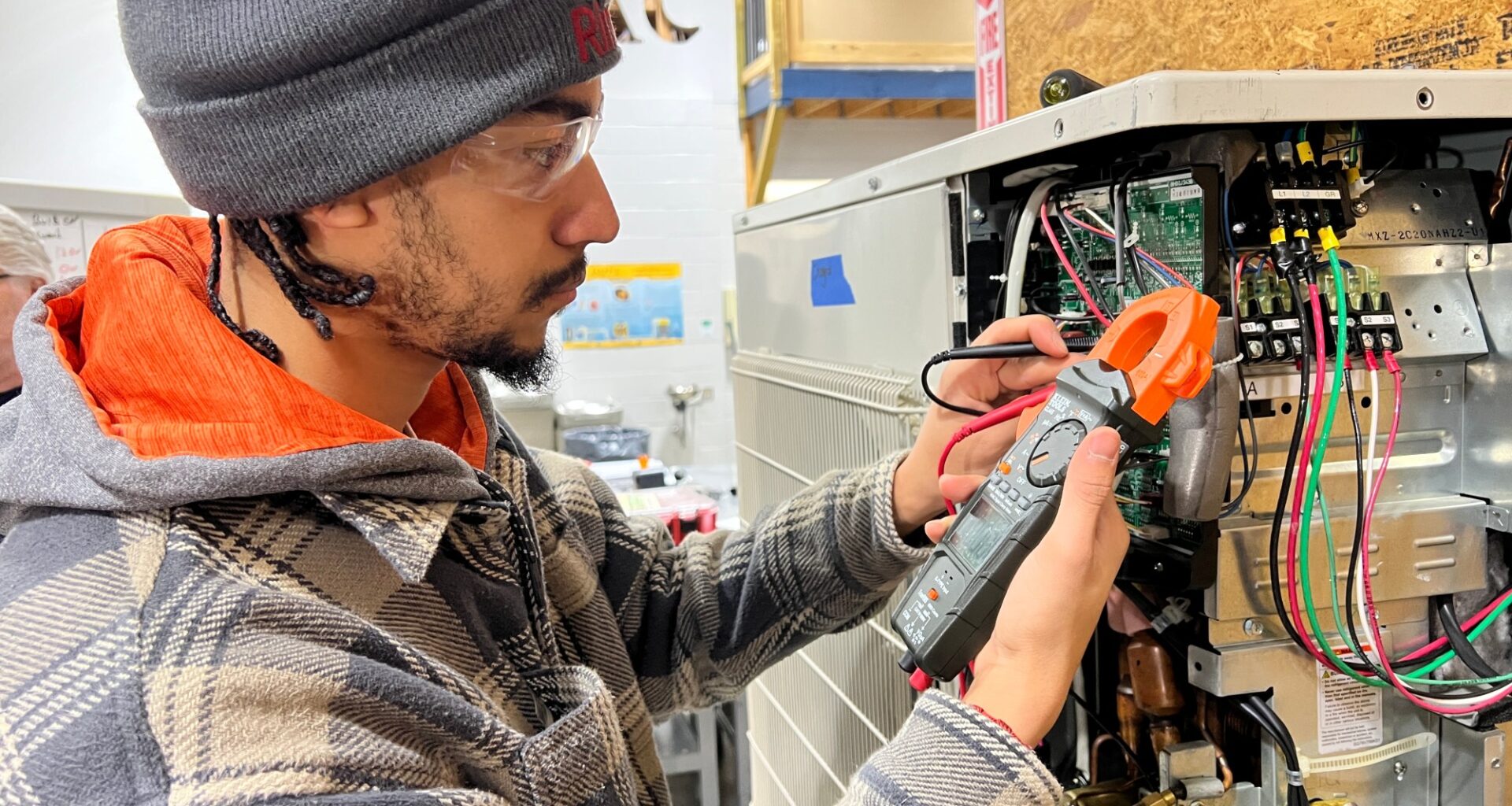
 Charles Campbell decided to learn a trade and enrolled at Johnson College’s Hazleton campus. Campbell will start the second semester of his first year in the college’s electrical construction technology program this fall and already started an internship in late July with a plant in the Humboldt Industrial Park in Hazle Township.
He received a severance package, so he took some time off to decide what to do. Campbell started a master’s program in computer information science at Bloomsburg University. Even then, however, he was uncertain of his future. So, Campbell, who is in his mid-40s, decided to learn a trade and enrolled at Johnson College’s Hazleton campus.
“I decided a trade program was more reliable as far as practical experience,” the Philadelphia native said.
Campbell will start the second semester of his first year in the college’s electrical construction technology program this fall and already started an internship in late July with a plant in the Humboldt Industrial Park in Hazle Township.
Campbell is among a growing number of students — recent high school graduates and adults who are changing careers — enrolling in trade schools for a reliable career in which they can enter the workforce in a year or two and earn a great salary, all while saddled with less college debt.

A student works in the Carpentry and Cabinetmaking Technology at Johnson College.

Students work in the Electronic Engineering Technology program at Johnson College.

A student works in the Electrical Construction Technology program at Johnson College.
Show Caption
1 of 3
A student works in the Carpentry and Cabinetmaking Technology at Johnson College.
Bill Burke, the Scranton-based Johnson College vice president of enrollment and student affairs, said trade school enrollment has been increasing nationally for several years.
The Education Writers Association reported that according to a March 2025 report by the higher education marketing and research firm Validated Insights, enrollments in trade schools have been growing and are projected to continue significant growth through 2030, significantly outpacing overall growth in higher education enrollment.
According to the report, fall enrollment at trade schools is projected to grow 6.6% per year, while market revenue is projected to grow at 6% annually through 2030. These rates are well above enrollment growth projections for higher education, which Validated Insights estimates at 0.8% annually.
“Our enrollment since 2021 has increased 30%,” Burke said. “We’re seeing more and more interest.”
He said Johnson’s enrollment was 693, as of mid-July. Enrollment is up 60% since 2018, he added.
He said the school’s building trades programs in electrical, HVAC (heating, ventilation, air conditioning), welding and radiologic technology are among the most popular.
“I think the number one thing for students and parents is they really see a return in investment,” Burke said. “They (students) are only here one or two years, and see the amount of money they could make when they go to work.”
He said electricians and welders, for example, could start at $50,000 to $60,000 a year.
Many factors in growth
Karla Carlucci, Ed.D., executive director of the Career Technology Center of Lackawanna County (CTCLC), Scranton, said enrollment continues to grow each year at the high school-level program and has reached its highest enrollment yet — 1,038 — for the coming school year. That’s a 41% increase over the 736 students enrolled five years ago for the 2021-2022 school year.
At the school, students from nine area high schools enrolled at the center spend a half day of each school day at their home school and a half day at CTCLC.
“We currently have waiting lists in several programs, including many construction trades, manufacturing programs, such as welding and automotive technology, cosmetology and several healthcare programs,” Carlucci noted.
“I believe there are several factors driving this growth,” she said. “One significant factor was the COVID-19 pandemic. During that time, many people realized that skilled trades remained essential even while other industries slowed or shifted to remote work. That realization has continued as technology and AI evolve. Many skilled trades still require hands-on expertise that cannot simply be replaced by technology.”
Carlucci said another major factor is value. Students and families increasingly recognize that a career and technical education provides high-quality training at a fraction of the cost of a traditional four-year degree while leading directly to high-demand careers with excellent wages.
Burke said 20% to 25% of Johnson’s students transfer from another institution because they decide the career they were seeking with a four-year college degree wasn’t for them. Even graduates of four-year colleges decided to learn a trade when they couldn’t find a job.
“We see that a lot,” Burke said.
“Our programs are streamlined to need,” he said. “We’re starting our fourth year at our Hazleton campus, where there are such programs as manufacturing, warehousing building. “Our students are in there doing the work from day one. Most of our students are working.”
He noted electricians and similar trades will always be needed.
“These jobs are recession-proof, AI-proof.”
Learning diverse skills
Campbell said his internship also is helping him diversify his skills. As part of the plant maintenance team, he has been exposed to not only electrical work, but also welding.
He has realized that working in a cubicle wasn’t for him. He learned that after years of trying to find his place.
He initially attended Temple University and took two years of classes after high school, then started working at a Walmart for several years. He moved up from an hourly position into the management program in the Allentown area before attending Muhlenberg. He said that while he loved his four-year college experience, he realized the resulting opportunities weren’t what he was interested in.
“The trades have always been an area of interest, but they were never really presented to me as a land of opportunities,” Campbell said.
Now he is finding more opportunities in a trades career.
“This is much more fulfilling,” he said. “l feel like the white collar jobs are getting pared down.
“I think the biggest thing Johnson College offers is the ability to pivot and ramp up into another industry, in my opinion. They embraced me and brought me up.”
Still growing
Burke said the school’s forecast for enrollment growth continues through 2028, mostly due to Hazleton campus.
He said the school also offers a transportation technician training program at a Wyoming Avenue, Scranton, site and an aviation maintenance training program at the Wilkes-Barre/Scranton International Airport.
High school students also can simultaneously take classes at Johnson College to earn college credits. Burke said he estimated that 14 students recently graduated from high school and Johnson in the same year.
Carlucci said CTCLC has dual enrollment agreements with some schools and articulation agreements, which allows students to earn post-secondary credits.
The school offers high school students programs in areas such as cyber security, computer networking, digital communications, commercial illustration.
“We currently have high school students participating in cooperative education placements earning between $20 and $40 per hour before they graduate,” Carlucci said. “We also have graduates receiving job offers ranging from approximately $40,000 to over $100,000 annually, depending on the occupation, employer, certifications earned, and whether they choose to travel for work, particularly within the union trades.”
She said some of the highest-demand careers from an employer perspective include automation, cybersecurity and computer networking, even though those programs are still growing their enrollment. Employers are actively seeking graduates in these fields, Carlucci said.
The school continues to see exceptionally strong demand in construction trades such as HVAC, electrical, carpentry, and building mechanics, as well as welding, automotive technology and healthcare programs, including patient care technician, EMT and medical assisting.
“From an enrollment standpoint, we anticipate continued strong interest,” Carlucci added. “In fact, we are approaching the physical capacity of our building and are exploring scheduling options and other alternatives to serve additional students.”
She also said it is not just enrollment that is increasing, but student achievement is, as well. Students continue to improve their performance on the NOCTI assessments, which are Pennsylvania’s technical end-of-program assessments.
“Increased enrollment accompanied by improved student performance demonstrates that career and technical education is producing both more graduates and highly skilled graduates who are prepared to meet workforce needs,” Carlucci said.