
One warm, August night, while driving through the middle of nowhere with one of her sons, Diane Turnshek’s car broke down.
The astronomer and lecturer at Carnegie Mellon University pulled over on the side of the road and waited an hour and a half for a tow-truck. Nevertheless, she found herself in luck.
It was Aug. 12 — a peak viewing period of the Perseids in dark skies. Ones that can only really be found outside of the city (in “middle of nowhere” places).
“We’re sitting there waiting for the tow truck, and it was the most glorious night in the dark with this meteor shower.”
This Aug. 12, the Perseids will peak once again.
What are the Perseids?
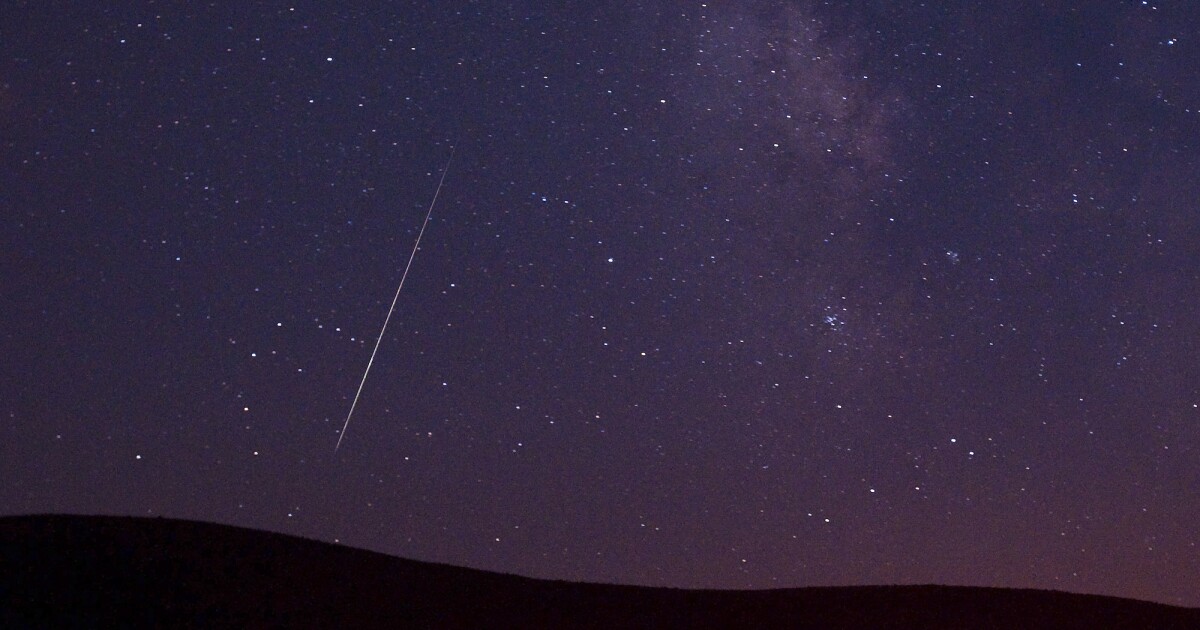
The Perseids are an annually recurring meteor shower and, according to NASA, one of the most popular. The event lasts for over a month from mid-July to late-August, peaking mid-August.
A meteor is the streak of light produced by a bit of space rock hitting the atmosphere.
The Perseids come from 109P/Swift-Tuttle — a 26 km wide comet with an 133 year orbit around the sun. The earth passes through the comet’s trail of rocks every year, creating one of earth’s annual meteor showers. The meteors appear as if they originate from the constellation Perseus, hence the name.
“Every 133 years the comet comes around and replenishes the supply of rocks in its path.”
According to Turnshek, the last time Swift-Tuttle came by in 1992, the comet burned off more rocks into its stream. This resulted in “some really absolutely lovely meteor showers since that year.”
Meteors can only be seen for a second or two, produced by pea-sized rocks hitting the atmosphere. “Fireballs,” or larger rocks, “sizzle” in the sky, according to Turnshek. Their collisions can bring multiple colors and streaks.
In clear and dark sky conditions, 50 to 100 meteors could be seen an hour.
“There were 300 per hour the next year [after the comet passed by], 1993. There were 200 per hour in 2016,” said Turnshek. “So now 100 per hour seems like not that much, but it’s beautiful when you’re in a dark place.”
The best time to view the shower is between midnight and dawn on Thursday, but meteors could be seen as early as 10 p.m. Wednesday.
This year, the Perseids will coincide with a solar eclipse and a new moon. Pittsburgh will only be able to see a partial solar eclipse — a little under 2% — from 1:11 p.m. to 2:18 p.m., peaking around 1:45 p.m. The total solar eclipse will be visible in Spain, Iceland and Greenland.
Light Pollution
Unfortunately, like most cities in the world, Pittsburgh has a considerable amount of light-pollution. Light pollution, while not recognized as a pollutant by the EPA, refers to the improper or overuse of artificial light outdoors. According to Turnshek, blue light from LEDS, fluorescents and mercury lights, are the most disruptive.
“It obliterates the sky. You can’t see the stars,” Turnshek said. “It just grays everything up. And where we live in downtown, you can see a handful of stars.”
Outside astronomical impacts, Turnshek points to light-pollution being an environmental justice issue.
“Once you disrupt your circadian rhythm by having artificial light at night, you run the risk of higher risk of many different diseases.”
These include depression, diabetes, hormonal cancers, Alzheimer’s, Parkinson’s, and heart disease.
“The list just goes on and on of the things that people in areas where the artificial light at night is more — have more risk of all these different diseases,” said Turnshek. “And where is that in a city? It’s in the areas where there are people who don’t have the means and the ability to reach the government agencies that are putting the lights in.”
Even with the light, there are still options to see the meteors. Here’s how to catch them in the Pittsburgh-area.
City-Limits
The heart of the city is undoubtedly bright, but there are some places to get away.
Riverview Park (Perry North)
Park goers can catch a few hundred stars and the beginning of the visible shower at 10 p.m. from the hillside next to Allegheny Observatory in Riverview Park. The park closes at 11 p.m.
Frick Park (Regent Square)
Braddock Trail in Frick Park’s east side is deep in a ravine, making it a good place to get out of the light. The park closes at 11 p.m. Just outside the city
While the outer-suburbs aren’t pitch black, they aren’t as light as the heart of the city.
According to Turnshek: “If you were in Pittsburgh and you felt like driving somewhere to get a nice dark sky to see the most meteors, you would want to go 45 minutes north up I-79.”
Apart from that, individuals can access a number of viewing spots an hour or so from the city.
Far, but worth it
For those committed to seeing the Perseids in full force, a darker sky would be necessary. Several Pa. state parks are hosting Perseids viewing events. Here are a few under three hours from the city.
Perseid Meteor Shower Watch (Chapman State Park) — Aug. 12, 10 to 11:30 p.m.
Meet at the beach with a chair or blanket.
Perseids Meteor Shower Watch (Clear Creek State Forest) — Aug. 14, 8:30 to 10 p.m.
Meet at Laurel Fields with a chair or blanket.
Stargazing & S’mores (Oil Creek State Park) — Aug. 14, 8:30 to 10 p.m.
At the McCrea Farm/ Cross Country Ski Area, individuals can learn about the night sky while seeing meteors fly by. Registration is required.Tips
Some ways of stargazing are better than others, even if you’re in a dark sky. Here are some tips to get the best experience.
Be careful not to look at your phone once you’ve begun looking at meteors. Your eyes have to adapt to the dark; light from your phone will disrupt that. You don’t need any special equipment to see meteors. Binoculars and telescopes are cool, but fresh eyes are all you need. To the east and south of Pittsburgh are forecasted to be a bit cloudy. No matter where you end up, north may be your best bet.