
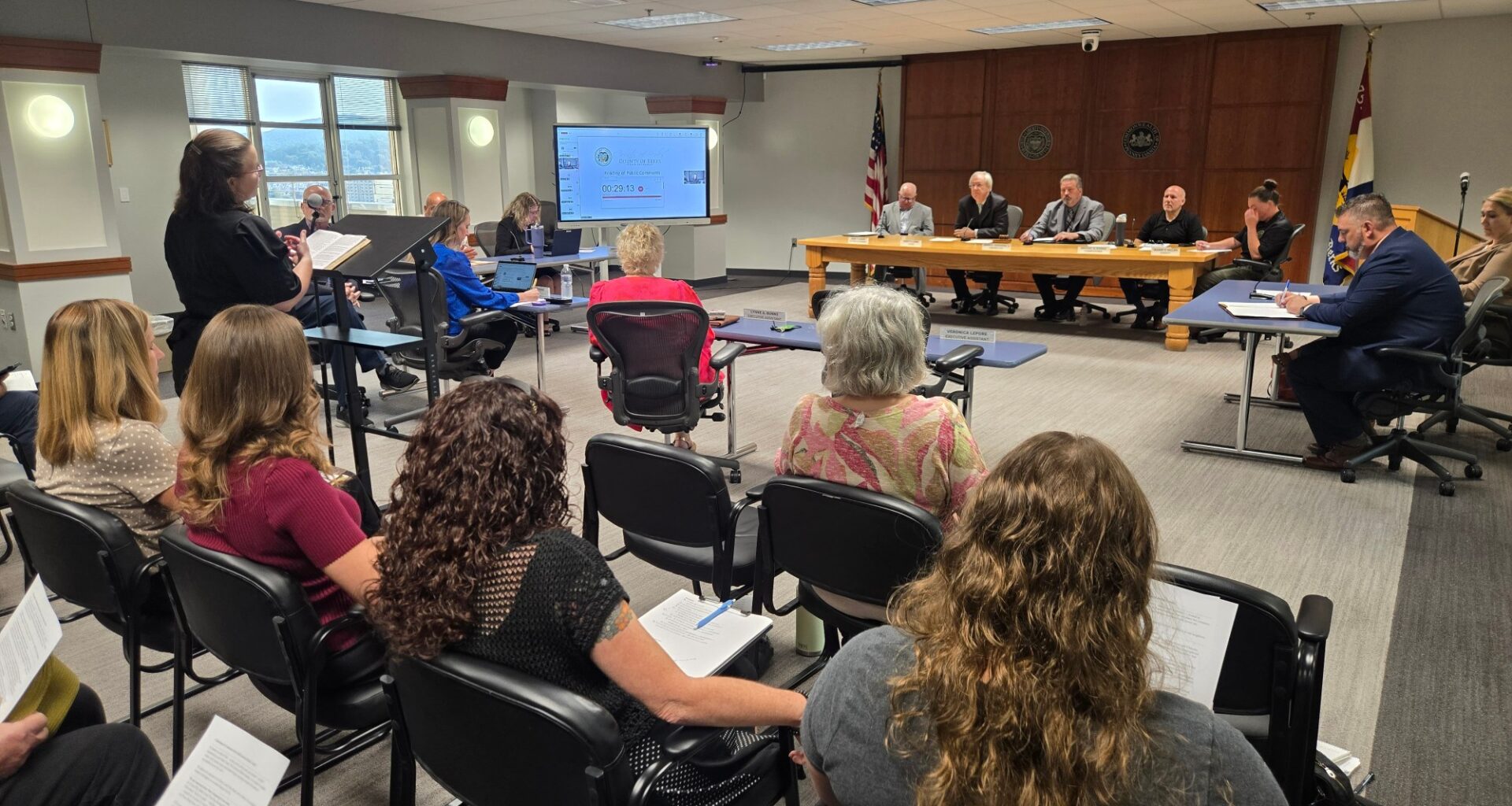
More than 20 leaders of the local faith community have joined a group of citizens calling on Berks County officials to end longstanding policy of transferring individuals in its custody to U.S. Immigration and Customs Enforcement.
Several of those leaders attended Wednesday’s meeting of the Berks County Prison Board to voice their opposition, presenting a “statement of conscience” signed by 21 faith leaders from across the county.
The Rev. Mandy Miller of Holy Cross United Methodist Church and the Rev. David Duquette of Pennside Presbyterian Church read from the statement during the meeting.
“We speak as people of faith — pastors, priests, rabbis, imams and ministers — rooted in communities across Berks County,” Miller said. “We come from different traditions, but we share two common values: every human being carries inherent dignity and people entrusted with power are accountable for how they use it.”
She went on to say that action taken by those in power in the name of the people “belongs to all of us.” And when that action involves voluntarily cooperating with an agency like ICE, she said, opposition to that choice must be voiced.
“ICE is not a neutral law enforcement partner,” Miller said. “It is an agency that holds people in conditions that violate basic standards of human decency. It is an agency that has denied elected officials — county commissioners, state and federal legislators — their legal right to inspect detention facilities under their jurisdiction.”
And, the statement read, it is an agency that has seen more than 50 people in its custody die since January 2025.
“These are not abstractions,” Miller said. “These are the consequences of collaboration.”
The issue
The opposition to the practice of holding people in the Berks County Jail beyond their scheduled release first gained attention last spring.
At an April 2025 meeting, the prison board voted unanimously to increase the amount of time it would hold someone at the county jail who is accused by ICE of being illegally in the U.S. to 24 hours from four hours. The change allowed the possibility of detainment up to 48 hours under extenuating circumstances.
Faced with the possibility of losing more than a quarter of a million dollars in annual federal funding, officials said the move was an attempt to balance compliance with detention requests and the rights of those being detained.
The issue arose when District Attorney John T. Adams, a member of the prison board, said he received information that the county was in jeopardy of losing about $290,000 a year in federal emergency management funding if it did not comply with President Donald Trump’s priorities on immigration enforcement.
Adams recommended the county change its policy to avoid any potential funding loss.
Prison board members have said the jail has an orderly process of honoring detainers.
Jail officials say immigration status is checked when people are brought into booking and that ICE is notified if someone is found to be here illegally. A judge determines whether the person goes to jail or will be released on bail.
If they go to the jail, their immigration status is checked a second time and if the jail confirms that status they again notify ICE.
The opposition
The board’s decision garnered backlash from members of the community, including from the newly created Berks Organizing Workgroup.
Members of the organization and other citizens have spoken at meetings of the prison board and county commissioners, asking for the end of the detainer policy and against now-cancelled plans for ICE to build a detention center in Upper Bern Township.
On Wednesday, faith leaders added their voices to the opposition.
“We call on the Berks County Prison Board to end their pipeline to ICE,” Duquette said. “Our faith traditions compel us not to look away from suffering when we have the power to address it.”
Duquette claimed the prison board has built a cooperative relationship with ICE that goes beyond what federal law requires.
“None of this is mandated,” he said. “All of this is a choice, justified by an argument that it was necessary to keep $290,000 in federal emergency funding.”
Duquette said he and his fellow faith leaders are asking the board to no longer notify ICE about the immigration status of people in custody, to no longer honor ICE detainer requests and to allow people to be released when their time has been served.
“Let them return to their lives, their families, their communities while due process continues,” he said. “This is not a negotiation about hours. There is no version of cooperation that is acceptable to us — not four hours, not one hour, not one phone call.
“The relationship must end.”
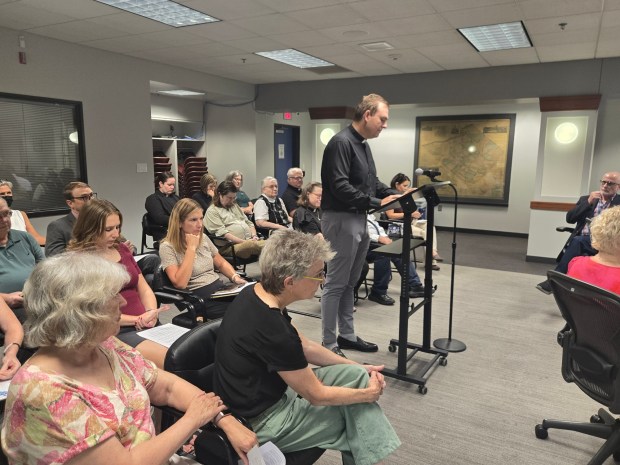 The Rev. Hans Becklin, senior pastor at Trinity Lutheran Church in Reading, asks Berks County leaders to consider how they work with ICE. Becklin’s comments came during a county prison board Wednesday. (KAREN SHUEY – READING EAGLE)
The Rev. Hans Becklin, senior pastor at Trinity Lutheran Church in Reading, also spoke Wednesday. He read two Bible passages in which God directly states that we should love strangers in our midst. He said they deserve serious study and consideration
“Even in ancient times there were attempts to curtail the rights and privileges of the stranger and God corrected those attempts,” he said. “God insists that we do not see strangers in a different way than we see the citizens that live among us.”
Becklin said many of us have forgotten these messages, especially those in charge of the federal government.
“So, today, I am asking that our leaders here in Berks County whom I trust and know to be people of conscience will take these messages into account and consider how you collaborate with ICE,” he said.
Berks Judge Scott Lash, who is chairman of the prison board, pushed back. He pointed out that while God says that we should be kind to foreigners, he also says that some criminals should face exile or be executed.
“So it’s a little different when we talk about criminals,” he said.
Jane Palmer, a community activist who was one of the first to call for the end of the detainer policy, took issue with Lash’s response.
“Judge Lash, it sounds like you are saying there are two kinds of people in this world: criminals and noncriminals,” she said. “I worked with the jail for a couple of years and I know there are a lot of people in the jail who are there on low-level offenses, they are not the worst of the worst. They are not murderers and rapists.”
Fellow community activist Crystal Kowalski pointed out that there have been at least four people held on ICE detainers who were being held in jail prior to their trial.
“I don’t think you can consider people who have not been convicted to be criminals,” she said.
The Rev. John Cullinan of First Unitarian Universalist of Berks County spoke to the board about the humanitarian aspect of ICE detention, regardless of whether or not someone is deemed a criminal.
He said he has read reports about ICE detention centers where conditions are “horrendous” and recently visited the Delaney Hall Detention Center in New Jersey where, he said, people are not receiving proper medical care.
“I think history will ultimately show this is a stain on our community,” he said. “The return on this investment is not enough — please end your cooperation with ICE.”
The defense
Lash was the lone member of the board to address those gathered Wednesday and defended its policy.
“People, in this case, who are turned over to ICE rather than being released into the community are criminals,” he said. “Unless you are opposing deportation altogether, then what has to happen is people who are criminals and warrant deportation should be deported — plain and simple.
“If we don’t turn them over to ICE, they will be released back into the community and they will engage in additional criminal acts.”
Lash said ICE has been in existence since 2003, and up until recently the prison board has never had to address the issue of detainer requests. He said the entire agency’s reputation is being stained by a spate of high-profile cases where ICE agents have committed abuses of their power.
“Keep in mind there are 24,000 ICE agents right now,” he said. “Are they all abusers? We hate abuse and that abuse needs to stop.”
Lash said the board policy simply allows for the deportation process to flow properly and lawfully, which is what the board has done for years without objection from the public.
“We sympathize and hate the abuse, but all we are doing is a lawful operation for deportation of criminals,” he said. “There is no one in the jail who is not a criminal.”
Lash said he believes the process is much better than the alternative in which ICE may follow the individual into the community to apprehend them.
“If those apprehensions take place in the community that could lead to more fear and anxiety within the county,” he said.