
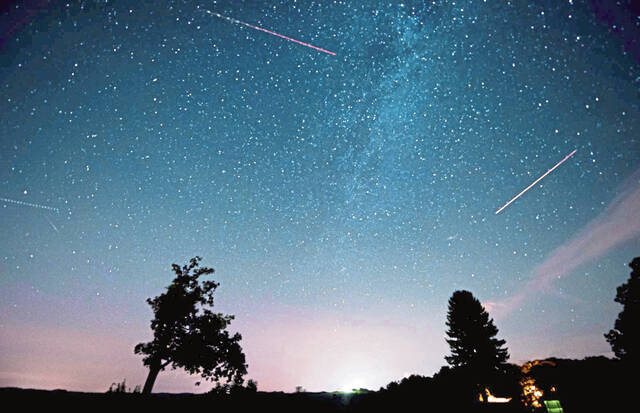
A meteor shower should be visible in Pennsylvania this weekend, experts say.
The Perseids, which NASA deemed the most popular meteor shower, will peak Wednesday night and Thursday in the Pittsburgh region.
The shower lasts until Saturday, coinciding with a solar eclipse and a new moon.
Meteor showers are remnants from comets. The Perseids occur annually in August, said Allegheny Observatory outreach coordinator Karry Handron.
To understand why the Perseids happen each year, Handron said to picture the Earth’s orbit around the sun, then imagine a gravel trail along that orbit that has been left behind by a comet.
“Every August, the Earth orbits through that gravel trail, and we get the Perseids,” she said.
The Perseids are expected to leave long streaks of light and color in their wake as they streak through the night sky, according to NASA.
The shower is one of Earth’s most abundant — with 50 to 100 meteors visible every hour.
Handron said the size of the meteors is almost equivalent to a grain of sand.
The meteor shower may be difficult to see, especially within city limits where light pollution obscures visibility.
At the same time, a partial solar eclipse Wednesday afternoon was only 1% visible from Pittsburgh. Handron said it could barely be seen because of the gray skies that have covered the city for much of the week.
“The place to go for that would have been Europe,” she said.
The total solar eclipse is currently visible in Spain, Iceland and Greenland. It can be viewed on NASA’s website.
To see the meteor shower, Handron recommended viewing from darker sites outside of Pittsburgh.
The Amateur Astronomers Association of Pittsburgh is hosting several viewings in McCandless, Washington County and Tarentum this weekend.
Within the city, experts have recommended Riverview Park and Frick Park, which may be shielded from light pollution because of their geographic locations.