
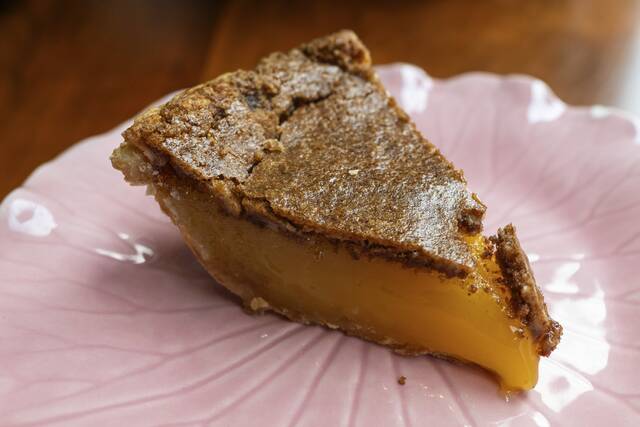
At Sidecar Coffee & Bake Shop, the most-requested dessert has the least appealing name. Vinegar pie — a simple custard pie made with eggs, sugar, butter, vanilla bean paste and vinegar — is in high demand at the Oakland cafe and its sister restaurant, Butterjoint, next door. Every Thanksgiving, Sidecar makes more than 40 special-order pies and stocks miniature versions for weddings and cookie tables.
Those unfamiliar with vinegar pie tend to psych themselves out before taking a bite, according to Sidecar’s general manager and head pastry chef Robin Yocum, affectionately known to co-workers and regulars as “Robin En. Wizard.”
“People hear the name (vinegar pie) and say, ‘Oh, that sounds disgusting,’ ” Yocum said. “I think we get a lot of people who want the pie to be bad or want it to be some strange flavor that they’re never going to want to revisit.”
But Yocum has watched enough first bites to recognize the pattern.
“I love seeing the reaction every single time,” she said. “People will kind of skeptically put it in their mouth. Then, as soon as they bite, their eyes light up a little bit, like, ‘Oh my God! That’s not what I expected.’ And I think that was what happened when (staff) first tried the pie here (at Sidecar), too, is we all thought, OK, this is a cool pie.”
Yocum began making vinegar pie at Sidecar eight and a half years ago and has been surprised to see it become one of the bakery’s signatures. She first got a glimpse of the pie’s potential at a 2017 Persad fundraiser, where she served exactly 1,036 miniature pies.
“A couple of bold people came over. And as the night went on, people kept coming back saying, ‘So-and-so told me I had to come try this,’ ” she remembered. “That was a super cool thing to see word of mouth travel and people already be falling in love with it.”
Vinegar pie belongs to a long American tradition of so-called “desperation” or “scarcity” pies — desserts made from pantry staples when fresh fruit was unavailable. Dating back to the 19th century, recipes used vinegar to cut the sweetness of eggs, sugar and butter and mimic the acidity of lemon or other citrus.
Rachel Wharton, author of “American Food: A Not-So-Serious History,” found vinegar pie in Laura Ingalls Wilder’s “Little House on the Prairie” book series, even appearing in a 1979 cookbook based on the later television adaptation. A variation of it, sugar cream pie (also referred to as desperation pie) is the official state dessert of Indiana, and Martha Stewart remembers her Polish American mother making it.
In Pennsylvania, vinegar pie has deep roots in Pennsylvania Dutch cooking, the tradition Yocum drew from for Sidecar’s version. Former Butterjoint owners Trevett and Sarah Hooper encouraged Yocum to create desserts that evoked childhood nostalgia. After making Pop-Tarts, dirt cups and apple hand pies, she began leafing through Pennsylvania Dutch and Amish cookbooks at flea markets and secondhand bookstores, first trying out shoofly and chess pies.
Though Yocum grew up in West Virginia, vinegar pie wasn’t part of her own childhood. She was heartened when customers recognized it from theirs.
“That is the highest compliment to me is when somebody (says), ‘This makes me think of Grandma’s pie when I was little,’ ” Yocum said. “We get a lot of people remembering their grandparents, which is pretty cool.”
Unlike many versions of the pie, Sidecar uses champagne vinegar instead of apple cider vinegar.
“It gives it more of a lemony kind of taste,” Yocum said.
The sparse ingredient list remains true to the pie’s roots: champagne vinegar, farm-fresh eggs and vanilla bean paste are combined with sugar, butter, cinnamon and salt, then baked at 200 degrees.
“The big thing with the simplicity of the ingredients is making sure that you have the method down pat,” Yocum said, taking care not to overmix or undermix. The finished pie must have a set, molded custard with a nicely cracked brown sugar top.
“If you mix it right at that sweet spot, the butter and sugar will separate while it’s baking, and then it gives it that nice crunch,” she said. “It’s also a beautiful slice.”
Both Sidecar and Butterjoint serve vinegar pie à la mode — Yocum’s preferred way — with the restaurant’s house-made ice cream to cut its sweetness.
Sidecar’s four-person kitchen staff has made vinegar pie so often that Yocum now considers it a “background task.” But she was surprised when the dessert went semiviral on the Pittsburgh section of Reddit about a year ago. A poster argued that the pie should be “venerated” alongside signature Pittsburgh foods like pierogies and the Primanti Bros. sandwich, and scores of commenters agreed.
“I loved that so much,” Yocum said, amused that something “we’ve been giving to people for such a long time” was something the bakery could still get recognized for.
For Yocum, the attention is gratifying if it brings more people through Sidecar and Butterjoint’s doors. The restaurants’ Oakland location near the universities, she said, means they work year-round to remain a destination.
“We really try to keep it as local as we possibly can, and we put as much thought and love into the food as we possibly can,” Yocum said, even if it might not be the food people are expecting.