
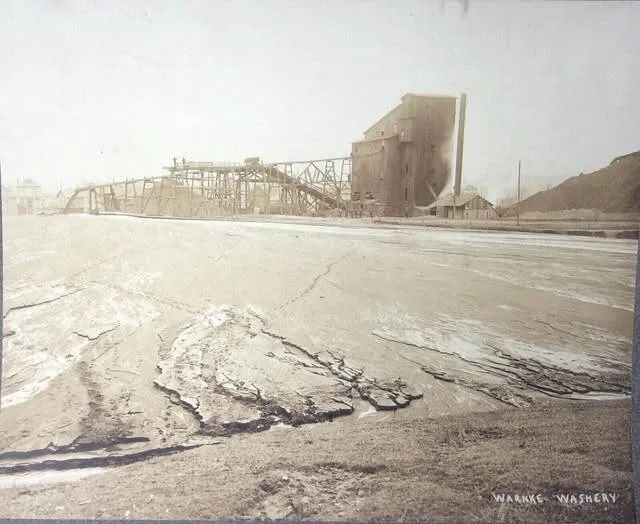
Duryea was the scene of a serious riot at the Warnke Coal Washery during the coal strike of 1902.
With coal mines, wash plants, and railroads idle for most of the year, owners of the coal mines wanted to reopen their mines with non-union labor to refurnish stockpiles of coal for the approaching winter.
George Warnke, one of the owners of the Warnke Colliery and wash plant, hired nearly 100 coal and iron policemen from Scranton to provide security for the non-union workers in early August 1902. A barbed wire fence was erected around the facility.
The result was a riot with shots fired, and Duryea Police Chief Lawrence Cosgrove nearly got shot while he made heroic efforts for a cease-fire on Aug. 15, 1902.
“At 2 p.m., a crowd of men collected in front of the washery, and an argument with the coal and iron police was started by someone, and soon some stones were thrown at the police by boys. This started the riot. One of the policemen began shooting, and in a short time, a crowd of a thousand people collected – men, women, and children,” the Wilkes-Barre Record reported on Aug. 15, 1902.
The coal and iron police initially used blank cartridges to scare the hostile crowd of striking unionized coal miners. When “showers of stones and other missiles” were thrown, the policemen used real cartridges against the crowd, the Record reported.
Cosgrove, who testified days after the riot at a Habeas court proceeding before Luzerne County Court of Sessions Judge Galus L. Halsey, said he heard 12 to 14 shots fired from the coal and iron policemen.
John Uravicz, a Lithuanian striker, was the only victim who sustained a gunshot wound to his knee.
“Chief of Police Cosgrove ran behind the wire fence and ordered the guards to cease shooting. He says he heard bullets whistle over his head as he ran behind the fence. The guards stopped firing when they saw that he was an officer of the law,” the Record reported.
Thomas Joyce, president of Duryea Borough Council, immediately went to the Duryea Burgess office of Dr. John A. Burlington and swore out arrest warrants for the owners of the Warnke Colliery and wash plant, George Warnke, Frederick Warnke, and Jacob Warnke, and several guards, charging them with felonious wounding and inciting a riot. A total of 22 men were arrested, but none were striking coal miners.
While Cosgrove was escorting prisoner George Warnke through the crowd, he was pelted by stones, the Record reported.
The Record reported George Warnke suffered a head injury, and Harry Collins, a guard, suffered a fractured skull.
The Habeas proceeding before Judge Halsey was held at the Luzerne County Courthouse on Public Square, Wilkes-Barre, three days after the riot. After the three-hour habeas proceeding, Judge Halsey dismissed all charges against 19 of the 22 men arrested.
The riot at the Warnke Colliery and wash plant in Duryea was considered one of the first in Luzerne County during the 1902 coal strike. Other riots occurred outside collieries in Nanticoke, Wanamie in Newport Township, and Plymouth in late August and during September 1902, resulting in Luzerne County Sheriff Albert H. Jacobs requesting military assistance to keep peace.

Local journalism matters, and your support makes it possible. You can help sustain this work by making a donation or choosing one of our subscription options. Subscribers enjoy valuable benefits, including full access to our e-edition, a reduced ad experience on timesleader.com, and more.
Your support helps ensure independent, high-quality local news remains available today and for future generations. Thank you for standing with local journalism.
Click for subscription offers.