
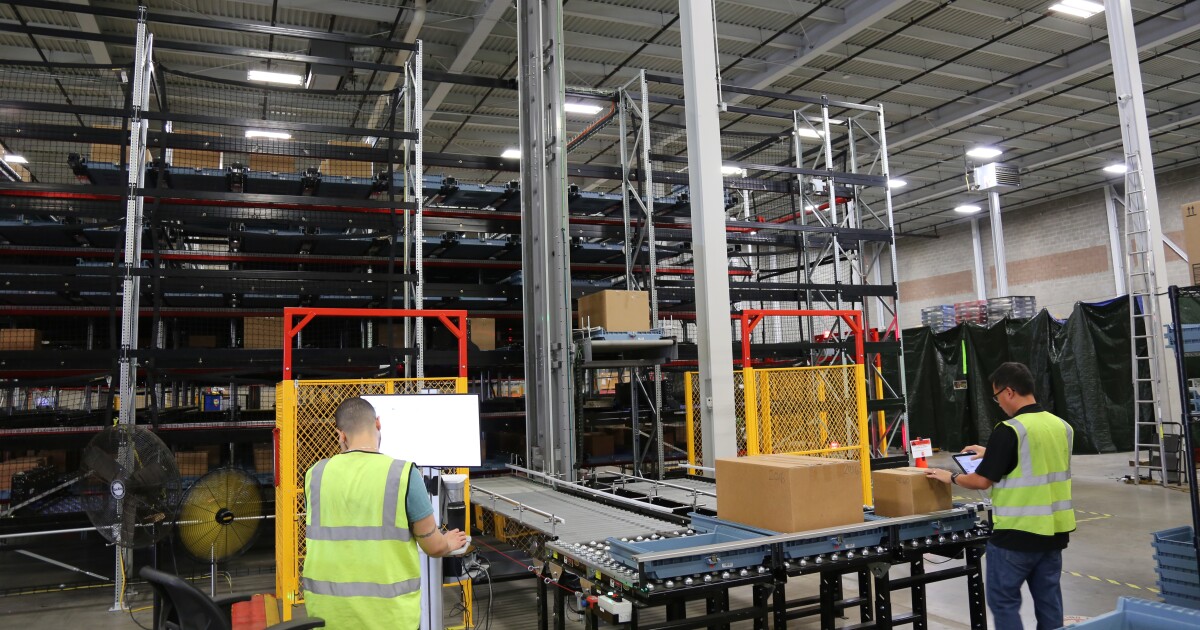
Inside a Lawrenceville warehouse, Michael Lutsky holds out a small speaker and plays a clip of a woman speaking Japanese.
He asks an assembled group to form a picture of the person behind the voice in their minds, then explains how the sound from vocal cords can be analyzed to determine a person’s age, height, ethnicity, and even create a sketch of their face.
Lutsky plays the clip again and a woman’s face appears on a screen behind him.
“The thing that’s kind of odd is that it doesn’t — to me anyway — it does not look like a Japanese-style face. It’s a little bit more Anglo,” he said.
So, he pulled up the source: the YouTube channel of a German woman living in Tokyo.
“The point there is that it’s not speech-to-text,” said Lutsky, chief strategy officer of Carnegie Foundry. “We don’t care what language it is and it has no bearing on the other information that’s being pulled out.”
Lutsky said they’ve packaged the voice analysis tool and made it available to banks to identify impersonation attempts through the startup VoxEQ.
“This is a tool that can actually protect you from a fraudster or your teenager trying to get a credit card,” Lutsky said.
VoxEQ is one of a few companies created with help from Carnegie Foundry, which seeks to commercialize the science coming out of universities.
It’s an example of the kind of “innovation economy” that the Shapiro administration is trying to encourage with the Innovate in PA 2.0 program.
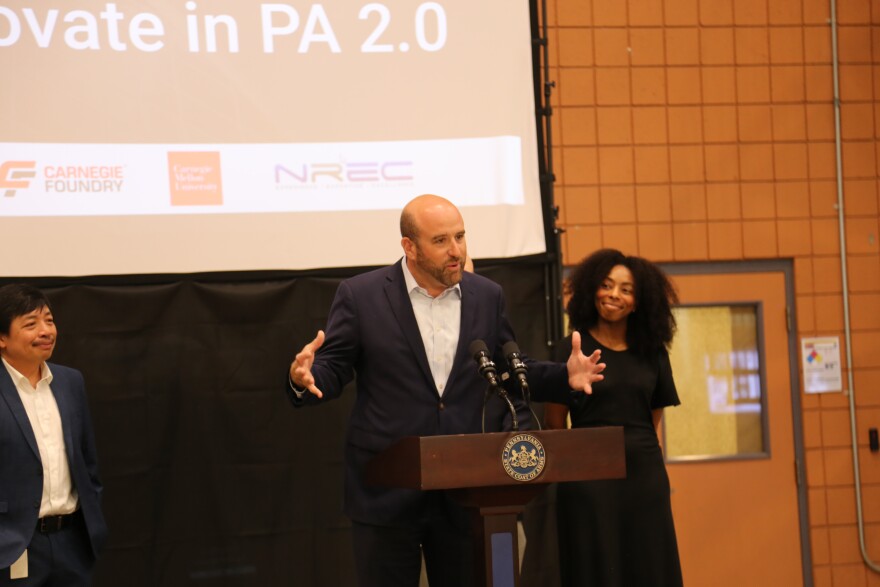
Department of Community and Economic Development Secretary Rick Siger speaks about the Innovate in PA 2.0 program at the National Robotics Engineering Center in Lawrenceville on Aug. 14, 2026.
Department of Economic and Community Development Secretary Rick Siger said the $125 million made available for the program in the most recent state budget aims to close the gap between invention and commercialization, attract outside investment to the state, and create jobs.
Siger visited Carnegie Mellon University’s National Robotics Engineering Center on Friday to highlight the program, which the administration is working to finalize.
“We believe this is going to be a real shot in the arm for innovators and entrepreneurs, all while enhancing our competitive position, solidifying our economy amidst — let’s be real — a very rapidly changing technology landscape,” Siger said.
Innovate in PA 2.0, the descendent of a 2013 program called Innovate in PA, focuses on several key pillars, Siger said.
Money will go to fund the Ben Franklin Technology Development Authority, where it will be used to attract venture capital. Siger said the administration also plans to create a program where state dollars can match available federal money to help scale projects, as well as a competitive grant program. Some grants will focus specifically on the life sciences workforce and clinical research.
“This funding, along with the really critical work of our partners … will ensure that our innovators have the opportunity to succeed here,” Siger said. “Not taking new technology out of our universities and commercializing it in Boston or San Francisco, building it right here in Pennsylvania.”
Carnegie Foundry cofounder Robert Szczerba said the program is a great opportunity for “venture studios” like his.
“I’ve only been in Pittsburgh nine years and I see so many great startups leave the area,” Szczerba said, “and I couldn’t figure out why for the longest time. And it’s because there weren’t programs like this that give you the opportunity.”
In five years, the foundry has launched three companies.
With additional money, Szczerba said, they might be able to launch up to eight more startups in the next two years that will help the robotics and AI industries grow in Pittsburgh.